EV Charger Downtime is Costing Operators More Than They Think
As EV adoption accelerates worldwide, one issue continues quietly costing charging network operators and fleet managers millions of dollars every year: charger downtime.
The global EV industry is entering a new phase of growth. Rising fuel prices tied to geopolitical instability and ongoing disruptions in global oil markets are accelerating interest in electric vehicles across North America, Europe, and Asia. Consumers, fleets, and governments are increasingly looking to electrification as protection against volatile gasoline and diesel costs.
In Canada alone, consumers purchased more than 21,000 new zero-emission vehicles in March 2026 — a 74.7% increase year over year.
But while the industry has spent years focused on deploying more charging infrastructure, operators are now confronting a growing operational reality:
Installing chargers is no longer enough.
Networks must reliably deliver successful charging experiences at scale.
And many are struggling to do so.
The EV Charging Industry Has a Reliability Problem
Broken chargers, frozen payment systems, communication failures, software bugs, damaged connectors, networking outages, and degraded charging performance are becoming some of the industry’s biggest operational challenges.
For charging network operators, downtime immediately impacts revenue.
Every charger that goes offline stops generating income while continuing to incur ongoing operational costs including:
- leases
- software platforms
- maintenance contracts
- utility costs
- field service expenses
According to ABB E-mobility, a single 400 kW charger handling roughly 10 charging sessions per day can lose approximately €400 in revenue for every day it remains offline.
Across large charging networks, those losses can quickly scale into millions annually.
But the financial impact extends far beyond lost charging sessions.
Downtime also creates:
- increased truck rolls
- higher support costs
- reduced charger utilization
- negative driver experiences
- declining customer trust
Studies show many EV drivers abandon charging networks after repeated failed charging attempts.
According to a recent 2025 J.D. Power study, 14% of EV drivers visited a public charger and left without successfully charging their vehicle.
And the reliability problem may be even worse than many reported uptime statistics suggest.
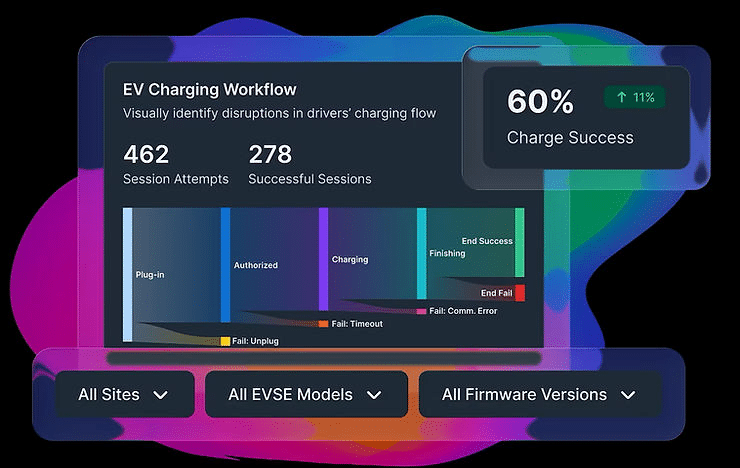
Research evaluating 657 public DC fast charging connectors found that only 72.5% were fully functional during testing, despite many operators reporting uptime figures above 95%. Industry data from Paren and other charging analytics firms has further highlighted the growing gap between reported uptime and actual successful charging experiences for drivers.
That gap is becoming increasingly important across the industry.
Because drivers do not care whether a charger technically appears “online.”
They care whether charging actually works.
Why Traditional Uptime Metrics Are Misleading
A charger can appear operational while still failing drivers in practice.
Payment systems may freeze.
Vehicle communication may fail.
Power delivery may become unstable.
Sessions may terminate unexpectedly.
Firmware issues may quietly degrade performance long before a charger officially goes offline.
As a result, many operators are beginning to recognize that traditional uptime metrics often fail to reflect the actual driver experience.
The industry is increasingly shifting toward more meaningful reliability measurements focused on:
- successful charging sessions
- first charge success
- real-world charging performance
That shift is especially important as EV infrastructure becomes increasingly mission-critical.
For Fleets, Charging Reliability Is an Operational Risk
For commercial fleets, charging reliability is no longer just a maintenance issue — it is a business continuity issue.
Transit agencies, logistics providers, delivery companies, school bus operators, and commercial fleets increasingly depend on overnight depot charging to keep vehicles operational every morning.
When chargers fail overnight, the consequences can ripple across the entire operation.
Fleet charging failures can trigger:
- delayed routes
- stranded vehicles
- labor inefficiencies
- missed deliveries
- SLA penalties
- significant operational disruption
As fleets scale, charging infrastructure is rapidly becoming critical operational infrastructure rather than a secondary utility.
Most Operators Still Don’t Know What Downtime Is Actually Costing Them
Despite the growing focus on reliability, many operators still struggle to quantify the true financial impact of downtime across their charging networks.
Lost charging revenue is only part of the equation.
The broader impact can include:
- reduced charger utilization
- unnecessary field service dispatches
- customer churn
- operational inefficiencies
- lower fleet productivity
- declining driver confidence
Even small reliability issues can create substantial financial consequences across large charging portfolios.
To help operators better understand these hidden costs, Clockwork Energy has launched a new EV Charging Downtime ROI Calculator designed specifically for public charging networks and fleet charging operations.
The calculator helps operators estimate how charger downtime, failed charging sessions, and poor charge success rates may be impacting overall network performance and profitability.
Rather than focusing solely on basic uptime percentages, the calculator is designed to model the broader operational and financial impact of charging reliability.
Operators can estimate:
- annual revenue lost to downtime
- the operational cost of failed charging sessions
- the financial impact of reduced reliability
- the potential upside of improving first charge success across their networks
For fleet operators, the calculator also highlights how charging reliability directly impacts vehicle readiness, operational continuity, and fleet utilization.
As the EV industry matures, many operators are discovering that even modest improvements in reliability can create meaningful financial gains at scale.

Clockwork Is Building the Reliability Layer for EV Charging
Clockwork is focused entirely on solving the EV charging reliability problem.
The company describes itself as the “reliability layer” for EV charging networks.
Rather than replacing existing charging management systems, Clockwork integrates across the broader charging ecosystem to help operators detect, diagnose, and resolve issues faster.
The platform combines data from:
- OCPP systems
- charging hardware
- SIM cards
- routers
- gateways
- electrical systems
- network infrastructure
This data provides operators with a more complete real-time view of charger health and charging performance.
According to the company, many charging failures begin long before a charger officially appears offline.
Communication instability, degraded performance, voltage irregularities, firmware issues, and intermittent charging failures can quietly impact driver experience while stations still technically appear operational.
Clockwork’s platform continuously monitors these signals to identify issues earlier and help operators improve real-world charging reliability and First Charge Success.
The platform also helps automate:
- fault classification
- ticket creation
- technician dispatching
- operational diagnostics
These factors are helping to reduce downtime and improve charging network performance over time.

The EV Industry’s Next Competitive Advantage May Be Reliability
As EV infrastructure rapidly expands, industry attention is increasingly shifting away from simply installing chargers toward ensuring they consistently work for drivers and fleets.
Reliability is becoming one of the industry’s most important operational and competitive challenges.
The networks that minimize downtime, improve first charge success, and deliver more consistent charging experiences are likely to retain customers, improve utilization, and strengthen long-term trust in electrification.
Operators interested in understanding the true financial impact of downtime can explore Clockwork’s EV Charging Downtime ROI Calculator to estimate how reliability issues may be affecting network revenue, operational performance, and fleet readiness.

Electric Vehicle Marketing Consultant, Writer and Editor. Publisher EVinfo.net.
Services