New Study Says Charging Infrastructure Remains the Biggest Bottleneck to Global EV Adoption
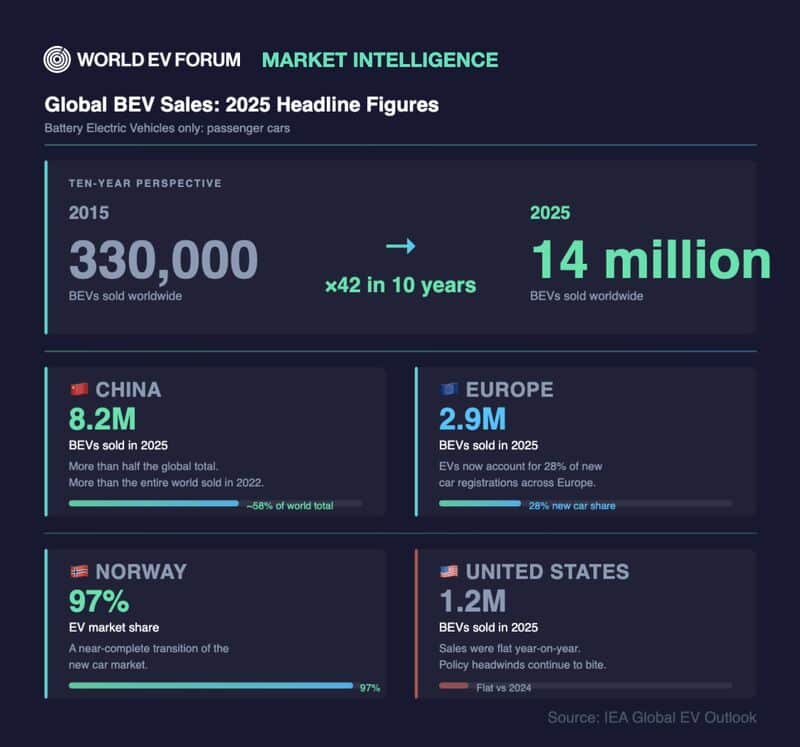
The World EV Forum highlighted the astounding growth of electric vehicles (EVs) worldwide. IEA’s Global EV Outlook reported that in 2015, the world sold 330,000 BEVs. In 2025, that figure had risen to 14 million. China alone sold 8.2 million EVs, more than the entire world managed in 2022. Europe hit 2.9 million, with EVs now making up 28% of new registrations. Norway is at 97% market share, an exemplar of what’s possible.
Global electric vehicle adoption is approaching a pivotal moment as battery electric vehicles (BEVs) become increasingly attractive to consumers around the world. Rising fuel prices, expanding model availability, and improvements in vehicle technology are accelerating interest, but widespread adoption will depend on more than growing demand for new vehicles. According to BearingPoint’s E-Mobility Attractiveness Index 2026, based on a survey of more than 10,000 consumers across Germany, the United Kingdom, the United States, China, and India, overcoming concerns about charging infrastructure, resale value, and battery health remains essential for the next stage of EV growth.
BearingPoint found that among consumers planning to purchase a vehicle within the next three years, BEVs have become the preferred choice in most of the countries surveyed. Even in Germany and the United Kingdom, where overall enthusiasm for electric vehicles remains relatively cautious, purchase intentions shift toward BEVs as buyers move closer to making a decision. India stands out as an especially promising growth market, with consumers showing strong interest in EVs despite lower average purchasing power, largely due to expectations of lower operating costs and improving infrastructure.

The study suggests that many markets have moved beyond the early adopter phase, with electric vehicles increasingly viewed as a mainstream transportation option. However, continued growth depends on addressing structural barriers that still discourage potential buyers.
Charging infrastructure remains the biggest obstacle, particularly in Western markets. BearingPoint reported that 45% of respondents in Germany, 52% in the United Kingdom, and 41% in the United States do not have reliable access to charging at home or at work. Although public charging networks continue to expand, they are not yet sufficient to fully support everyday EV ownership for many drivers.
Another significant challenge is the lack of firsthand experience with electric vehicles. Many respondents have never driven an EV, including 79% in the United Kingdom, 76% in the United States, and 62% in Germany. BearingPoint believes that increasing opportunities for test drives could play a major role in helping hesitant consumers better understand the benefits of electric vehicles and increase purchase confidence.
The research also found that EV purchasing decisions have become increasingly focused on managing long-term risk rather than simply comparing purchase prices. Buyers place high importance on battery durability, expected lifespan, repairability, warranty coverage, cybersecurity, and vehicle safety. While affordability remains important, consumers are evaluating the total ownership experience rather than making decisions based solely on upfront cost.

This trend is particularly evident in the used EV market. Many consumers remain hesitant to purchase used electric vehicles because of uncertainty surrounding battery condition, remaining battery life, future repair costs, and resale value. Willingness to purchase used BEVs declines noticeably once vehicles reach approximately three years of age, especially in Germany and the United Kingdom. BearingPoint found that uncertainty about battery health often outweighs attractive pricing, leading many buyers to choose new vehicles despite their higher purchase price.
The report concludes that improving confidence in the used EV market will require standardized battery health certifications, stronger residual value models, and clearly defined second-life and third-life battery applications. Without these measures, the used vehicle market could become a major constraint on future EV adoption.
The survey also highlights changing brand preferences. While domestic manufacturers continue to lead in their home markets, including BYD in China, Tata in India, and Volkswagen in Germany, South Korean automakers Hyundai and Kia continue gaining popularity across multiple countries due to their reputation for technology, reliability, and value. BEV-focused manufacturers such as BYD are also becoming increasingly attractive to prospective EV buyers outside China, even if they have not yet reached the top of overall brand rankings in Western markets.
BearingPoint notes that consumers seriously considering an electric vehicle are placing greater emphasis on measurable performance, reliability, and ownership experience than on traditional brand loyalty. This shift presents both challenges and opportunities for established automakers as global competition in the electric vehicle market continues to intensify.

Electric Vehicle Marketing Consultant, Writer and Editor. Publisher EVinfo.net.
Services