Why An EV Charging Management System With No Monthly Fees Is A Smart Choice for Property Owners
The electrified vehicle industry in the first half of 2026 is looking positive. On July 10,2026, Cox Automotive reported hybrid sales are forecast to increase by approximately 9%. According to Kelley Blue Book’s estimates, 247,226 electric vehicles (EVs were sold in the second quarter of 2026, up 14.7% from the revised Q1 total.
EV charging analytics company Paren reported that 4,382 new ports were added in Q2 2026. The June 2026 year-over-year increase in sessions of 3.5 million (+29%) was a great sign for charging companies. Reliability continues to improve driven primarily by the large volume of more reliable new ports being added.
As electric vehicle adoption continues to accelerate, more businesses, multifamily communities, workplaces, hotels, municipalities, and commercial property owners are investing in EV charging infrastructure. While selecting the right charging hardware is important, choosing the right EV Charging Management System (CMS) can have an even greater impact on long-term success.
Many charging providers offer cloud-based management platforms that require recurring monthly subscriptions for every charger installed. At first glance, these fees may seem reasonable. However, as charging deployments grow from a few chargers to dozens or even hundreds of ports, monthly software costs can become a significant operational expense.
This is why an EV Charging Management System with no monthly fees, such as the solution offered by OnCharge EV, is becoming increasingly attractive for property owners looking to maximize return on investment while maintaining full control of their charging operations.
OCPP-Compatible Chargers May Be Able to Switch to OnCharge Without Replacing Hardware
One of the advantages of the OnCharge EV platform is that property owners may not need to replace their existing charging hardware to take advantage of its no-monthly-fee software model. Many EV chargers support the Open Charge Point Protocol (OCPP), the industry-standard communication protocol that enables charging stations to connect with different management platforms.
If a site’s existing chargers are OCPP-compatible and not restricted by the current network provider, operators may be able to migrate those chargers to the OnCharge platform without replacing the equipment itself. This can help reduce costs, preserve existing infrastructure investments, and allow site hosts to benefit from OnCharge’s pay-as-you-go management system while avoiding the expense and disruption of a complete hardware replacement.
The Hidden Cost of Monthly Charging Software Fees
Most EV charging management platforms charge recurring fees for services such as user management, payment processing, charger monitoring, energy reporting, access control, and pricing management. While a monthly charge of $20 to $40 per charger may not seem substantial, the costs add up quickly as deployments expand.
For example, a multifamily property with 50 charging ports paying $30 per month per charger would spend $18,000 annually just to access management software. Over a decade, that figure could exceed $180,000 before accounting for potential price increases. For larger commercial properties, workplace charging programs, and fleet operators, the total cost can be significantly higher.
A no-monthly-fee model eliminates this recurring expense and allows property owners to retain more of the revenue generated by their charging infrastructure.
Better Long-Term Return on Investment
Every EV charging project is ultimately measured by its total cost of ownership and its ability to generate value over time. Removing recurring software subscriptions can dramatically improve the economics of a charging deployment.
Instead of directing revenue toward monthly platform fees, property owners can use those funds to recover installation costs more quickly, expand charging capacity, improve electrical infrastructure, or invest in other property enhancements. For multifamily communities in particular, EV charging is often viewed as a resident amenity rather than a profit center, making it even more important to minimize ongoing operational costs.
Predictable Costs and Easier Budgeting
One challenge associated with subscription-based platforms is uncertainty. Software providers can increase fees, change pricing structures, or place additional features behind premium plans. These changes can affect project economics years after the original installation.
A charging management system without monthly fees provides greater financial certainty. Property owners know their costs upfront and can plan budgets with confidence. This predictability is especially valuable for municipalities, homeowner associations, commercial real estate owners, and property managers who operate on long-term planning cycles.
Advanced Features Without Recurring Fees
Some property owners assume that a no-monthly-fee platform means sacrificing functionality. This is not the case with OnChargeEV.
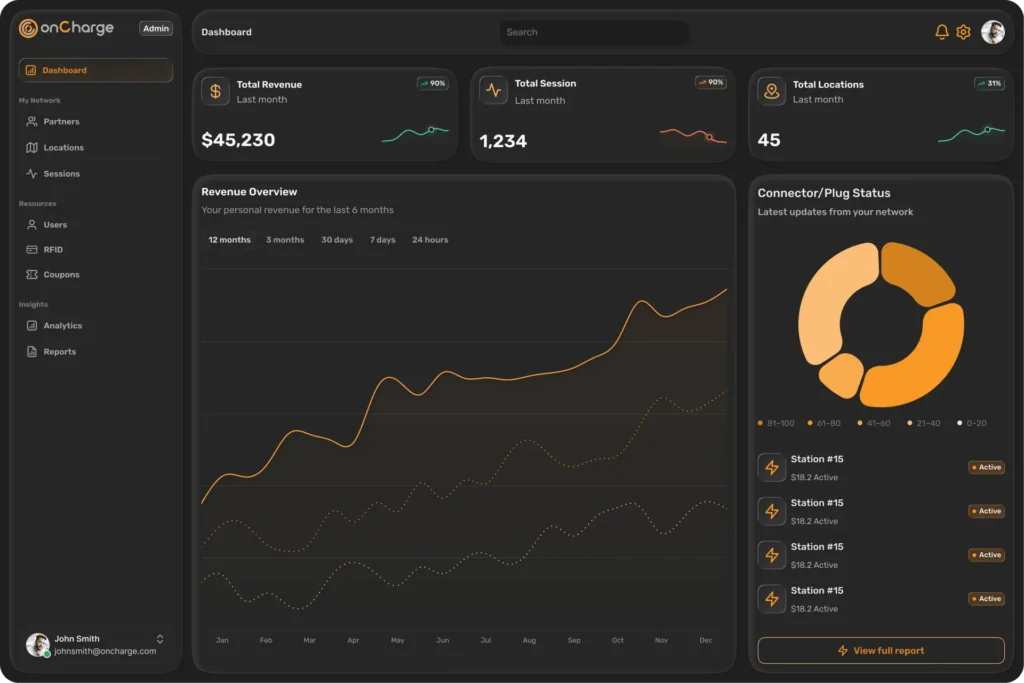
The platform allows property owners, charging operators, and installers to manage chargers, pricing, revenue, and deployments from a centralized dashboard. Users can monitor charger status, energy delivery, charging sessions, revenue, and system performance in real time while maintaining control over multiple locations and partner relationships. The software also supports revenue-sharing arrangements and automated payouts.
For commercial charging operators, OnCharge provides multi-location management, partner administration, revenue split management, and analytics tools designed to simplify network operations and support growth. Residential users can manage a single charger, make it available to neighbors or the public, and receive payments through the platform.
The driver experience is designed to be straightforward. Drivers can start charging by scanning a QR code, track charging sessions and costs in the mobile app, locate nearby charging stations, and pay using a credit card. The platform also supports RFID cards for tap-to-charge functionality and coupon codes for discounted charging sessions.
OnChargeEV Was Built From Real-World Experience, Not Theory
OnCharge EV was created by a team with more than 30 years of experience serving commercial properties through the lighting and energy-efficiency industry. After helping customers transition from traditional lighting to LED systems and navigate utility rebate programs, the company expanded into EV charger installations as electric vehicle adoption increased.
During those deployments, the team identified a major industry challenge: most EV charging management platforms charge monthly or annual software fees regardless of charger usage. They found that after utility rebate compliance periods end, these recurring costs can make charging stations uneconomical to operate, causing some chargers to be taken offline and leaving property owners with underutilized assets.
To address this issue, OnCharge EV developed its own charging management platform based on a pay-as-you-go model. Rather than charging monthly subscription fees, the platform only generates costs when a charging session occurs. According to the company, there are no monthly fees, annual contracts, or idle costs, helping ensure that charging infrastructure remains financially sustainable over the long term.
The company’s mission is to build charging infrastructure that lasts, protect long-term investments, and make EV charging economically viable for property owners, charging operators, installers, and businesses. In addition to supporting its own deployments, OnCharge EV has opened its platform to other small and mid-sized EV charging companies looking for an alternative to traditional subscription-based software models.
As EV adoption continues to accelerate, property owners are increasingly seeking solutions that combine reliability, flexibility, and financial sustainability. By eliminating recurring software fees while maintaining robust management capabilities, companies like OnCharge EV are helping make EV charging infrastructure a more cost-effective investment for the long term.

Electric Vehicle Marketing Consultant, Writer and Editor. Publisher EVinfo.net.
Services