Rivian Adding a Second Shift to Its R2 Assembly Line
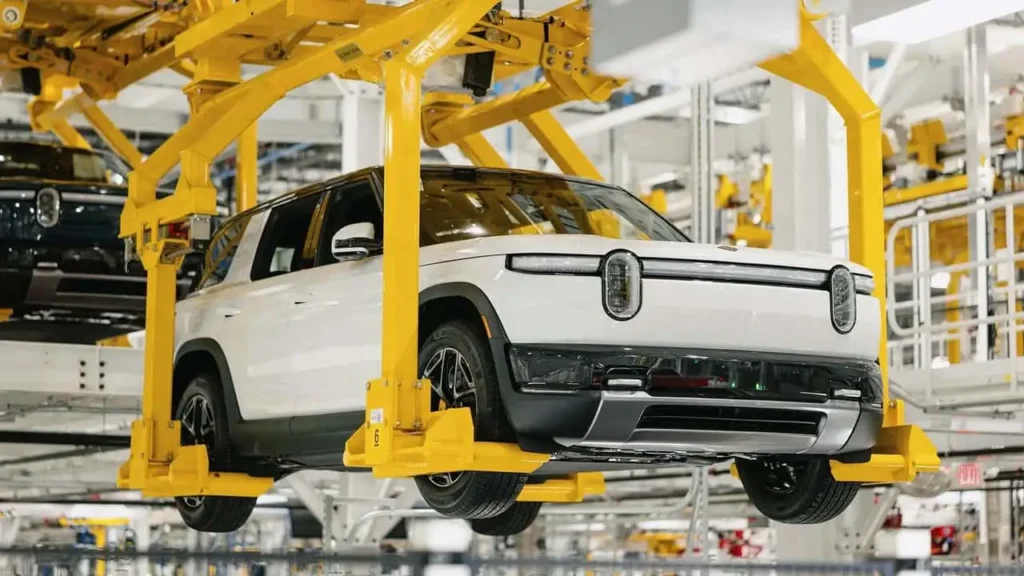
Despite the declining economy, Rivian plans to introduce a second shift at its Illinois manufacturing facility for its R2 by the end of the third quarter, which ends September 30. Production is expected to expand further once the company’s second manufacturing facility in Georgia becomes operational.
The move is significant for the still-growing EV manufacturer because increasing production brings Rivian closer to one of the most important goals for any startup: reaching profitability. During Rivian’s latest investor call, founder and CEO RJ Scaringe said the company is working with hundreds of suppliers to ensure they can increase their own production in an organized manner and support a smooth R2 ramp-up.
Rivian has not disclosed how many employees currently work on the R2 assembly line or how many additional workers will be hired for the second shift, as the company no longer reports its headcount specifically for the Normal facility.
The R2 is Rivian’s smallest and most affordable vehicle to date, opening the door to a significantly larger potential customer base for the California-based automaker. Deliveries began June 9 with the top-of-the-line Performance trim, which starts at $59,485. The Performance model offers an EPA-estimated 330 miles of range, dual-motor all-wheel drive, 656 horsepower and a NACS charging port.
More affordable R2 versions are scheduled to arrive in the coming months. The least expensive model, the Standard Rear-Wheel Drive, is scheduled to launch in summer 2027 with a starting price of $46,495. Rivian expects the entry-level R2 to deliver more than 275 miles of range.
Rivian has reportedly received more than 200,000 R2 reservations, along with another 57,000 demo drives, highlighting the substantial interest generated by the company’s mainstream electric SUV. The R2 is currently the only midsize electric SUV in the U.S. marketed as an adventure-ready vehicle, while also offering the capability to appeal to buyers looking for a practical everyday crossover.
Scaringe said a “significant number” of R2 buyers are first-time EV owners. According to the CEO, the vehicle is attracting consumers who wanted an electric crossover with the R2’s combination of size, capability and affordability but previously had few comparable choices.
“The U.S. automotive marketplace is starved for high-quality EV choice, and I believe R2 is an attractively priced option for everyday adventures that will resonate with a broad set of consumers,” Scaringe said.
EVinfo.net’s Take: Why the Exciting Rivian R2 Matters for the U.S. EV Market
The exciting Rivian R2 is important for more than just Rivian. The United States needs more electric vehicle choices, particularly EVs that are affordable enough to reach a much broader range of consumers. For years, the EV market has offered plenty of expensive models, but the selection of reasonably priced electric SUVs and crossovers remains limited. The R2 can help address that gap by bringing Rivian’s adventure-focused electric vehicle technology to a larger potential customer base, with pricing eventually starting below $50,000.
More affordable EVs are especially important as the U.S. works to increase EV adoption. Consumers need choices across different vehicle sizes, body styles and price points rather than being limited to a relatively small number of models. Competition also encourages automakers to improve technology, reduce costs and offer better value.
The federal government made a major mistake by suddenly cutting the federal EV tax credit, removing an important incentive at precisely the time when the market needs more affordable electric vehicles, and catching automakers off guard.
This lost the OEMs billions of dollars, having to reverse years-long plans and investments in EV production and innovation. But losing billions was partially the OEM’s faults, as they vastly over-reacted to the bad federal policy, when they should have just largely ignored it and pushed forward with EVs.
Fortunately, smart state leaders are stepping in to fill part of the gap left by federal mistakes. California, for example, has created new state EV incentives designed to make electric vehicles more accessible to consumers. State-level programs can help offset higher upfront costs and encourage more drivers to make the transition to electric transportation.
CA’s support of EVs and renewables are gaining the state significant jobs and economic growth, as jobs are cratering nationwide due to federal mistakes.
The U.S. economy unexpectedly lost 23,000 jobs in July, and the labor force participation rate fell further to 61.4%, its lowest in more than five years.
ABC News reported on August 7 that Americans are deeply negative on the economy with nearly 8 in 10 Americans rating the economy poorly.
The combination of vehicles such as the R2 and state incentives could be important for the next phase of U.S. EV adoption. America needs more EVs, more affordable EVs and more competition. Giving consumers better choices while providing targeted incentives is a far more effective way to grow the market than limiting access to affordable electric transportation.

Electric Vehicle Marketing Consultant, Writer and Editor. Publisher EVinfo.net.
Services