Why EV Charging Signage is Needed to Help Drivers Find Stations
Electric vehicle (EV) charging stations are becoming an increasingly common sight across the United States, but finding them is not always as easy as it should be. That is why highway and other signs directing drivers to EV charging stations remain an important piece of transportation infrastructure.
Critics sometimes argue that EV charging signs are unnecessary because EV drivers can use their vehicles’ onboard navigation systems or smartphone apps to locate charging stations. While those tools are valuable, they do not eliminate the need for physical signs.
EV charging is different from gasoline fueling in one important respect. There are numerous charging networks and apps, and no single app always displays every available station. Drivers may need to use several apps to find chargers, check availability, identify compatible connectors, or determine whether a station belongs to a particular network. An onboard navigation system can face similar limitations.
A physical highway sign provides information that does not depend on a particular app, network or vehicle software.
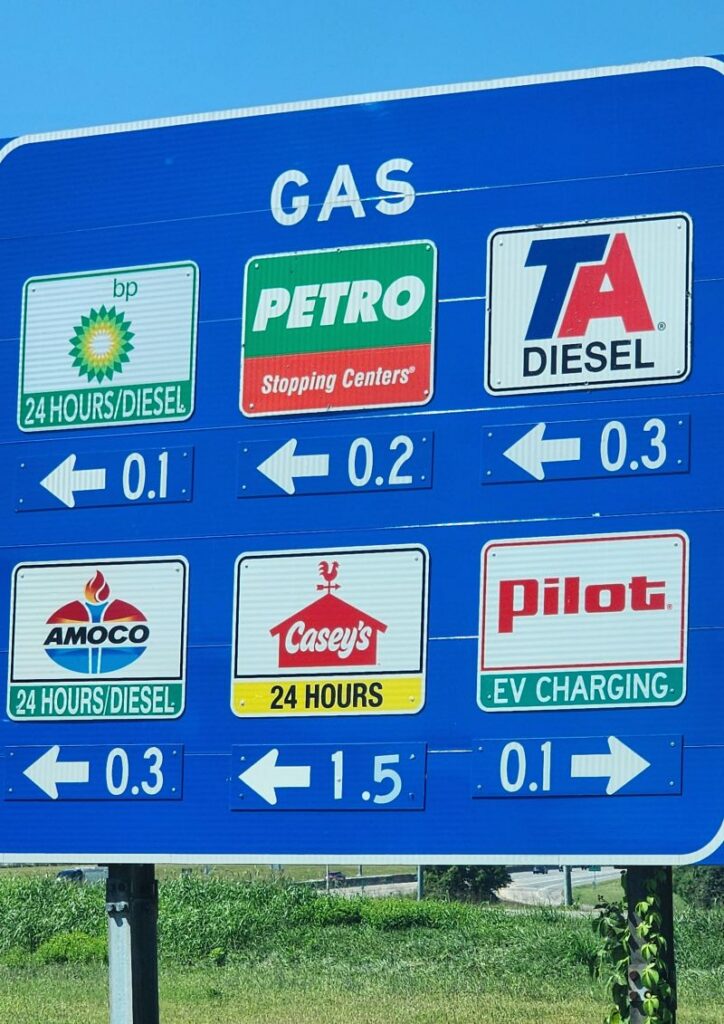
Charging signs are not only for existing EV drivers. They can act as a public service aimed at the general driving public. Millions of people still do not realize how rapidly DC fast-charging infrastructure is expanding, which contributes to lower EV adoption. Highway signs can demonstrate that charging stations are becoming a normal part of the transportation landscape, much like gasoline stations.
That visibility could also help encourage EV adoption. A driver who repeatedly sees signs pointing toward fast-charging stations along familiar highways may begin to recognize that owning an EV does not mean giving up convenient long-distance travel. In that sense, charging signs provide more than directions. They increase the visibility of the EV charging network and can help reduce one of the psychological barriers to EV ownership: uncertainty about where to charge.
That public-information role is especially important as federal support for EVs declines, which increases costs for drivers and increases pollution. With fewer federal efforts promoting EV adoption and charging infrastructure, state and local transportation agencies can help fill part of the information gap. A highway charging sign is relatively simple infrastructure, but it puts EVs and charging directly in front of thousands of drivers every day.
There is also a practical problem that smartphone apps and vehicle navigation cannot always solve: finding the actual charger once a driver reaches a destination.
Charging stations are increasingly located in shopping centers, parking garages, hotels, office complexes and large parking lots. A navigation system may correctly identify the address but provide little useful information about where the charger is located.
Consider a multi-level parking garage. An app might show that a charging station exists at a particular address, but a driver arriving at the garage may not know whether the chargers are on the first, second or fourth level. Signs at the entrance and inside the garage can direct drivers to the correct floor and charging area.
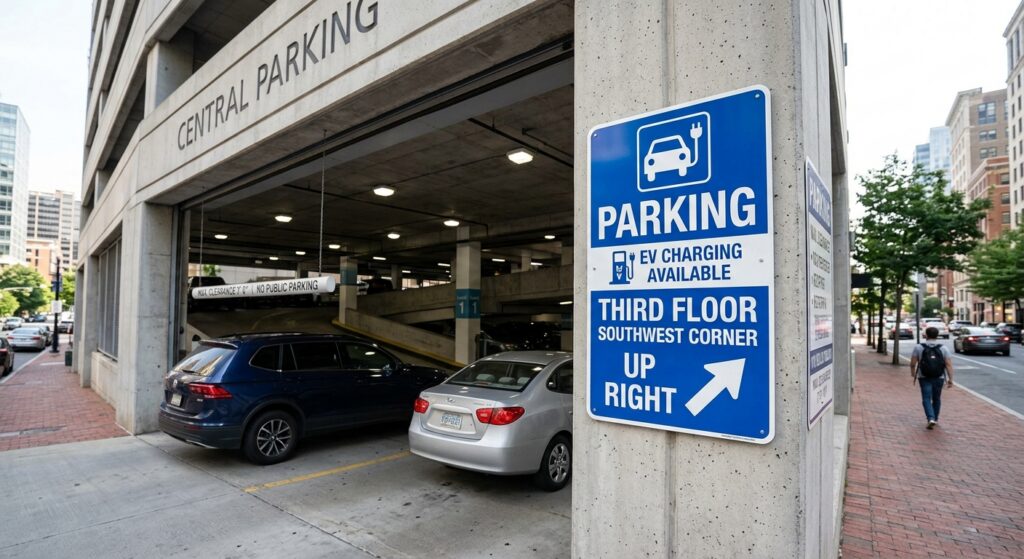
The same applies to large parking lots. A charger may be located hundreds of feet from the entrance or hidden behind another building. Wayfinding signs can direct drivers toward the charging spaces instead of forcing them to slowly search the entire property.
The U.S. Department of Energy’s Alternative Fuels Data Center recognizes the importance of charging-station signage at workplaces, public charging locations, parking garages and multifamily properties. Proper signage can help drivers navigate to chargers, identify charging spaces, communicate access policies and hours, and increase visibility of charging infrastructure to prospective EV buyers.
California provides a useful example of how highway charging signs can work. Caltrans guidance allows Zero-Emission Vehicle General Service Signs to direct drivers to charging and fueling stations located within three miles of a highway and operating at least 16 hours per day.
Caltrans also permits Specific Service, or logo, signs for qualifying EV charging businesses. These signs identify a business using its logo on a blue Caltrans sign panel. To qualify, an EV charging station must be publicly accessible, located within three miles of a freeway interchange and available at least 16 hours per day.
Caltrans pays for General Service Signs installed on the state highway system, while businesses pay an annual permit and rental fee for Specific Service Signs.
The Federal Highway Administration also recognizes wayfinding signage as an important part of EV charging infrastructure. The Manual on Uniform Traffic Control Devices provides standards for highway signs, including provisions for electric vehicle charging infrastructure and Alternative Fuel Corridors.
EVinfo.net’s Take: Pilot Doing a Highly Commendable Job With EV Charging Signs
As an EV driver I’ve faced the problem of finding stations first-hand, it can be very frustrating. In one case, I drove all around and up and down the floors of a parking garage looking for the station.
Pilot is doing a great job with EV charging signage. Joshua Copeland, Principal Project/Program Manager –EV Infrastructure Deployment at Pilot Travel Centers, Inc., said the company has signs like the one in the photo below at every one of its EV sites.
Copeland also addressed the problem that has occurred frequently in the past, which is the installation of chargers in lonely parking lots, far away from amenities such as food, drink and restrooms.
Copeland said, referring to EV drivers: “The layout, the access, the lighting, the safety, the amenities, and the way the site makes them feel—that is what tells them whether they matter. We should not be building EV charging sites that simply have chargers. We should be building sites where an EV driver feels like a normal customer.”
When the federal EV tax credit was foolishly and suddenly cut, EV adoption in the USA fell significantly. But the price break the credit provided wasn’t the only reason more Americans are not buying new EVs. A whole lot of barriers remain. Lack of stations in rural areas, the time needed to charge at public stations, the difficulty that multifamily dwellers who can’t charge at home face, EV charging station reliability, multiple apps needed for charging, small number of EV models available, the need for expensive electric panel upgrades to install home charging, and more.
But what many car buyers don’t realize is that all of the barriers are being reduced, and it is easier now than ever to adopt EVs. In my over four years in the exciting EV industry, Iv’e witnessed first-hand great advances in reducing the barriers, and have worked with some of the industry’s top leaders with my EV industry marketing services.
Now, EV education is one of the most persistent barriers to be addressed. The signs can not only help drivers find stations, but build public awareness of EVs as well, tackling one of the many issues holding back EV adoption.

Electric Vehicle Marketing Consultant, Writer and Editor. Publisher EVinfo.net.
Services