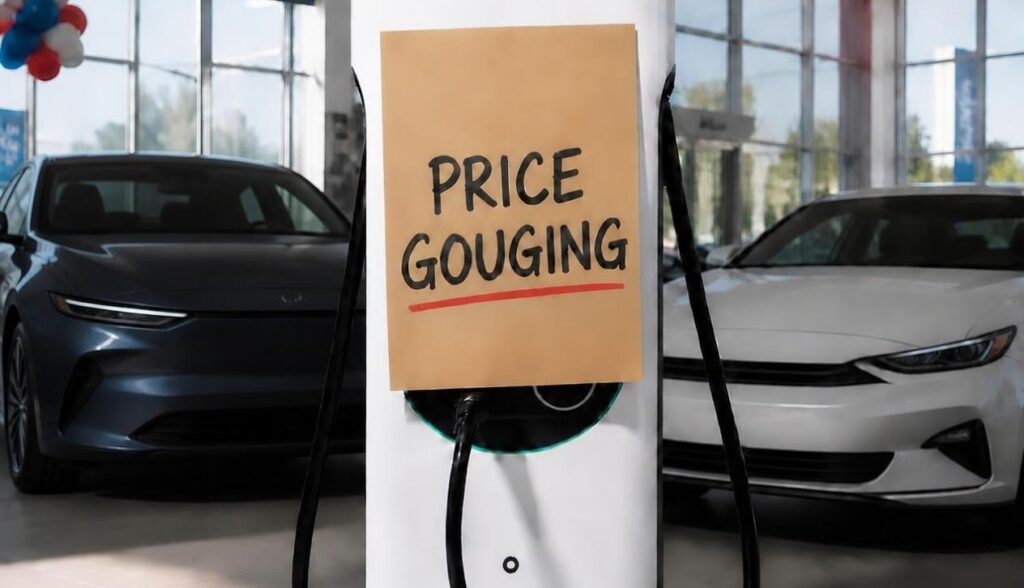
An EV Driver Was Price-Gouged $418 at a Dealership Charger Listed as Public
On August 26, 2026, ABC WXYZ Detroit reported that A Clinton Township, Michigan, man received a $418 bill after charging a rented Chevy Bolt for 44 minutes at a Hyundai dealership in Macomb Township. The charger appeared as publicly available on the EVgo app, leading him to believe it was available for public use.
Stanley Kpenkann was driving home after dropping a friend at the airport when his battery became critically low. With about 20 minutes of estimated range remaining, he opened the EVgo app and followed its directions to the nearest charger, located at a Hyundai dealership on Hall Road.
After completing the 44-minute charging session, Kpenkann discovered a $418 charge. He initially assumed the amount resulted from a billing error, but EVgo confirmed the charge was valid.
The dealership’s charger displayed pricing of $5 per kilowatt-hour plus $5 per minute. Kpenkann said he did not see those rates before beginning the session.
Dealership managers told WXYZ that the charger was intended for dealership customers and vehicles and that the unusually high pricing was deliberately set to discourage outside use.
The incident highlights a growing problem with EV charging apps. A station can appear available to drivers even when the property owner does not actually want public customers using it. EV drivers relying on an app for emergency charging may not realize that a station carries dramatically different pricing or access restrictions.
EVgo explained that the dealership participates in roaming through ChargePoint, whose name appears on the charger. Because roaming is enabled, drivers can access the station through an EVgo account, but the dealership, as station owner, controls the pricing.
Kpenkann questioned why the charger remained publicly accessible through the app if the dealership intended to discourage outside use.
After Kpenkann contacted EVgo and WXYZ became involved, EVgo issued a $405 goodwill refund. The remaining $13.27 represented what the charging session would have cost under his EVgo subscription plan.
The episode underscores the importance of transparent EV charging information. Drivers should check pricing before plugging in, but charging networks and station owners also need to clearly communicate whether chargers are actually intended for public use.
For an EV driver running low on battery, an app directing them to a charger creates a reasonable expectation that the station is available and that its pricing is clearly disclosed. When that information is inaccurate or confusing, the consequences can be expensive.
EVinfo.net’s Take: A $418 EV Charging Bill Should Never Happen
A driver receiving a $418 bill for a 44-minute EV charging session is unacceptable. Situations like this should never happen, particularly when the charger appears publicly available through a major charging app.
If a dealership does not want the public using its chargers, there are straightforward alternatives. The station can be marked private, removed from public charging apps, or restricted to dealership customers.
Charging customers $5 per kilowatt-hour plus $5 per minute as a deterrent is not a reasonable solution. It creates the potential for enormous bills, damages consumer trust and reinforces negative perceptions about EV charging.
Incidents like this can also hurt EV adoption. Drivers already have concerns about public charging availability, reliability and pricing. An unexpected $418 bill gives prospective EV buyers another reason to hesitate.
It also reflects poorly on the dealership. A business selling electric vehicles should be helping customers understand and embrace EV technology, not creating a charging experience that can leave drivers feeling exploited.
The solution is simple: if a charger is not intended for public use, don’t make it appear to be publicly available. Clear access restrictions and transparent pricing protect drivers, charging networks and dealerships while building the trust needed for broader EV adoption.

Electric Vehicle Marketing Consultant, Writer and Editor. Publisher EVinfo.net.
Services