Recycled Minerals From Used GM EV Batteries Are Helping Power New Ones
When it comes to electric vehicle batteries, questions about driving range and battery life are common. But an EV battery’s story can continue long after its time in a vehicle. Its materials can be recovered, refined and used to produce new EV batteries, creating a more circular battery lifecycle.
Before EV batteries are sent to recycling, they are often used in second-life repurposing. One example is Redwood, the industry leader in battery recycling and second-life battery repurposing. Through its new Redwood Energy division, the company has transformed used EV battery packs, many of which still retain most of their original capacity, into reliable, high-performance energy storage systems. The result is a 12 MW / 63 MWh microgrid: the largest second-life battery deployment in the world and now the largest microgrid in North America.
Today’s recycling technologies can recover substantial amounts of critical battery materials, including up to 95% of nickel, cobalt and manganese and up to 80% of lithium, depending on the process and battery chemistry. Future improvements could increase recovery rates further. The batteries powering today’s EVs can therefore help provide materials for tomorrow’s EVs.
That is the focus of a General Motors closed-loop recycling pilot that has reached a major milestone. Materials recovered from end-of-life GM EV batteries were refined and incorporated into new battery cells that are now powering new electric vehicles.
Closing The Loop
GM and its partners completed a pilot demonstrating a closed-loop recycling pathway by building its first EVs using battery cells containing cathode active material made with 100% recycled nickel, cobalt and manganese, including materials recovered from end-of-life GM EV battery packs.
Over several years, GM has worked with companies involved in battery recycling, materials processing and cell manufacturing to develop a process for recovering and reusing critical minerals from end-of-life batteries.
As part of the pilot, 80 end-of-life GM EV batteries were recovered with partner Cirba Solutions. The batteries were recycled at Cirba Solutions’ facility and converted into black mass, a mixture of battery materials produced through the disassembly and separation of end-of-life lithium-ion batteries.
Producing black mass is only the first stage. The recovered material must be processed into cathode material containing critical minerals such as nickel, cobalt and manganese. Those materials play an important role in battery cost, safety and performance. Before recycled material can be incorporated into a new battery cell, it must meet the same quality, performance and safety requirements as newly sourced material.
The recovered black mass was converted into more than 12 metric tons of new cathode active material containing 100% recycled nickel, cobalt and manganese. The material was then validated against the quality, safety and performance standards required for electric vehicle applications.
After testing confirmed that cells produced with the recycled materials performed as well as cells using virgin materials, Ultium Cells manufactured new EV battery cells using cathode active material containing 100% recycled nickel, cobalt and manganese.
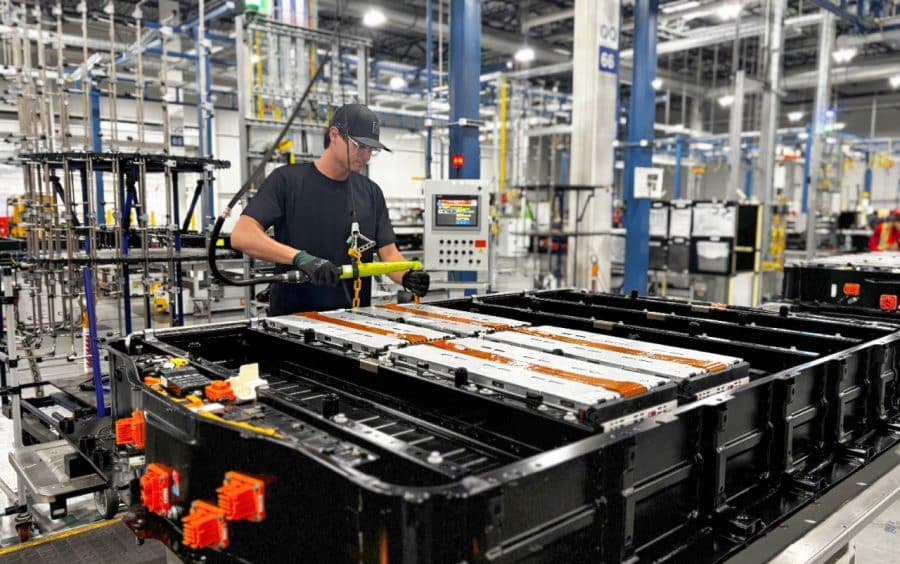
GM manufacturing teams assembled those cells into battery modules and packs at Factory ZERO and Spring Hill. In September 2026, the first new Cadillac LYRIQ, LYRIQ-V, VISTIQ, ESCALADE IQ and IQL, Chevrolet Silverado EV Trail Boss, and GMC Sierra EV AT4 equipped with battery cells containing cathode active material made from the recycled critical minerals rolled off production lines at Spring Hill Assembly and Factory ZERO.
Why The Closed Loop Matters
The pilot required years of engineering, quality control, logistics, testing and manufacturing work involving GM and partners including Cirba Solutions, Ultium Cells and LG Energy Solution.
Recovering and reusing battery materials could help reduce reliance on newly extracted raw materials, support battery cost reductions over time and strengthen supply chain resilience. GM says the pilot has also demonstrated how much coordination is required to establish a closed-loop battery recycling system.
The company views the project as a starting point as more EV batteries reach the end of their useful lives over the coming decades.
Recycling Is One Part Of The Battery Lifecycle
GM’s battery strategy extends beyond recycling. Its remanufacturing and refurbishment programs are designed to reuse more than 70% of battery pack components, extending useful life while reducing the need to manufacture an entirely new pack.
Battery packs can also be used for energy storage after their first life in a vehicle. GM is working with Redwood Materials to deploy approximately 10,000 GM second-life batteries in real-world energy infrastructure. The deployments include what GM describes as the largest second-life battery microgrid in North America, along with additional projects at GM’s U.S. manufacturing facilities.
Not every battery will follow the same path. Some may be refurbished or remanufactured, others can serve as stationary energy storage, and eventually battery materials can be recovered and recycled into new cells.
GM says its broader approach is intended to keep batteries delivering value throughout their lifecycle, from powering EVs today to supporting energy storage applications and eventually providing recovered materials for the next generation of electric vehicles. The company says the closed-loop pilot provides a pathway for using recovered materials in new battery cells while exploring ways to reduce the carbon footprint and costs associated with battery materials.
GM plans to share additional information about the project and other EV, electrification and circularity initiatives at Climate Week NYC, where it is a title sponsor of the Nest Climate Campus.

Electric Vehicle Marketing Consultant, Writer and Editor. Publisher EVinfo.net.
Services