From Monitoring to Autonomous Reliability: How EV Charging Operations Are Evolving
In 2026, electric vehicle (EV) charging reliability is becoming a core operating requirement rather than an afterthought.
North America’s EV charging network is expanding rapidly as EV adoption grows. The U.S. has added many public charging ports, with continued growth in both Level 2 and DC fast charging in 2026. Charging is spreading across highways, cities, workplaces, retail locations and other destinations.
The Joint Office of Energy and Transportation currently reports approximately 260,310 public EV charging ports nationwide, more than double the number available in 2020. As the installed base expands, the operating challenge increasingly shifts from deployment volume to whether chargers consistently deliver successful sessions and remain economically productive.
However, the industry’s challenge is shifting from simply installing chargers to keeping them reliable and financially productive. Uptime, maintenance, payment systems and customer experience are becoming increasingly important. The next phase of charging growth will depend not only on more chargers, but on infrastructure that is accessible, efficiently operated, and above all else, reliable.
Reliability Is Improving, but Uptime Alone Does Not Tell the Whole Story
An independent peer-reviewed field study published in Human Factors evaluated 655 open public DC fast-charging EVSEs and found that 73.3% were functional at the time of testing. The researchers contrasted that field result with the 95%–98% uptime commonly reported by EV charging service providers, highlighting an important distinction: reported availability and a charger’s ability to successfully deliver a charge are not the same measure.
The JD Power 2026 U.S. Electric Vehicle Experience (EVX) Public Charging Study, released in August 2026, reported that EV charging reliability is improving.
The industry non-charge visit rate reached its lowest level in the study’s history at 12% in the most recent quarter, improving from 14% during the same period a year ago. Newer OEM-backed networks posted the lowest failure rates, while legacy networks also improved. Together, these measures reinforce why operators need to look beyond reported uptime to session success and other operational outcomes.
Overall, public charging performance is improving, but reliability remains one of the industry’s most important operating challenges. Adding charging stations only creates value when those assets can consistently complete successful sessions, deliver energy and return to service quickly when problems occur. WattsUp is focused on helping operators close that gap between charger visibility and verified resolution.
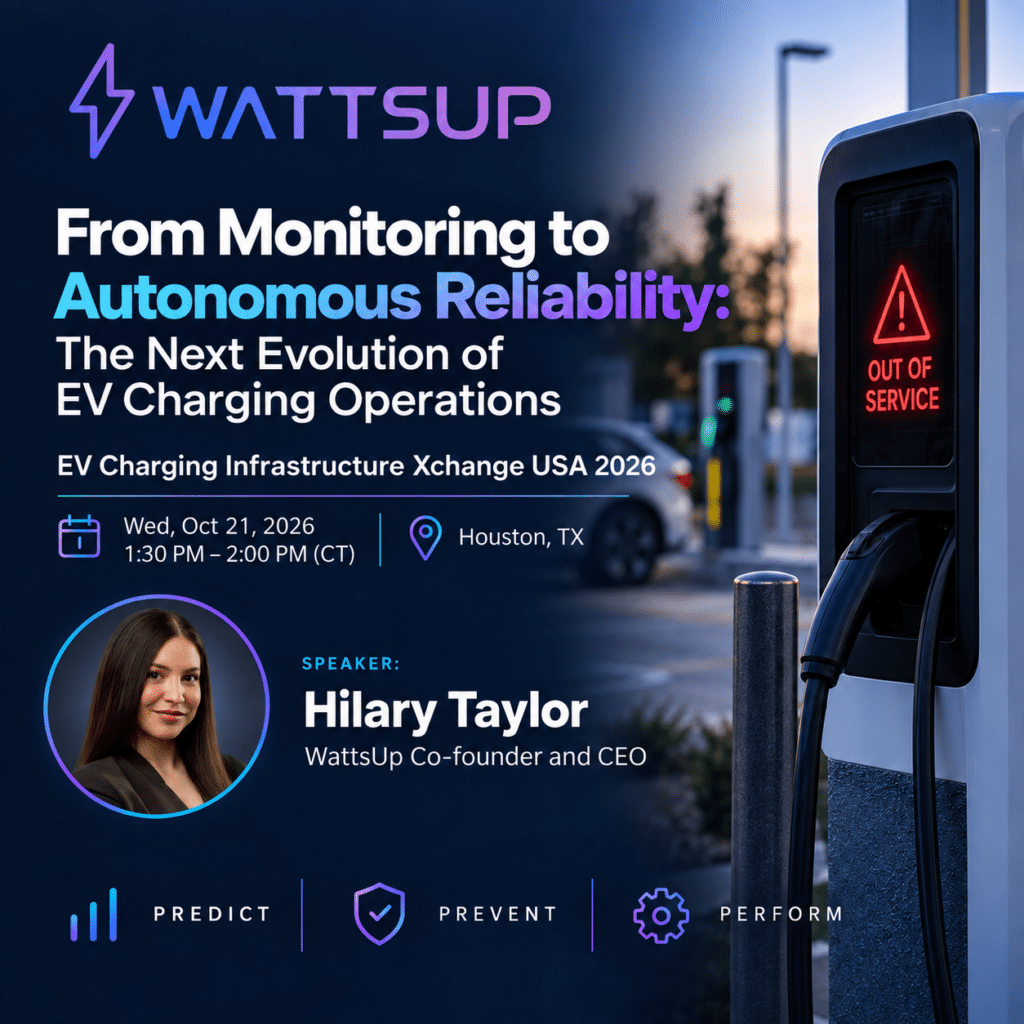
WattsUp Session: “From Monitoring to Autonomous Reliability: The Next Evolution of EV Charging Operations” at EV Charging Infrastructure Xchange USA 2026
WattsUp is building what the company describes as an autonomous reliability layer for EV charging infrastructure, designed to move charging operations beyond basic monitoring toward systems that can actively improve network performance.
WattsUp is addressing the reliability challenge by combining predictive analytics, autonomous remote resolution and closed-loop field-service orchestration to shorten the time between detecting a problem and restoring service.
Hilary Taylor, co-founder and CEO of WattsUp, will discuss these issues at EV Charging Infrastructure Xchange USA 2026 in Houston, Texas, on October 21, 2026. Her session, “From Monitoring to Autonomous Reliability: The Next Evolution of EV Charging Operations,” is scheduled for 1:30-2:00 PM CST.
The session will examine the difference between simply monitoring charging infrastructure and actively managing reliability outcomes. When a charger cannot complete sessions, operators lose delivered energy, asset productivity and, in many commercial networks, revenue. The distinction matters because identifying an issue is only the beginning of the reliability workflow.
Another focus of the session will be the hidden operational costs associated with unexpected charger downtime. Hardware failures, service delays and other reliability problems can create financial impacts that extend beyond the immediate loss of a charging session.
Taylor brings more than a decade of experience in engineering leadership, product development and field deployment. A Georgia Tech electrical engineering graduate and clean transportation expert, she is focused on developing scalable and operationally efficient systems that can help charging reliability accelerate rather than hinder EV adoption.
WattsUp Offers a Proactive Approach, Rather Than Waiting for Failures to Occur
WattsUp is focused on predictive analytics and autonomous software workflows that can identify problems and help improve physical network performance more quickly. The goal is to create a more proactive approach to charger operations instead of waiting for failures to occur and then responding.
For EV drivers, that evolution could mean fewer failed charging sessions and greater confidence that a station will work when needed. For charging operators, autonomous reliability technologies help reduce downtime, improve utilization and protect revenue from increasingly valuable charging assets.
WattsUp describes its platform as an Autonomous Reliability Layer for EV charging infrastructure. It is designed to move operators from visibility to action by combining predictive health signals with detailed diagnostics, autonomous remote resolution and field-service orchestration. The objective is not simply to generate more alerts, but to reduce the time and effort required to restore reliable charging service.
The platform is designed to work across heterogeneous charging environments by bringing together OCPP and other available charger data with information from CMS platforms, OEM systems and external operating sources. This broader data set helps its Insight module identify emerging performance issues, support more accurate diagnosis and determine the most appropriate next action before downtime is unnecessarily extended.
WattsUp goes beyond identifying problems. When an issue can be resolved remotely, its Foresight module supports detailed diagnosis and autonomous remote-resolution workflows. When field intervention is required, its Oversight module can help create a higher-quality scope of work, identify likely parts requirements and move the issue into a structured field-service workflow.
Field-service orchestration is another part of the approach. The Oversight module supports technician dispatch management, repair-workflow oversight and closed-loop verification so that an issue is not treated as resolved simply because a ticket was closed or a technician left the site. The goal is faster restoration, fewer repeat visits and better accountability through completion.
The Platform is particularly relevant for charge point operators, fleets, charger OEMs and service organizations operating or supporting charging infrastructure at scale. WattsUp is designed to complement existing CMS, OEM and maintenance systems while helping those organizations increase Remote Resolution Rate, improve First-Time Fix Rate, reduce True MTTR (Mean Time to Repair), and improve session success.
WattsUp’s broader mission is to accelerate EV adoption by improving the reliability and efficiency of charging infrastructure. The company was founded by EV charging technology professionals, with its founding team bringing 25 years of combined EV charging and automotive industry experience.
WattsUp is positioning predictive analytics as one component of a broader autonomous reliability model. The operating sequence is straightforward: predict earlier, diagnose more accurately, resolve remotely where possible, dispatch better when field intervention is required, and verify restoration. This closed-loop approach is intended to improve reliability outcomes without requiring operational headcount to scale in direct proportion to charger count.
WattsUp adds a reliability layer to the EV charging ecosystem by connecting data that is typically separated across charging management systems (CMS), charger OEMs and external sources. While CMS platforms manage access, payments, sessions and load management, and OEMs provide hardware diagnostics, firmware and service information, WattsUp combines these datasets with grid and power conditions, weather, site observations and driver feedback. This broader view helps operators understand not only what is happening at a charger, but why. The result is earlier failure prediction, more effective remote troubleshooting and better field-service dispatch, improving session success, remote resolution, true mean time to repair and first-time fix rates.
WattsUp complements rather than replaces CMS and OEM systems by turning broader operational data into actionable charging reliability decisions.
Don’t Miss EV Charging Infrastructure Xchange USA 2026, Houston, TX, October 21, 2026
EV Charging Infrastructure Xchange USA 2026, presented by ThoughtX, is bringing together charge point operators, utilities, automakers, fleet operators, investors, technology providers and policymakers in Houston on October 21, 2026 to address the next phase of EV charging infrastructure. The event will focus on the industry’s shift from rapid deployment toward reliable, scalable and commercially sustainable networks, with discussions covering ultra-fast and megawatt charging, grid integration, interoperability, financing, asset monetization and fleet electrification. Reliability and uptime are central themes, including maintenance, diagnostics, remote monitoring and software resilience as charging networks become larger and more critical to transportation.
Thought Xchange Network curates specialized conferences focused on the technologies, infrastructure and business opportunities shaping the energy transition. Its events bring together industry leaders, technology providers, investors, policymakers and other decision-makers to examine emerging challenges and identify practical opportunities across sectors including electric vehicle charging, energy security, carbon capture and lithium extraction. Through focused discussions and industry networking, Thought Xchange aims to connect professionals working to accelerate the development and deployment of next-generation energy technologies.
Sources for revised market and reliability context:
• Joint Office of Energy and Transportation: current national public EV charging port count (driveelectric.gov).
• Rempel, Cullen, Bryan & Cezar, “Reliability of Open Public Electric Vehicle Direct Current Fast Chargers,” Human Factors (2024): field testing of 655 open public DC fast-charging EVSEs found 73.3% functional, compared with 95%–98% uptime reported by EV service providers. DOI: 10.1177/00187208231215242.
• J.D. Power, 2026 U.S. Electric Vehicle Experience (EVX) Public Charging Study: non-charge visit rate of 12% in the most recent quarter.
• EV Charging Infrastructure Xchange USA 2026 official speaker page: Hilary Taylor session scheduled for 14:00–14:30 on October 21, 2026.

Electric Vehicle Marketing Consultant, Writer and Editor. Publisher EVinfo.net.
Services