A Deep Dive Into Solving the EV Charging Reliability Problem With Hilary Taylor, CEO of WattsUp
The U.S. electric vehicle market recorded its strongest quarterly performance in a year during the third quarter of 2026, with 262,649 EVs sold, according to Kelley Blue Book estimates from Cox Automotive. Sales increased 6.1% from the second quarter, marking the highest quarterly total since the third quarter of 2025.
The U.S. Public EV Charging Network Is Growing Fast
The U.S. public charging network added 664 stations and 4,106 ports in the third quarter of 2026, according to Paren, bringing total stations up to 14,614 and total ports up to 80,964. Q3’s reliability score was 93.9, showing that lots of room for improvement remains. With chargers expanding beyond highways into cities, workplaces, retail centers and fleet facilities, the industry’s focus is shifting from deployment to reliability.
Reliability Is Improving, But Failures Remain
J.D. Power’s 2026 U.S. Electric Vehicle Experience (EVX) Public Charging Study found unsuccessful charging visits fell to 12%, the lowest level in six years, compared with 14% in 2025 and 19% in 2024. DC fast charging satisfaction also increased 12 points to 666. However, one in eight charging visits still fails. Plug In America’s 2026 Annual EV Driver Survey found 52.4% of non-Tesla EV drivers encountered a broken charger during the previous year.
Uptime Does Not Tell The Whole Story
ChargerHelp’s 2025 reliability report found networks commonly report 98.7% to 99.9% uptime, while field data from more than 100,000 sessions showed only about 71% succeeded on the first attempt. A charger can be powered and communicating while still failing because of payment, communication, connector or power-delivery problems.
Reliability Has Become A Financial Issue
As charging networks rely increasingly on private investment, reliability directly affects revenue. Failed sessions mean lost electricity sales, underused infrastructure and frustrated customers.
Driivz’s 2026 State of EV Charging Network Operators Report found 47% of charging professionals planned to prioritize around-the-clock network availability, underscoring the industry’s shift toward keeping existing infrastructure operational as EV adoption grows.
Reported uptime does not always reflect the driver’s experience. A charger can be powered, connected and technically “online” while still failing to complete a successful charging session. That gap between status and actual performance is where reliability operations become critical.
Moving From Monitoring To Autonomous Reliability
WattsUp positions its IRIS platform as an Autonomous Reliability Layer designed to move charging operators beyond monitoring problems toward diagnosing, resolving and verifying them.
The approach combines OCPP telemetry and charge-management system data with OEM diagnostics, firmware information, grid conditions, weather, site observations and driver feedback.
WattsUp’s IRIS closes the reliability loop through three layers: Insight, Foresight, and Oversight.
Insight establishes what is actually happening across chargers, and charging sessions.
Foresight diagnoses problems, assesses failure risk, and enables remote resolution where possible.
Oversight coordinates field intervention when physical service is required and verifies that the charger has genuinely returned to service.
The process is designed as a closed loop: identify a problem, diagnose its likely cause, resolve it, verify that the repair worked, and use the outcome to improve future predictions.
That final verification is critical. A service ticket being closed does not necessarily mean a charger is working. The real test is whether drivers can successfully complete charging sessions after the repair.
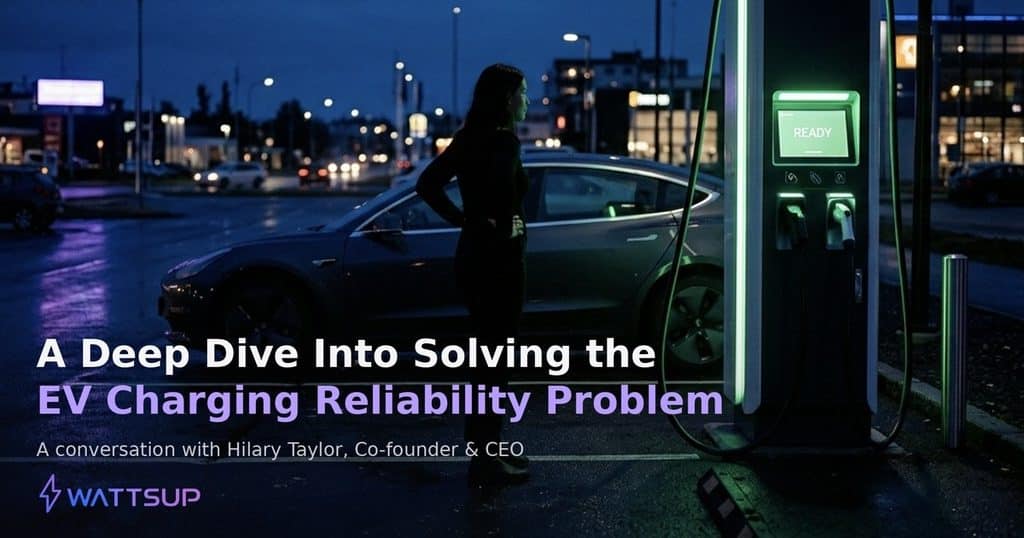
Hilary Taylor, CEO of WattsUp, Interviewed by EVinfo.net
EVinfo.net spoke with WattsUp CEO Hilary Taylor about how charging operators can move from monitoring failures to predicting, resolving and verifying them.
Bill Pierce:
What does WattsUp do that a traditional CMS typically does not?
Hilary Taylor:
A CSMS runs the business of charging: sessions, pricing, billing, status.We sit alongside it, not in place of it. But reliability isn’t a missing feature of the CSMS. It’s a different job, and there are three structural reasons a CSMS can never own it.
First, a CSMS grades its own homework. Its uptime number is its own report card, and the industry’s reported uptime runs 10 to 15 points above what drivers actually experience. Operators don’t just need better monitoring; they need an independent layer that measures what’s true and verifies every fix held. You can’t be the auditor of yourself.
Second, every CSMS sees one slice. One network, its own brands, its own sites. Reliability intelligence only works cross-brand. Our models learn from verified outcomes across every manufacturer and every network we touch, which is a dataset no single CSMS can ever assemble, no matter how good their engineering is.
Third, fixing a charger is a job that crosses company lines: the OEM’s warranty desk, the service network, the parts supplier, the technician. A CSMS ends at its own software’s edge. We orchestrate everything between the impending failure and the verified fix, no matter whose logo is on the hardware.
Every ops layer in software history looked like a feature at first. Monitoring looked like a feature of AWS until Datadog. Security looked like a feature of the operating system until CrowdStrike. The pattern is the same every time: when the job requires sitting across all the vendors instead of inside one of them, it’s not a feature, it’s a layer. That’s what we’re building for charging.
Bill Pierce:
What actions can WattsUp automate today, and where does human oversight remain important?
Hilary Taylor:
So the honest answer has two halves, and I love this question because the second half matters as much as the first.
What runs on its own today: everything software. WattsUp is watching every charger and peripheral datasets around the clock, including the sneaky ones that tell the network ‘I’m fine’ while turning away every single driver. It figures out what’s actually wrong, and for software failures, a hung controller, a stuck session, it fixes it automatically. And it will fix the issue before anyone even knew there was a problem. Then it does my favorite part: it watches that charger for seven more days of real charging to make sure the fix held. If it didn’t, it reopens the case again. Nobody has to catch it.
And where do humans stay in the picture? We deliberately keep them in the loop in a few places.
Fundamentally, hardware is human. Software can’t replace a power module, and we’d never pretend otherwise. What we automate out is the misery around the visit: the manual diagnosis, the scope of work, routing to the right technician. The human does the thirty minutes of skilled work instead of the three weeks of figuring out what the work is.
Our customers control the policy. Every operator decides what WattsUp does on its own versus what it waits on. Most operators start cautious and hand over more as they watch us work, which is exactly how it should go. Trust is something that is earned one verified resolution at a time.
Finally, when the platform runs into something it’s never seen, it says so. It raises its hand and brings a person everything it knows. Once that person solves it and we verify it held, our algorithms have learned it. So the line between what’s automated and what’s human isn’t fixed, it moves a little further every quarter, and it only moves after the system has proven itself. I think that’s the only responsible way to build autonomy.
Bill Pierce:
How does Foresight determine whether an issue should be monitored, resolved remotely, or escalated to field service?
Hilary Taylor:
At a high level, every issue gets weighed on three questions. What is it, and how confident are we? What’s it actually costing, in revenue and in drivers turned away? And what’s the cost of being wrong? A remote fix is cheap and reversible, so the bar for trying it is low. A truck roll is expensive, so the bar is high.
So stable and low-impact issues get watched, deliberately. High-confidence software failures get fixed remotely, usually in minutes. Anything with a hardware signature escalates, and not just as a ticket: the technician gets the diagnosis, the part, and the scope of work before they drive anywhere.
And one rule we hold ourselves to: if a fix doesn’t survive our seven-day verification, we don’t just try it again. The system escalates, because at that point it’s telling us something. We’d rather roll one truck with the right part than ‘fix’ the same charger eleven times.”
Bill Pierce:
What does WattsUp consider “resolved,” and how is restored performance verified?
Hilary Taylor:
Most of the industry calls a charger resolved the moment it comes back online. We think that’s how you end up fixing the same charger eleven times. A charger that accepts a session at 2 p.m. and strands a driver at 6 a.m. was never fixed. It was briefly restored.
So for us, ‘resolved’ is earned, not declared. After any fix, remote or in the field, WattsUp watches that charger through seven days of real-world charging. Real sessions, real drivers, real conditions. We’re not pinging it to ask if it’s online; we’re confirming it’s actually doing its job. Only then does the episode close. And if performance slips inside that window, the ticket reopens itself, automatically, with everything we learned the first time attached.
Bill Pierce:
Why do you emphasize session success, remote resolution, true MTTR (Mean Time to Repair) and FTFR (First-Time Fix Rate), and what results have you observed across deployments?
Hilary Taylor:
We chose metrics that are hard to make look good. The easy ones are how this industry ended up with 99% uptime and stranded drivers. Each KPI we chose is one that closes a gap between what gets reported and what drivers actually experience.
Session success is a lie detector of sorts. Uptime says ‘the charger responded to a ping.’ Session success says ‘a real driver plugged in and had a successful charge.’ Those two numbers disagree frequently, and the gap between them is where operators lose money.
Remote resolution rate matters because the cheapest truck roll is the one that never happens. Most charger failures are software problems wearing a hardware costume. That’s a really expensive costume if you ask me.
True MTTR is about when the clock starts. The industry starts counting when a ticket gets opened, which is often days after the charger actually failed, because a driver complaint is what surfaced it.
And first-time fix rate, because more than half of repairs in this industry take two or more visits. Every second visit is the same story: a technician arrived without the diagnosis or the part. FTFR measures whether you solved that, and it’s the number technicians and service partners care about most.
As for our impact, I think it’s important to understand that more revenue is only half the answer. A charger can be online, even busy, and still bleed money on the cost side. Our whole thesis is that operational doesn’t mean profitable, so we measure our impact on both sides of the ledger.
On the revenue side, uptime moves into the high nineties and stays there, and operators recover charging revenue they didn’t know they were losing.
But the cost side is where profitability actually gets rebuilt. With WattsUp, our goal is to differentiate between issues that can be remotely resolved and those that can’t, so truck rolls simply don’t happen if they don’t need to.The visits that do happen need to succeed on the first try, so operators stop paying twice for one repair. And the hours their own people spent chasing tickets between the OEM, the network, and the contractor, that overhead just goes away.
So the best way to describe our impact is this: we widen the margin on every charger from both directions at once. More sessions completed, fewer dollars spent completing them.
Bill Pierce:
How do those improvements translate into lower operating cost, greater asset productivity, and more charging revenue captured from infrastructure already deployed?
Hilary Taylor:
So here’s how we think about it: The industry just spent a decade putting chargers in the ground. The federal incentives that fueled this buildout, NEVI for example, have been paused and pulled back. This means that operators really can’t subsidize their way past reliability problems anymore. And for that reason, the next decade needs to be about making the chargers already in the ground actually perform.
The clearest way to see it is to follow one failure through an operator’s books.
Today, that failure costs operators three times. They pay in lost revenue while the charger sits dead, often for weeks, because nobody knew it was down until a driver complained. They pay in labor, dispatch fees, and repeat visits to get it fixed. And they pay a third time in the demand that never comes back, because drivers remember which sites burned them.
What we do is address all three. The failure gets caught proactively, and the goal is to fix it before anyone notices, so the lost-sales window shrinks. The repair that does require a person happens once, not three times, and the game of telephone and endless emails around it disappears entirely. And because the site stays dependable, drivers keep coming back, which is where the revenue story compounds.
So lower operating cost, more kiloWatt hours out, more revenue captured: these are all interconnected attributes to a successful charging business. They’re what results when downtime stops being a weeks-long event and becomes a minutes-long one. And the part that matters most right now, with federal incentives like NEVI pulled back: all of this comes out of infrastructure that’s already bought and already in the ground. Operators don’t need more chargers to make more money. They need the ones they own to work. That’s margin recovered from capital that’s already spent, which is the best growth there is.
Bill Pierce:
As EV charging infrastructure matures, what do you believe operators will need to measure and manage differently over the next few years?
Hilary Taylor:
I think the market will shift to prioritize three things: margin per asset, auditable reliability, & lifecycle analytics.
Number of ports installed, number of built out sites– these were the right metrics to build the business, but not to sustain it. We’ve been talking about operators profit and loss (P&L) this entire interview, and that’s exactly where operators are headed. Margin per charger, not number of chargers on the map.
Here’s why this leads straight to autonomous reliability. Managing margin per asset will be incredibly difficult to do with just an ops team. We are talking about millions of data points with eyes capable of managing a few dozen assets at a time. And honestly, the worst failures wouldn’t be caught by more people anyway. The expensive ones are the silent ones, the charger that reports online while failing every driver.
So this is why I say the shift to margin thinking and the shift to autonomous reliability are the same shift. It’s not that ops teams aren’t needed, they absolutely are. It’s that the job has outgrown what any team can carry. Let the software focus on what scales, and let ops teams focus on the judgement calls that matter.
Next is auditable reliability. We know there is a gap between reported uptime and what drivers actually experience. We also know that reliability numbers are starting to have money attached.
Put those two things together, do you see the issue? A site host in a revenue share, a fleet with an uptime clause in the contract, a lender financing sites: all of them are making decisions based on a reliability number. And right now, the number is pretty much single sourced. Uptime as we use it today will not work in contracts long-term. The operators who can hand over an independently verified number are going to win the contracts, the capital, and the sites.
Finally is asset lifecycle, which is a shift in focus that is fast approaching in this industry. There’s a large share of installed chargers that are about to age out of warranty coverage. And sure extended warranties are an option, but they don’t address the problem in full. Operators still need answers they’ve never needed before. Which assets are degrading? Which are worth repairing? Which aren’t?
So three different shifts, but one common thread. Each of them requires knowing what every charger is doing and being able to prove it in order to maintain a healthy margin. You don’t get that from a dashboard someone has to stare at. You get it from software that watches, acts, and verifies on its own. The operators who have that will answer questions the rest of the industry can’t. They will own the next phase of the market.
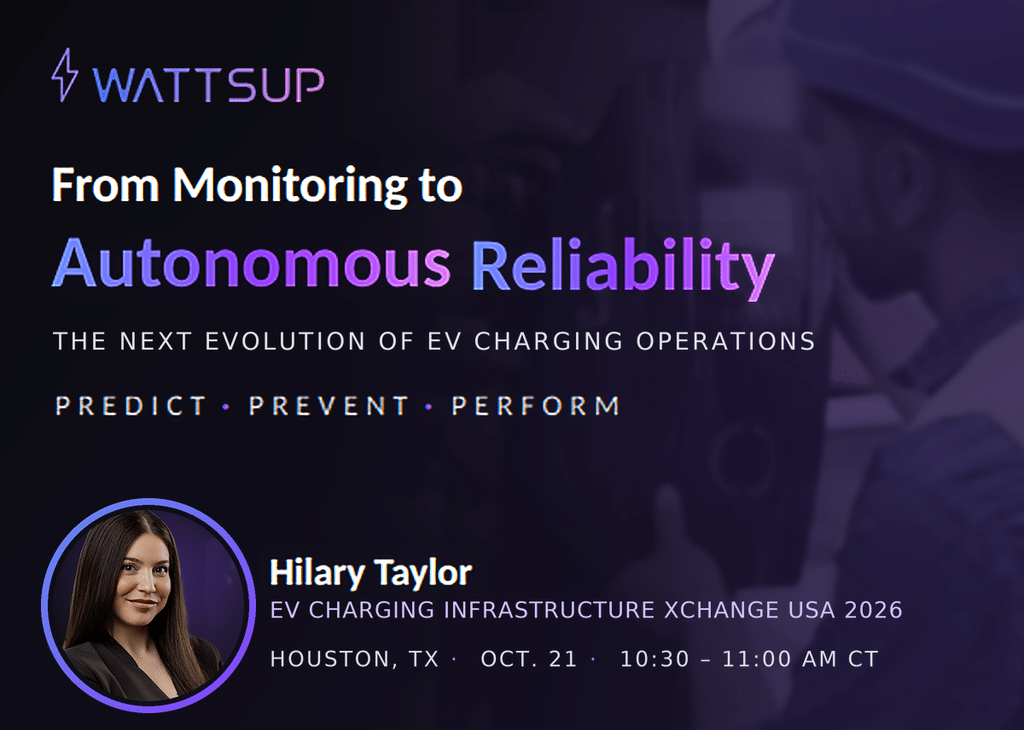
WattsUp to Address Autonomous EV Charging Reliability at Houston Conference, October 21, 2026
Taylor will present “From Monitoring to Autonomous Reliability: The Next Evolution of EV Charging Operations” on October 21, 2026, from 10:30 to 11:00 AM (CT) at EV Charging Infrastructure Xchange USA in Houston, Texas.
The session will examine why reported uptime does not always translate into successful charging sessions, which performance metrics matter most to operators, and how downtime generates hidden costs through service truck rolls, repeat visits and undetected failures. Taylor will also explore the organizational and technical requirements for closing the loop from fault detection to verified resolution as charging networks expand.
A graduate of Georgia Tech with a degree in electrical engineering, Taylor brings more than a decade of experience in engineering leadership, product development and field deployment across the EV charging industry. The focus has been on developing scalable, operationally efficient systems that improve charging reliability and support broader EV adoption. WattsUp’s founding team brings more than 20 years of combined experience in EV charging and the automotive industry.
Presented by Thought Xchange Network, EV Charging Infrastructure Xchange USA 2026 brings together charge point operators, utilities, automakers, fleet operators, investors, technology providers and policymakers on October 21. The conference will address the industry’s transition from rapid infrastructure deployment to reliable, scalable and commercially sustainable charging networks.
Topics include ultra-fast and megawatt charging, grid integration, interoperability, financing, asset monetization and fleet electrification. Reliability, diagnostics, remote monitoring and software resilience will feature prominently as charging providers focus on improving network performance and delivering dependable service at scale.
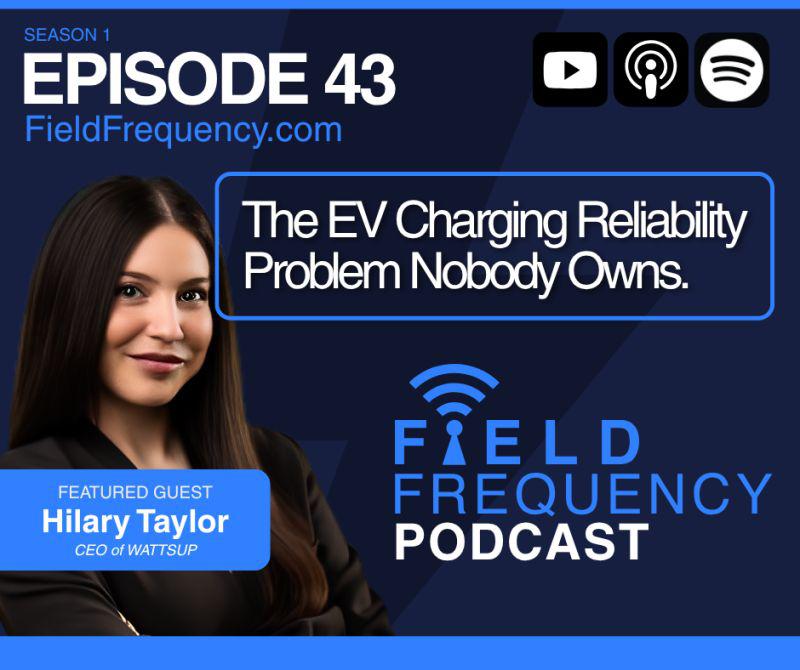
Field Frequency Podcast: Episode 43, The EV Charging Reliability Problem Nobody Owns, Featuring Hilary Taylor, CEO of WattsUp
In September 2026, WattsUp CEO Hilary Taylor appeared on the Field Frequency Podcast with host Jason Cortes to discuss the company’s approach to EV charging reliability.
Taylor described WattsUp as a layer connecting the fragmented charging ecosystem rather than replacing existing charging management systems. The platform combines machine learning, contextual data, operational workflows and technician feedback to shift maintenance toward proactive action.
The charging ecosystem includes roughly 90 hardware brands and 40 software providers, creating numerous potential failure points. Critical information is often spread across charging management, field service, asset management and warranty systems. WattsUp aims to create a standardized source of truth connecting those stakeholders.
Access to previous work orders, recurring errors and service history can help technicians make better decisions before arriving at a charger. WattsUp pairs predictive insights with specific workflows and uses technician feedback to improve future recommendations.
The platform also incorporates data beyond traditional OCPP information, including normal and extreme weather events, and utility conditions. This context can help determine whether a charging failure is caused by the charger or external conditions, potentially preventing unnecessary service visits.
WattsUp uses standardized questions, voice-to-text capabilities and back-end processing to extract useful information from field reports while reducing inconsistent inputs.
Taylor noted that OCPP implementation can vary between manufacturers, creating additional interoperability challenges. Contextual data and software layers can help address some of those differences.
The broader goal is to connect reliability improvements with service-level agreements and uptime guarantees. Better predictive intelligence, workflows and technician productivity can help charging operators control service costs while increasing charger availability.
From Prediction to Action
The next phase of EV charging reliability is not simply about keeping chargers online. It is about maximizing successful sessions, reducing unnecessary service activity, shortening repair times and increasing the productivity of infrastructure already deployed. Increasingly, operators will need systems that identify problems earlier, resolve them faster and verify that they stay fixed.
WattsUp’s Autonomous Reliability Layer is designed around that closed-loop operating model: identify earlier, resolve faster and verify that the issue stays fixed.
Contact the WattsUp team for more information at info@wattsupev.io.
Electric Vehicle Marketing Consultant, Writer and Editor. Publisher EVinfo.net.
Services