GM’s Next-Generation EV Platform Has 30% Less Wiring and 20% Less Battery
General Motors revealed details of its fourth-generation electric vehicle (EV) platform at its GM Forward event in New York City on Wednesday, October 21, 2026. The new architecture is designed to deliver major improvements in vehicle efficiency, weight, battery costs, aerodynamics, and computing power. GM has not yet announced a firm timeline for the rollout of all vehicles using the platform or specified every model that will adopt it.
GM President Mark Reuss told attendees that the new architecture would underpin “a remarkable set of vehicles in several segments” and that its launch would happen “very shortly.” The company said the platform would support EVs in its highest-volume segments. A GM spokesperson clarified that this primarily refers to crossover SUVs.
Although GM provided limited details about the specific vehicles and configurations planned for the new platform, the company emphasized that its goal is to build electric vehicles that require fewer expensive battery materials without sacrificing driving range. Reducing battery capacity while maintaining competitive range could lower manufacturing costs and help GM expand its electric vehicle business.
“We continue to develop our future EVs and work to reduce battery costs,” Reuss said during the event, noting that GM operates globally and that EV sales are increasing around the world. “And when the U.S. market is ready for EVs in large numbers, we will be there for them.”
GM said its fourth-generation EVs will achieve a 15% reduction in vehicle mass, 20% greater energy efficiency, 20% less overall battery capacity, and 25% better aerodynamic performance. The company has also redesigned its electric drive units and power electronics to reduce the number of components inside each motor by 40%.
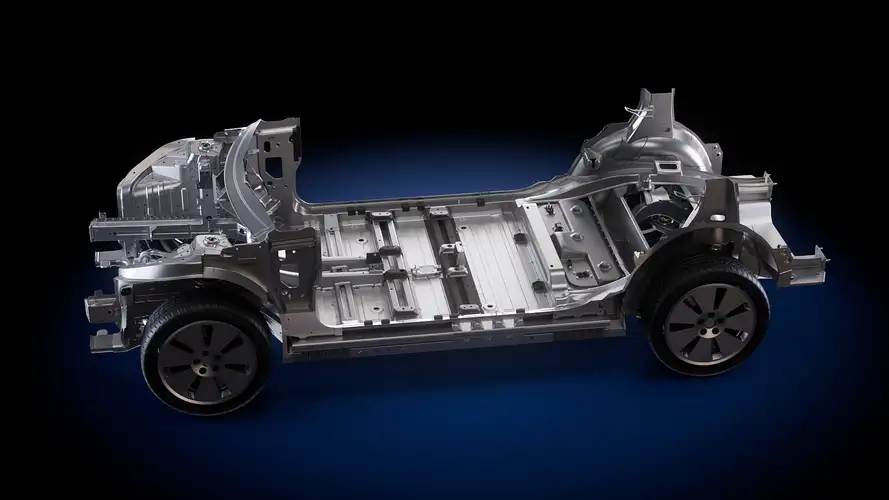
At the center of GM’s new EV technology are lithium-manganese-rich (LMR) batteries. GM says this chemistry is less expensive than high-nickel battery cells while providing 33% greater energy density than lithium iron phosphate (LFP) batteries. The combination could allow GM to reduce battery size and cost while maintaining or improving vehicle range.
“With that being unlocked, that changes everything,” Zach Walker, GM’s director of global EV architecture, said. “When you talk about equivalent or more range for 20% less battery, which is a dominating [bill-of-materials] cost of the system, you can extrapolate what that means for the value proposition to us and really to the customer.”
The new batteries will use prismatic cells that are structurally integrated into the vehicles, Walker said. He did not specify whether the cells would be arranged in a cell-to-pack configuration or incorporated through a module-based design. However, he explained that the new architecture would improve battery packaging, allowing GM to develop vehicles with lower profiles and better aerodynamics.
Improved battery packaging could also give designers more flexibility when developing vehicle shapes without compromising passenger comfort or practicality. Walker described the importance of achieving a lower roofline without creating an awkward-looking vehicle, saying, “Like, you can go slam a roof, and then the customer’s driving, like, a clown car.”
GM is not the only automaker developing a new electric vehicle architecture from the ground up. Ford is working on its own redesigned EV platform, which the company says will be more efficient and less expensive to manufacture than the technology used in the Mustang Mach-E and F-150 Lightning. Ford appears to be further along in its development process, with its approximately $30,000 Fathom pickup expected to enter production in late 2027 as the first vehicle built on its Universal Electric Vehicle platform.
In addition to its battery and vehicle engineering changes, GM is overhauling the electrical and computing architecture used in its next-generation vehicles. The new system replaces dozens of separate electronic control modules, each responsible for specific vehicle functions, with a more powerful and centralized computing system. Tesla and Rivian have pursued similar approaches to simplify vehicle electronics and consolidate computing functions.
The new architecture uses a single Central Compute Unit positioned near the front of the vehicle. It will manage perception, propulsion, safety systems, and chassis controls through a unified computing platform.
“This unified foundation provides the heavy computing power required to run both sophisticated in-cabin AI and autonomous driving simultaneously,” GM said in a press release.
Centralizing these functions is expected to support more comprehensive over-the-air software updates, enable new vehicle features, and give the automaker more control over how different systems operate together. The additional computing capacity will also support advanced driver-assistance technology, artificial intelligence features, and future autonomous driving capabilities.
GM said the new electrical and computing architecture will reduce wiring by 30% compared with its current EVs. Fewer wires can reduce vehicle weight, simplify assembly, and decrease system complexity. The architecture will also deliver 40 times more processing power and 50% faster cellular connectivity, supporting applications such as video streaming and other connected vehicle features.
The new architecture will debut in the 2028 Cadillac Escalade IQ and play a critical role in delivering GM’s first eyes-off driving system, which is scheduled to launch in that vehicle. The technology will subsequently be used in GM’s fourth-generation EVs and expand across the company’s gasoline-powered vehicle lineup, beginning with pickup trucks and three-row SUVs.
By combining LMR battery chemistry, improved battery integration, lighter vehicle structures, more efficient electric drive units, and centralized computing, GM is pursuing a comprehensive redesign of its electric vehicle technology. The goal is to reduce the cost and complexity of producing EVs while maintaining the driving range, performance, and advanced features customers expect.

Electric Vehicle Marketing Consultant, Writer and Editor. Publisher EVinfo.net.
Services