Why Don’t EV Charging Stations Have As Many Canopies As Gas Stations?
Most electric vehicle (EV) charging stations lack canopies because they are typically added to existing parking lots rather than designed as standalone fueling facilities. Grocery stores, shopping centers and office parks often convert standard parking spaces into charging areas without making major structural changes.
In a June 2026 Motor1 article, an EV driver complained about charging without a canopy: “You know, owning an electric car is nice, but why can’t we build chargers with covers like a gas station?” he said.
Several factors contribute to the limited use of canopies. Retrofitting existing parking spaces is generally simpler than building dedicated charging structures. Adding steel-framed canopies, lighting and structural supports increases construction costs and installation time. Charging companies often prioritize spending their capital on additional charging units and network expansion rather than overhead shelters.
Economics also play a role. Traditional gas stations generate revenue from fuel sales and convenience-store purchases, helping justify investments in large covered fueling areas. Public EV charging networks often operate with tighter profit margins, making canopies a more difficult expense to justify.
Convenience stores are increasingly installing EV charging, and those locations typically have canopies for their chargers, as the store revenue helps cover the costs.
The history of gas station canopies offers another explanation. These structures became increasingly important as full-service attendants disappeared and drivers had to pump their own gas in the rain, heat and darkness. Much of the early public EV charging infrastructure, however, followed the existing parking-lot model rather than the dedicated fueling-island design.
Solar canopies offer another possibility, but they face limitations. Although some high-profile charging locations feature solar-panel roofs, fast-charging stations require substantial amounts of electricity. Generating enough solar power to supply even a portion of that demand can require considerable panel coverage. As a result, solar canopies are not necessarily practical or economical for every charging site.
As public charging networks keep growing, canopies could become an important feature for improving the driver experience. Protection from rain, snow, intense sunlight and extreme heat would make charging more comfortable, particularly during longer DC fast-charging stops.
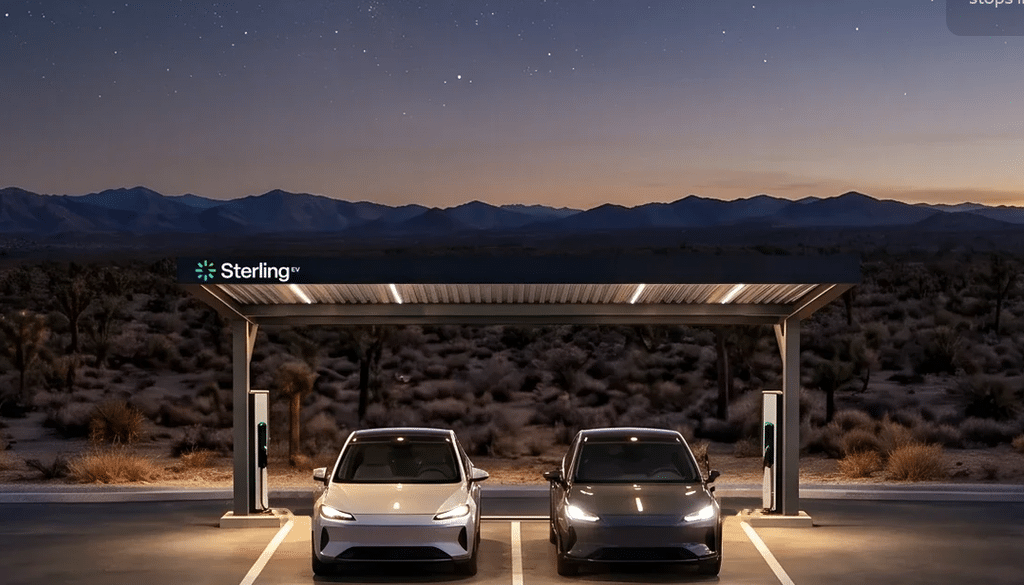
Roughly 35% of IONNA Sites Have Canopies
IONNA is a fast-growing network known for its clean, well lit stations, sometimes including canopies. EV charging expert Loren McDonald reported that roughly 35% of IONNA charging sites feature canopies.
IONNA CEO Seth Cutler said canopies are a major driver preference, but installing them requires additional approvals from convenience store operators, property owners and local zoning authorities. As a result, IONNA prioritized launching fast, reliable charging stations, with canopy coverage currently available at some of its locations.
EVinfo.net’s Take: Sterling EV Specializes in High Quality Canopies And Charging Station Design
EVinfo.net believes canopies for charging stations are a good idea. Clean, well-lit locations with restrooms and snacks available 24/7 are also good ideas.
EV charging networks can learn valuable lessons from the evolution of ATM networks, particularly the importance of canopies, customer experience, recognizable branding, reliability, and site design. Technology makes charging possible, but customer confidence and convenience determine whether drivers return.
Sterling EV was created to meet the needs of EV charging operators, after many years of experience in the ATM industry.
In a recent EVinfo.net article, Sterling EV and Sterling ATM CEO Mark Harling explains that canopies, consistent branding, clear signage, good lighting, visible security, clean surroundings, and intuitive payment systems help establish trust.
Transportation Energy Institute research found that only 56% of surveyed charging sites provided bright lighting around charging units, while Geotab found that 43% of U.S. women surveyed had safety concerns about EV charging stations.
Reliability is equally important. A failed charging session can drive customers to competing networks and damage confidence in every location carrying the same brand. J.D. Power’s 2026 public charging study reported that unsuccessful charging visits declined to 12%, the lowest level recorded in its study. Operators should measure successful customer experiences rather than simply whether chargers report being online.
Charging sites also offer opportunities to engage customers during longer visits through digital displays promoting memberships, local businesses, products, and services. However, displays must remain operational and feature relevant, updated content.
Harling’s central argument is that charging operators should invest in the entire customer experience, not just equipment and installation. Consistent branding, dependable charging, safety, cleanliness, maintenance, and thoughtful site design by Sterling EV can differentiate networks and encourage repeat visits.
Find Sterling EV
Website: https://sterlingev.com
LinkedIn: https://www.linkedin.com/company/sterling-ev
YouTube: https://www.youtube.com/@EVSterling
Contact
Email: coleb@sterlingev.com

Electric Vehicle Marketing Consultant, Writer and Editor. Publisher EVinfo.net.
Services