Global EV Alliance Survey: EV Myths and Misconceptions Remain Biggest Barrier to Adoption
A new 2026 Global EV Driver Survey found that myths and misconceptions about electric vehicles (EVs) represent the biggest obstacle to broader adoption, outweighing purchase prices and charging access concerns. The survey collected responses from more than 29,500 EV drivers across 34 countries.
According to the Global EV Alliance (GEVA), 74% of respondents identified EV misinformation as the greatest barrier to adoption in their country. Purchase price ranked second at 49%, followed by access to charging in apartment buildings at 47%.
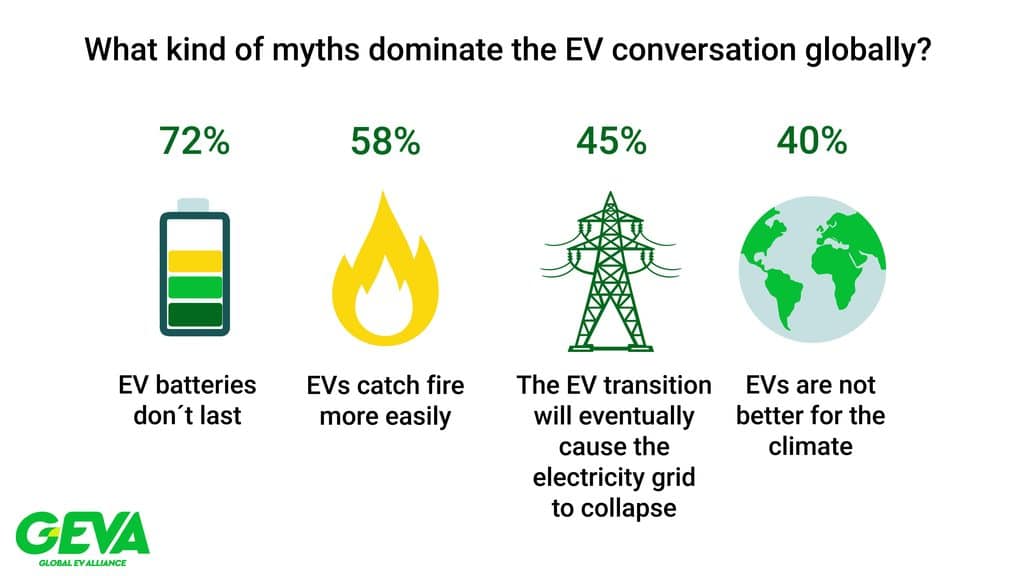
The most common misconceptions involved battery longevity, fire safety and electricity grid capacity. Respondents reported that the leading EV myths were that batteries do not last (72%), EVs catch fire more easily (58%) and widespread EV adoption will eventually cause electricity grid collapse (45%).
However, actual EV ownership experiences challenge these concerns. In the survey, 65% of respondents disagreed or strongly disagreed with the statement that they were concerned about battery lifespan, while only 18% agreed or strongly agreed.
“Outdated information and misconceptions continue to influence decisions long after the technology has moved on,” said Ellen Hiep, a member of GEVA’s Steering Committee.
She noted that modern EV batteries generally come with eight-year warranties and often outlast the vehicles themselves.
The annual Global EV Driver Survey examines EV ownership, charging experiences and adoption barriers. GEVA is a nonprofit network representing 71 EV associations across 41 countries.
The findings highlight the importance of consumer education in accelerating EV adoption. Continued improvements in battery technology, safety and charging infrastructure need to be accompanied by accurate information that addresses persistent misconceptions and helps potential buyers make informed decisions.
Survey results are available at Global EV Alliance.
EVinfo.net’s Take: Some of Our Goals Are to Promote EV Education and Debunk EV Myths
Kudos and congratulations to the stellar GEVA team, doing great work for EV adoption globally.
EVinfo.net provides EV education, debunks myths, and covers the latest EV news from around the globe. We debunked 11 common EV myths, including the top four listed above. A summary of the other seven myths we covered is below.
Many misconceptions about electric vehicles (EVs) overlook improvements in battery technology, charging infrastructure, affordability and vehicle performance. Although EVs have legitimate limitations, several widely repeated criticisms no longer reflect today’s technology.
Myth: Electric Vehicles Are Too Expensive
EVs can cost more upfront than comparable gasoline vehicles, but lower fueling and maintenance expenses can make their total cost of ownership competitive. Used EVs also offer more affordable entry points, while newer models, such as the 2027 Kia EV3 starting at $29,890, are expanding access to electric transportation.
Myth: EVs Don’t Have Enough Range
Range anxiety is increasingly outdated. Most new EVs offer approximately 200 to 350 miles of range, with the Lucid Air Grand Touring reaching 512 miles. EPA data also show that more than 98% of passenger vehicle trips are shorter than 75 miles, making modern EVs suitable for most daily driving.
Myth: Charging EVs Is Too Difficult and Takes Too Long
Charging takes longer than filling a gasoline tank, but home charging allows drivers to replenish their batteries overnight. Level 2 chargers typically provide a substantial charge within several hours, while DC fast chargers can add significant range in approximately 20 to 40 minutes. Improving charging speeds and more convenient Plug and Charge technology are further simplifying the experience.
Myth: EVs Are Heavy and Tearing Up Our Roads
EVs are generally heavier than comparable gasoline vehicles because of their batteries, but claims that they are destroying roads overlook other important factors, including axle loads, commercial truck traffic and road conditions. Similarly, cold weather reduces EV range and charging performance, but battery thermal management, preconditioning and heat pumps help mitigate these effects.
Myth: EVs Need Too Much Maintenance
Maintenance is another EV advantage, EVs need far less maintenance than gas vehicles. Electric powertrains eliminate oil changes, spark plugs and numerous components associated with internal combustion engines. Regenerative braking also reduces conventional brake wear, although tires and other vehicle components still require maintenance.
Myth: EVs Are Slow
Finally, the claim that EVs are slow ignores their instant torque and impressive performance capabilities. The Yangwang U9 Xtreme reached 312.65 mph in November 2026, becoming the world’s fastest production car.
The EV industry continues to improve affordability, range, charging speed and reliability. Consumer education is essential to replacing outdated assumptions with real-world information and accelerating electric vehicle adoption.

Electric Vehicle Marketing Consultant, Writer and Editor. Publisher EVinfo.net.
Services