AUDI’s E5 Sportback Sales Soar in China, Amid EV Price War
Volkswagen-owned Audi is desperate for a turnaround in China, the world’s largest automobile market by sales since 2009. Once its strongest market, sales have been slipping for Audi in China as buyers favor local EV startups with cutting-edge tech. To fix this, Audi has teamed up with China’s SAIC to build electric vehicles (EVs) tailored specifically for domestic customers under a new sub-brand, and early signs look very promising.
Branded simply as all-caps AUDI, the venture saw its first model, the E5 Sportback, receive over 10,000 orders in just 30 minutes. Built at SAIC-Volkswagen’s Anting plant in Shanghai, the model is exclusive to China and drops the iconic Four Rings. Ralf Brandstätter, VW’s China chief, called the launch “overwhelming,” with official Weibo posts confirming 10,153 early orders. AUDI will focus solely on EVs, with two more models expected soon, including a wagon positioned between the A5 and A6 Avant.
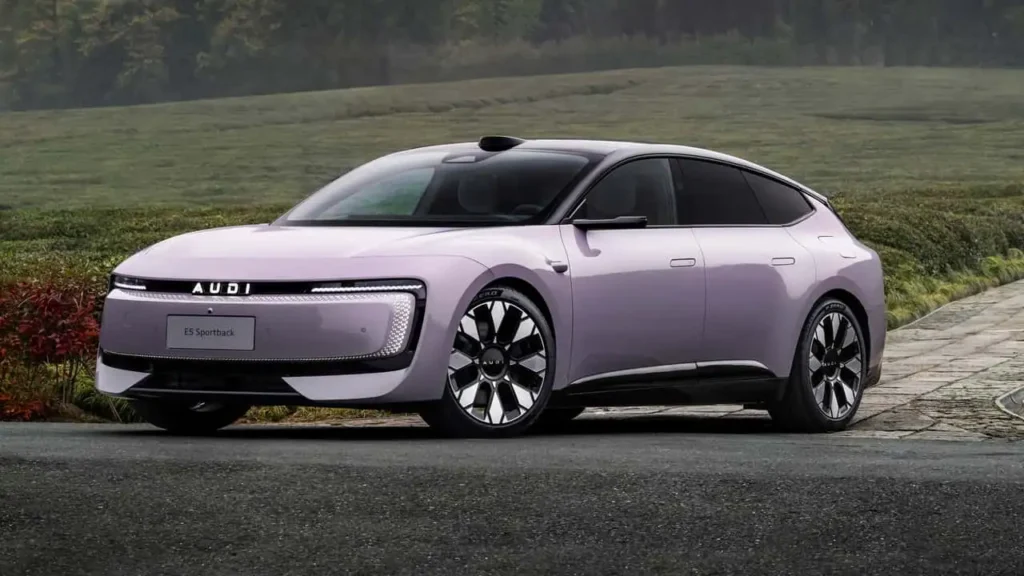
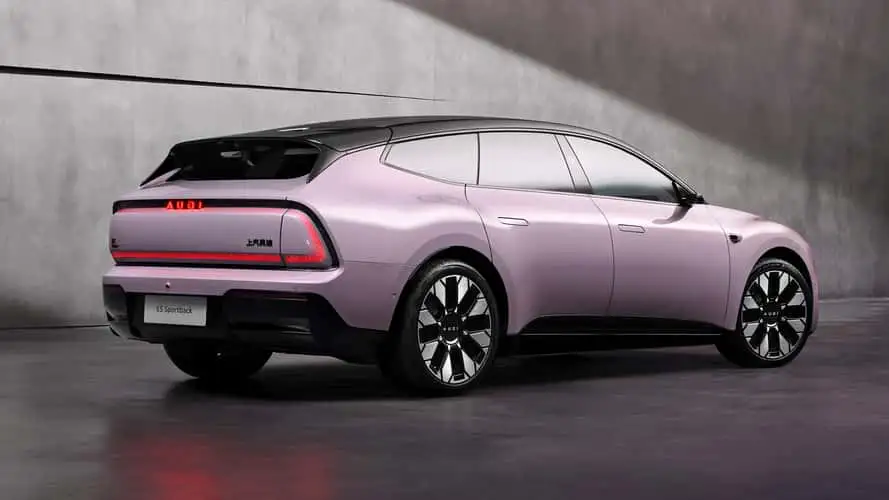
Pricing is especially aggressive. The entry model costs about $33,000, offering a rear-drive motor with 295 hp, a 76-kWh battery, and 384 miles of range on the forgiving CLTC cycle. The top Quattro version packs 776 hp, a 100-kWh pack, and does 0–62 mph in 3.4 seconds while still managing 402 miles of range, all for only $45,000. Despite its low cost, it comes loaded with premium tech like rear-wheel steering, adaptive air suspension, 800-volt fast charging, LiDAR, and a massive 27-inch 4K display across the dash.
Visually, the minimalist styling and screen-heavy interior set it apart from Audi’s global lineup. Without the blocky logo, it hardly resembles an Audi at all, though at least it avoids the SUV mold. Volkswagen’s gamble is clear: create a brand that reaches buyers Audi couldn’t capture before. Early demand is strong, but survival in China’s fierce EV market will be the true test.
China’s World-Beating Auto Industry Is in a Tailspin, While a Fierce EV Price War Rages
Reuters reported last week that China is sending its world-beating auto industry into a tailspin. China’s auto industry is facing a severe oversupply crisis fueled by years of subsidies and government policies that encouraged production over profitability. Automakers and dealers are drowning in excess inventory, sparking steep discounts, dubious sales tactics, and a growing gray market. In Chengdu, showrooms like Zcar offer new Audis at half price and bulk-purchased SUVs at deep cuts, often selling at a loss. Many dealers, desperate to meet sales targets and qualify for factory rebates, register unsold cars as “sold,” then dump them as zero-mileage “used” vehicles through livestream fire sales or export them abroad. Some brand-new cars end up abandoned in overgrown lots or auctioned off by courts.
The roots of the glut trace back to Beijing’s long-term drive to dominate electric vehicles. Local governments competed to lure automakers with cheap land and subsidies, prioritizing tax revenue and jobs over sustainable demand. By 2023, China’s auto factories had the capacity to produce nearly double the cars actually sold. With demand for gasoline vehicles shrinking and EV makers multiplying, price wars have intensified for three years running. Only a handful of China’s 129 EV and hybrid brands are expected to survive into the next decade, analysts say.
This turmoil threatens not only domestic automakers, most of which are unprofitable, but also foreign brands, whose share of China’s market has fallen sharply. The oversupply has larger implications too: the auto industry supports about one-tenth of China’s GDP. While some officials are now warning about unsustainable competition, local governments continue pushing output, unwilling to risk job losses or slower growth. The result is a vicious cycle of overproduction, collapsing margins, and “involution,” a race to keep pedaling just to stay upright. Unless Beijing allows weaker firms to fail, consolidation could take years, leaving the industry locked in an unstable, loss-making spiral.
China’s Price War Won’t Matter in the Long Term, Because It’s Already Light-Years Ahead
In China’s fierce electric-vehicle price war, cars are being sold at razor-thin margins, often with heavy subsidies, steep discounts, and lots of government intervention. It’s making headlines in the U.S. and Europe as potential threat: “Will cheap Chinese EVs flood our markets?” But the truth is, even if the price war shakes things up in the short term, China already is so far out in the lead, and holds far more fundamental advantages that give it long-term staying power. The U.S. and Europe face a very challenging uphill battle if they want to close the gap.
Western Automakers Desperately Need Help From China
Despite China’s oversupply and price war problems, western automakers are far behind Chinese EV technology, production, and pricing. Collaborations such as Audi’s with SAIC would benefit more western EV makers.
At the 2025 Shanghai Auto Show, the balance of power in the auto industry was clear: Chinese automakers are now leading in electric vehicle technology, leaving many Western brands scrambling to catch up. Once dominant in China, companies like Audi, Volkswagen, GM, and Toyota are increasingly relying on their local joint-venture partners, such as SAIC, FAW, and BYD, for batteries, software, and manufacturing expertise.
China’s homegrown brands like BYD, XPeng, Nio, and Zeekr are thriving thanks to years of subsidies, control of the battery supply chain, and fierce competition that pushes constant innovation. Consumers in China now expect long range, advanced ADAS, AI-driven features, and rapid over-the-air updates, and local companies are delivering. Foreign brands, meanwhile, are struggling to shed their image as outdated in the EV era.
Audi’s new E5 Sportback, co-developed with SAIC, boasts nearly 480 miles of range and advanced digital architecture. Volkswagen showed new EV and EREV concepts with features unavailable in the West, while Buick and Toyota also leaned heavily on Chinese partners for their latest launches. McKinsey data shows that local brands have grown from 30% to 60% of China’s auto market in just five years, with technology, more than price, driving consumer choices.
While these innovations excite global observers, their export potential is limited. U.S. restrictions on Chinese hardware and tariffs on vehicles will likely keep such models out of American showrooms for now. Still, experts say China’s pace of EV innovation will eventually ripple outward, reshaping expectations worldwide. In the meantime, Chinese consumers stand to benefit most, enjoying a wide array of advanced, affordable options.
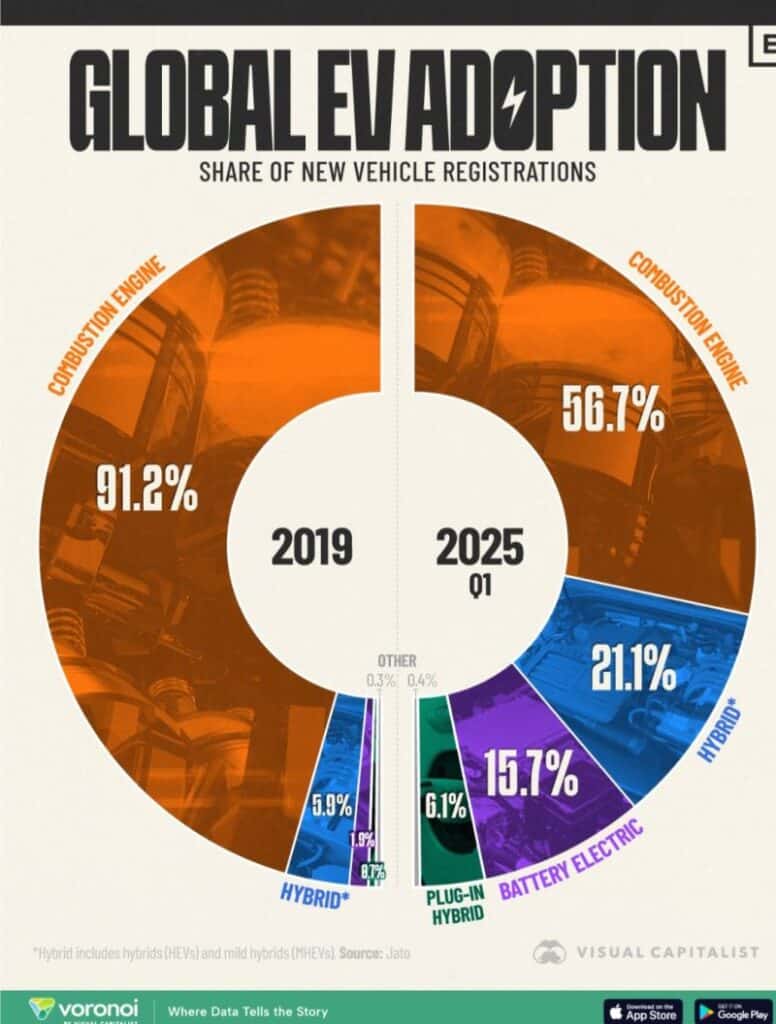
Electrified Vehicles Now Make Up 43% of Global Auto Sales as of Q1 2025
Visual Capitalist and JATO reported that electrified vehicles now make up 43% of global auto sales as of Q1 2025, up from just 9% in 2019. China accounts for more than half of global BEV sales, with Europe and the U.S. trailing far behind.
EVinfo.net’s Take: Why Improving Relations with China Is Key for the U.S. to Compete in the Global EV Market
The global race for electric vehicles isn’t just about who can build the most cars, it’s about who can build the best cars, the smartest software, and the most efficient batteries. Right now, China holds a commanding lead on all three fronts. For the U.S. to stay competitive, strengthening, not straining, its relationship with China could be one of the most important steps forward.
China’s EV industry has grown rapidly thanks to decades of heavy investment, strong government subsidies, and control of critical resources like the global battery supply chain. Companies like BYD, Nio, and XPeng are producing vehicles with cutting-edge features, from advanced driver assistance systems to over-the-air software updates and ultra-fast charging. U.S. automakers, on the other hand, are still playing catch-up, struggling with high production costs, software issues, and fragmented supply chains.
Instead of walling off the Chinese market or trying to isolate its technology, the U.S. could benefit by engaging more directly. That means partnerships, joint ventures, and technology exchanges that allow American automakers to learn from and compete with the best. Improved relations could also open up access to cheaper and more efficient batteries, a crucial factor in bringing down EV prices for American consumers.
Of course, there are real concerns about national security, intellectual property, and fair competition. But shutting the door entirely risks leaving U.S. automakers at a permanent disadvantage while Chinese companies continue to set the pace of innovation. The world’s largest auto market is also the fastest-moving one, and ignoring it could mean missing out on the chance to influence global standards for EV design and technology.
If the U.S. wants to lead in the EV era rather than just follow, it needs to rethink its approach. Cooperation with China won’t be simple, but without it, the gap will only widen. By balancing security with collaboration, the U.S. could accelerate its own EV industry, lower costs for consumers, and compete head-to-head on the global stage.
Why Reinstating the Federal EV Tax Credit and Expanding Federal EV Support Is a Smart Move
The U.S. is at a turning point in the race toward electric mobility. While automakers are investing billions in EV production, many consumers remain hesitant to make the switch. High upfront costs, limited charging infrastructure, and questions about range are still major barriers. Reinstating the federal EV tax credit, and going even further with more federal support for the EV industry would go a long way in closing that gap.
The original tax credit helped jumpstart early adoption, giving Americans an incentive to choose cleaner vehicles and signaling that the government was serious about supporting the transition. It is ending soon, at the end of September. But as caps were hit and the program wound down, momentum slowed. Reintroducing the credit would level the playing field, making EVs more affordable for middle-class families and keeping U.S. automakers competitive with countries like China and members of the EU, where subsidies remain strong.
Beyond affordability, stronger federal backing would accelerate infrastructure build-out. Expanding charging networks, supporting domestic battery production, and funding R&D into next-generation technology would not only benefit drivers but also create thousands of jobs. EVs are more than a climate solution, they represent a new manufacturing economy that could revitalize communities across the country.
Critics often call subsidies a temporary crutch. But in reality, strategic government support has always played a role in shaping transformative industries, from aviation to the internet. The global auto market is shifting at record speed, and without robust federal action, the U.S. risks falling further behind while competitors race ahead. Falling further behind risks losing many jobs, and sending our economy into deep decline.
Reinstating the EV tax credit isn’t just about helping individuals afford a new electric car, it’s about ensuring America stays a leader in the all-electric automotive future. With smart EV-friendly policy, the U.S. can drive innovation, reduce emissions, and empower consumers to make choices that benefit both their wallets and the planet.
EVinfo.net does not see America willingly remaining in last place in the global EV market as a viable option. We recommend reinstating the EV tax credit and increasing federal EV support today. If we don’t, it’s very clear China and Europe will only keep winning the EV race, leaving the USA in the dust.

Electric Vehicle Marketing Consultant, Writer and Editor. Publisher EVinfo.net.
Services