NYC and LA Team Up for EVs, Announcing the Nation’s First Bi-Coastal Fleet Accord
On May 21, 2026, during the 37th Annual Equipment & Vehicle Show, the New York City Department of Citywide Administrative Services and the Los Angeles County Internal Services Department announced the creation of the nation’s first Bi-Coastal Fleet Accord (BCFA). The agreement unites the largest city and the largest county in the United States, along with their massive municipal fleets and charging networks, into a coordinated advocacy coalition focused on accelerating transportation electrification.
Through the accord, New York City and Los Angeles County aim to strengthen investment, purchasing power, and innovation surrounding alternative-fuel vehicles while advancing the transition toward zero-emission municipal operations. Combined, the two governments manage more than 47,000 fleet vehicles.
New York City currently operates more than 5,800 electric vehicles, while Los Angeles County is pursuing a Zero Emissions Vehicle Mobility Plan that calls for replacing approximately 6,300 vehicles with zero-emission models.
As part of the partnership, DCAS and Los Angeles County fleet leaders will collaborate through quarterly meetings, shared operational data, and coordinated infrastructure planning. The agencies will exchange information on charger reliability, identify funding gaps, and work together on technical specifications for vehicles and charging equipment so manufacturers can develop products that better meet municipal fleet requirements.
In the photo below, DCAS Deputy Commissioner of Fleet Management and Chief Fleet Officer Keith Kerman, DCAS Commissioner Yume Kitasei, and Los Angeles County ISD Chief Deputy Director Quintin Haynes announce the Bi-Coastal Fleet Accord.
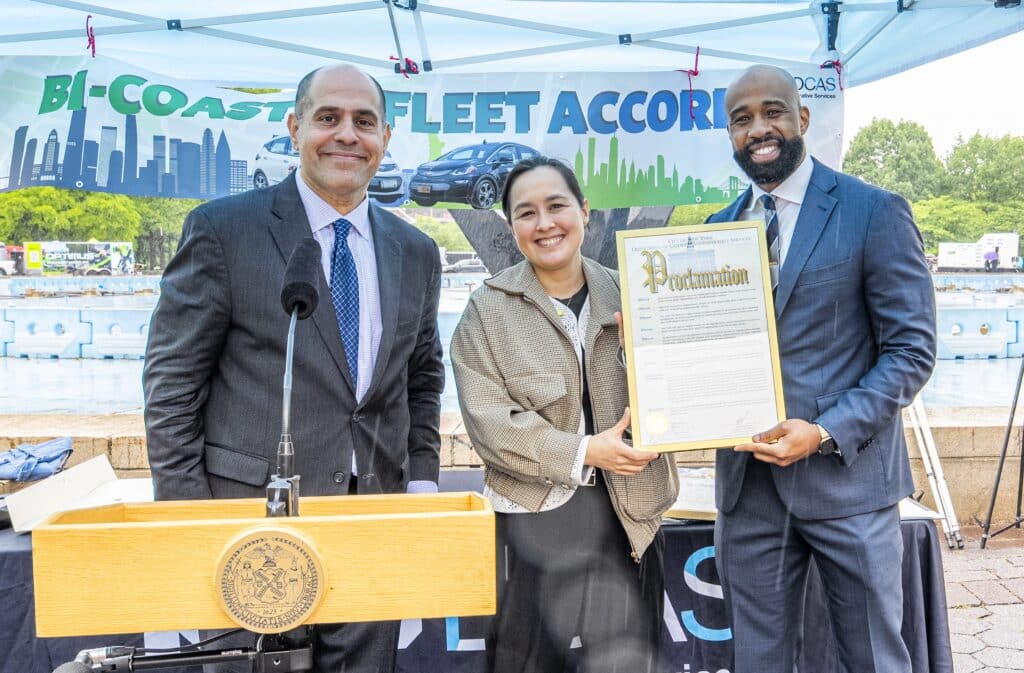
“The City of New York and Los Angeles County operate two of the largest municipal fleets in the country, and through the Bi-Coastal Fleet Accord we are unlocking transformative potential,” said DCAS Commissioner Yume Kitasei. “By aligning with Los Angeles County, DCAS is accelerating fleet electrification and helping to shape a more efficient and sustainable future for cities nationwide.”
The initiative will also include collaboration with the United States Department of Transportation Volpe Center on a joint Clean Fleet Transition Report designed to help cities across the country advance sustainable fleet operations.
The announcement builds on New York City’s expanding leadership in municipal fleet electrification. Last month, DCAS revealed that the city now operates more than 1,000 electric vehicles assigned to law enforcement agencies. The city also announced plans for the New York City Department of Sanitation, NYC Parks, and DCAS enforcement fleets to become fully electric by 2030, five years ahead of the timeline established under Local Law 140.
Today, New York City manages nearly 10,500 electrified fleet units, including 5,825 battery-electric vehicles and 4,683 hybrids. More than 2,500 charging ports support the fleet, creating the largest municipal charging network in New York State. In addition, 11,695 city fleet units operate on 100 percent renewable diesel, including law enforcement response trucks.
“The Bi-Coastal Fleet Accord is a landmark partnership that ensures Los Angeles County and New York City are no longer navigating the transition to clean energy in isolation. By establishing this ‘Bicoastal Bridge,’ we are combining our institutional knowledge to move the market and create a path for municipal fleet transformation. For ISD, this is about more than just vehicles; it is about working together to build a resilient, sustainable future that serves our departments and our communities alike,” said Quintin Haynes, chief deputy director of the County of Los Angeles Internal Services Department.
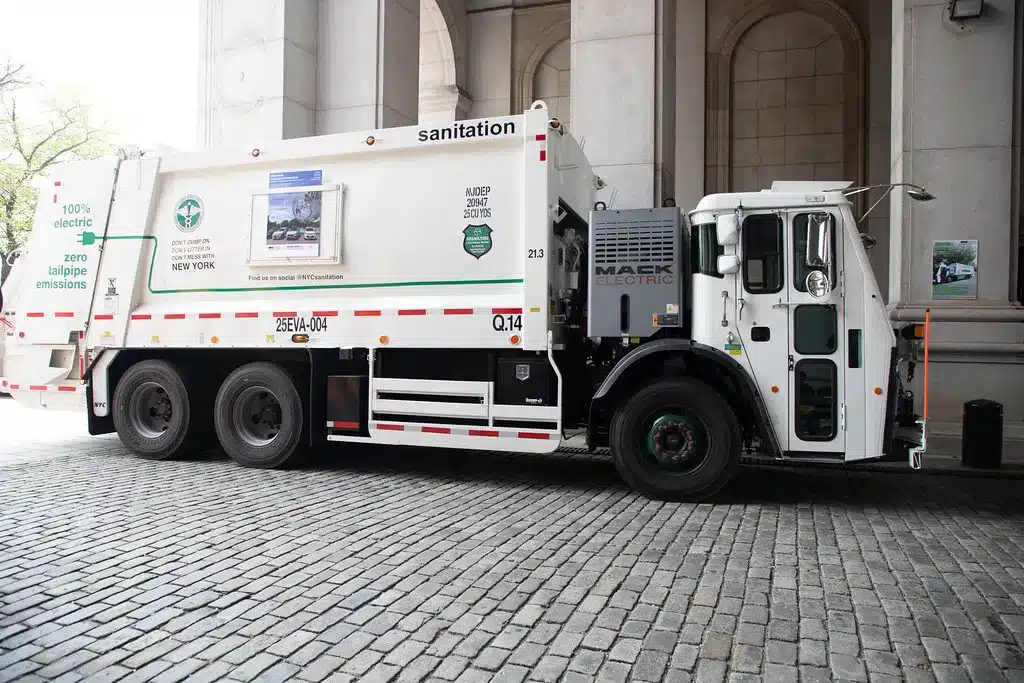
Los Angeles County’s Internal Services Department oversees one of the nation’s largest municipal fleets, with more than 15,000 vehicles supporting essential services for over 10 million residents. The department currently operates nearly 2,000 charging ports, making it the second-largest municipal charging network in the United States.
County officials say the infrastructure strategy emphasizes modular and resilient charging systems alongside innovative funding models designed to strengthen grid reliability and support long-term climate goals. The county also views its charging infrastructure as a potential national model capable of supporting both government operations and broader community access.
The Internal Services Department also administers several major public programs, including the Southern California Regional Energy Network (SoCalREN), Electrifyze, which promotes EV adoption, and the county’s EBD Program. In addition, the department has been designated by the Los Angeles County Board of Supervisors as the lead agency for broadband expansion and digital equity initiatives.
EVinfo.net’s Take: Many More of These Partnerships Are Needed
Since January 20, 2025, a concerning and foolish pattern has emerged in federal transportation and environmental policy. Instead of accelerating the transition away from fossil fuels, the U.S. administration is loosening incentives and standards that protect public health and the climate, reducing demand for EVs. These decisions are not minor regulatory adjustments. They will increase harmful smog, worsen air pollution, undermine climate progress, and cost drivers more money over time.
Wasting billions of dollars on a golden ballroom and golden archway seem more important to the administration than creating jobs, protecting the peoples’ health, fighting global human caused climate change, reducing pollution and reducing driver’s costs, through EV adoption and EV production.
As federal support for electric vehicles and clean transportation becomes increasingly inconsistent, partnerships like the new Bi-Coastal Fleet Accord between New York City and Los Angeles County may become one of the most important forces shaping America’s economic and industrial future.
The agreement is more than a fleet management collaboration. It represents a growing realization among city and state leaders that waiting for Washington to lead on electrification, infrastructure, and industrial policy is no longer a viable strategy. Instead, local governments are stepping in to create their own alliances, pool purchasing power, and accelerate innovation independently.
More partnerships like this are urgently needed.
The United States is currently losing valuable time in the global race for clean transportation leadership. While political battles continue in Washington over EV incentives and climate policies, countries like China are aggressively scaling electric vehicle production, battery manufacturing, charging infrastructure, and supply chain dominance. Meanwhile, European Union nations continue investing heavily in clean mobility and industrial decarbonization.
America cannot afford fragmentation. The Bi-Coastal Fleet Accord offers a practical blueprint for how regional governments can help close that gap. That matters economically.
Large-scale municipal electrification creates jobs across multiple sectors, including vehicle manufacturing, battery production, charging infrastructure deployment, software, grid modernization, maintenance, and construction. It also gives American companies clearer market signals during a period when many automakers are uncertain about future federal policy.
Fleet partnerships can also accelerate innovation faster than isolated city programs. When municipalities collaborate on charger reliability, vehicle specifications, and infrastructure planning, they reduce duplication and help manufacturers build scalable solutions that work nationwide.
Perhaps most importantly, these regional alliances can help rebuild American industrial competitiveness.
China currently dominates global battery manufacturing and EV supply chains because it treated electrification as a national economic strategy years ago. Europe followed with aggressive industrial policy and coordinated investment. The United States risks falling behind if every state, county, and city pursues disconnected approaches while federal leadership remains inconsistent.
Smart city and state partnerships can partially fill that vacuum.
Municipal governments control enormous vehicle fleets, infrastructure budgets, utility relationships, and public transit systems. If more regions begin coordinating like New York City and Los Angeles County, they can collectively influence market direction in ways that rival federal initiatives.
The transition to electrification is no longer just about climate goals. It is about economic competitiveness, manufacturing leadership, energy security, workforce development, and technological influence in the next global industrial era.
The Bi-Coastal Fleet Accord should not remain an isolated experiment. It should become the beginning of a much larger national movement led by cities, counties, and states willing to push forward even when Washington hesitates.

Electric Vehicle Marketing Consultant, Writer and Editor. Publisher EVinfo.net.
Services