Jaguar’s Internal Combustion Engine Era Ends
Production at Jaguar’s Solihull plant briefly paused on December 19, 2025, as the final F-PACE rolled off the assembly line. Its departure marked more than the end of a decade-long model run. It closed the chapter on internal combustion engines at Jaguar, bringing an entire era of the brand’s history to an end. While the F-PACE bows out, its platform sibling, the Range Rover Velar, will continue in production.
When it debuted ten years earlier, the F-PACE was a bold departure from tradition as Jaguar’s first SUV. The move challenged long-held perceptions of the marque, yet the gamble paid off. The F-PACE went on to become Jaguar’s best-selling model ever, expanding the brand’s reach while retaining its design DNA and performance ethos.
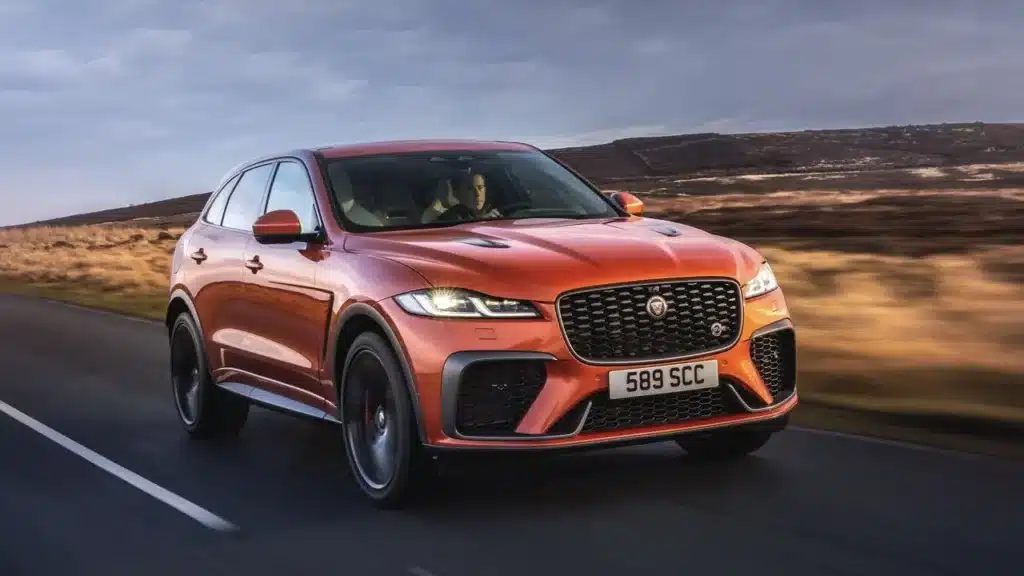
The significance of the moment extended well beyond commercial success. Employees from across the Solihull workforce gathered to witness the final build, including many who had been involved since the program’s earliest days. Engineers, assembly workers, and managers reflected on a decade of shared effort, technical excellence, and craftsmanship.
The final vehicle, a black F-PACE SVR, was chosen deliberately as a historical marker, echoing the black E-Type that once signaled the end of another Jaguar era. Rather than being sold, the car was entrusted to the Jaguar Daimler Heritage Trust and added to the national collection at Gaydon, where it now joins other milestone vehicles from the company’s 90-year legacy. Remarks from leadership focused on the workforce, with Solihull Plant Operations Manager Trevor Leeks emphasizing the precision and consistency required to assemble a vehicle comprising tens of thousands of components.
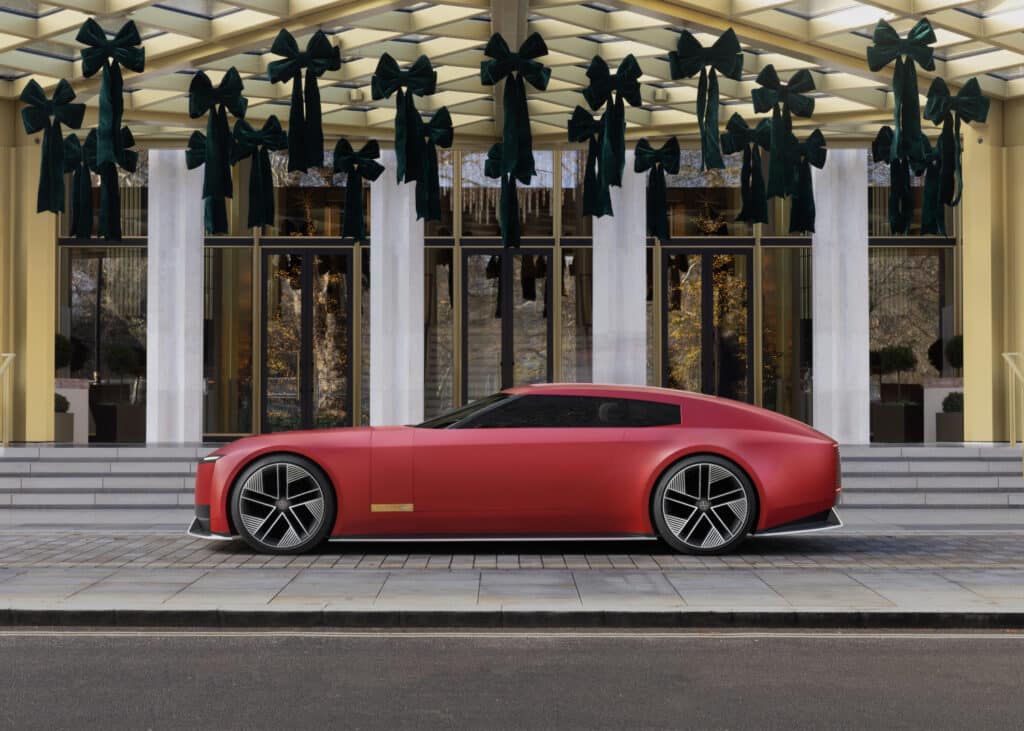
Despite the sense of nostalgia, the tone at Solihull was resolutely forward-looking. The conclusion of the F-PACE program underscores Jaguar’s confidence as it transitions to an all-electric future. The brand’s next chapter will begin with an ultra-luxury electric sedan, currently known as 00, following a widely debated branding campaign that accompanied the concept’s unveiling last year.
EVinfo.net’s Take: Hybrids and BEVs Accelerate as Automakers Prepare for a Post-ICE Era
The global automotive industry is approaching a structural turning point. Hybrid and battery-electric vehicles are no longer niche alternatives but are rapidly becoming the core of future product strategies. Jaguar’s decision to end internal combustion engine production underscores a broader shift that is gaining momentum across the industry, and it is increasingly likely that more automakers will follow.
Hybrid vehicles have played a critical transitional role, offering immediate emissions reductions without requiring a fully built-out charging ecosystem. For many manufacturers, hybrids have delivered regulatory compliance, improved fleet averages, and a bridge for consumers not yet ready to commit to fully electric vehicles. This has driven sustained growth across mild hybrid, full hybrid, and plug-in hybrid segments, particularly in markets where charging infrastructure remains uneven.
At the same time, battery-electric vehicles are scaling faster than expected. Advances in battery energy density, falling cell costs, improved thermal management, and the expansion of fast-charging networks are steadily eroding the traditional barriers to BEV adoption. Automakers are now able to design dedicated EV platforms that outperform ICE vehicles on efficiency, software integration, and long-term operating costs. As a result, BEVs are increasingly positioned not as compliance products, but as brand-defining flagships.
Jaguar’s exit from ICE production highlights a strategic reality confronting legacy manufacturers. Maintaining parallel powertrain portfolios is capital intensive, operationally complex, and increasingly difficult to justify as emissions regulations tighten and consumer expectations evolve. For premium brands in particular, electrification offers a clearer path to differentiation through performance, refinement, and digital experience rather than engine displacement or exhaust tuning.
While not every automaker will move as quickly or as decisively as Jaguar, the direction of travel is clear. Over the next decade, more brands are expected to announce timelines to wind down ICE development, relying on hybrids in the near term and transitioning fully to BEVs as infrastructure and supply chains mature.
The industry’s center of gravity is shifting. Hybrids are extending the runway, BEVs are defining the destination, and the internal combustion engine is moving steadily toward the margins. Jaguar may be early, but it is unlikely to be alone for long. The global automotive market is experiencing its most rapid transformation in more than a century.
The Decline of Combustion Engines
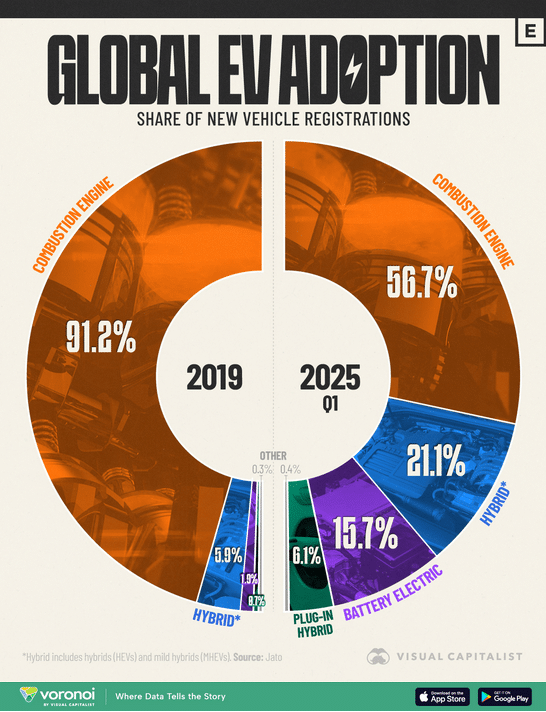
Based on data from JATO, the visualization below underscores the speed at which consumers worldwide are adopting electrified vehicles. In Q1 2025, electrified models, including battery electric vehicles, plug-in hybrids, and conventional hybrids, accounted for 43% of total global auto sales, up from just 9% in 2019.
In 2019, internal combustion vehicles made up more than 90% of new vehicle sales globally. By 2025, that share had fallen to approximately 57%. The contraction reflects a convergence of factors, including increasingly stringent emissions regulations, automaker commitments to reduce or eliminate gasoline-powered models, and rising consumer demand for cleaner, more efficient alternatives.

Electric Vehicle Marketing Consultant, Writer and Editor. Publisher EVinfo.net.
Services