Vertical Aerospace Debuts Final Prototype for All-Electric Testing Before Hybrid-Electric Flights
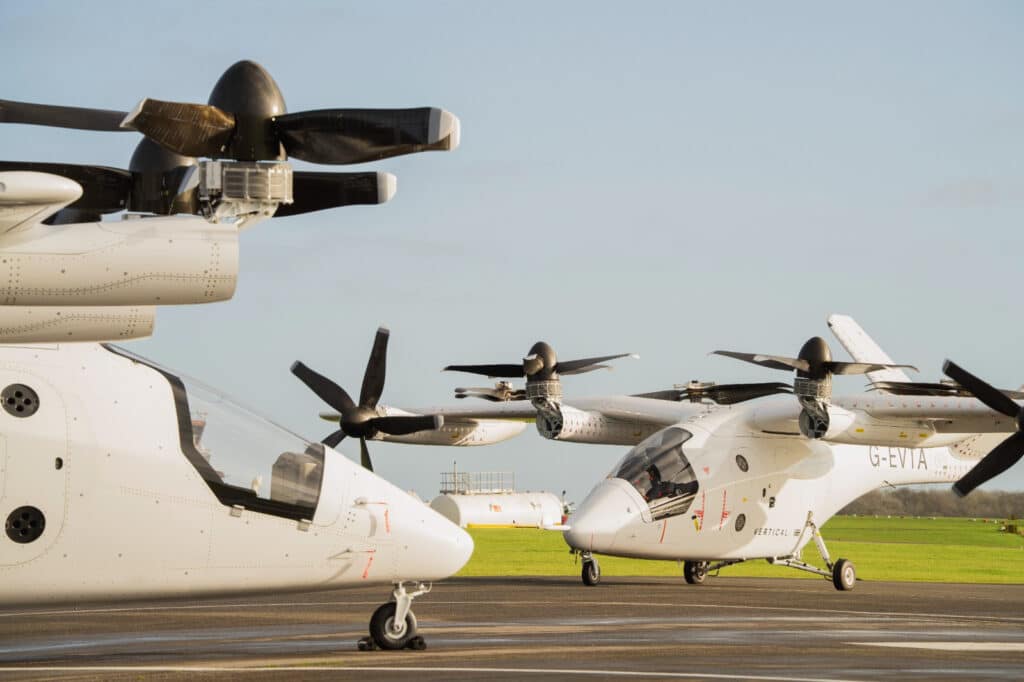
Vertical Aerospace, a global aerospace and technology company focused on advancing electric aviation, announced that it has completed its third and final full-scale prototype aircraft. The aircraft will enter commissioning in January 2026, followed by the start of piloted flight testing. The news was announced on BusinessWire on December 22, 2025.
The new prototype is an identical replica of Vertical’s current full-scale aircraft, which is actively conducting transition flight testing at the company’s UK Flight Test Centre. The most recent flight took place on December 19, with additional test flights scheduled in the coming days. As the final aircraft in Vertical’s flight test program, the prototype will double available flight test capacity and enable public demonstration flights planned for 2026. It incorporates advanced systems and technologies supplied by key partners, including Honeywell, Molicel, and Syensqo.
Stuart Simpson, CEO, Vertical Aerospace, said: “As we look ahead to 2026, the addition of our final prototype marks an important step in closing out our prototype flight test programme and maintaining momentum towards commercialization. Our test pilots are eager to get this aircraft into the air.”
After completing initial testing in an all-electric configuration, the aircraft will be retrofitted for hybrid-electric testing later in 2026. The update follows Vertical’s recent introduction of Valo, its next-generation certification aircraft designed for entry into commercial service after certification in 2028. As part of its certification strategy, Vertical plans to build seven Valo certification aircraft in the UK to support final testing and approval with the UK Civil Aviation Authority and the European Union Aviation Safety Agency.
Vertical also plans to launch a U.S. demonstration tour with Valo in 2026, beginning in New York City in January, to showcase the aircraft to customers, partners, and industry stakeholders.
Vertical Aerospace is developing piloted, four-passenger electric vertical takeoff and landing aircraft designed to deliver quieter, cleaner, and safer air travel. In addition to its all-electric configuration, the company is advancing a hybrid-electric variant to extend range and operational flexibility. Supported by partnerships with leading aerospace suppliers and its own proprietary battery and propulsion technologies, Vertical has accumulated approximately 1,500 pre-orders for Valo from customers across four continents. Headquartered in Bristol, UK, the company’s leadership team brings extensive experience from major aerospace and automotive manufacturers.
Electric Vertical Take-Off Charging Is Scaling Rapidly to Support Advanced Air Mobility
As electric vertical take-off and landing aircraft move closer to commercial service, charging infrastructure is emerging as one of the fastest-growing segments of the advanced air mobility ecosystem. What was once a conceptual challenge is now becoming a concrete deployment priority as manufacturers, airport operators, energy providers, and cities prepare for the first wave of certified eVTOL operations later this decade.
Unlike conventional aviation fueling, eVTOL charging must support frequent, high-power, short-duration energy transfers to keep aircraft cycling quickly between missions. Early operational models point to ultra-high-power DC charging systems capable of delivering multi-megawatt loads in compact footprints at vertiports. These systems are designed to minimize turnaround times while maintaining battery health and operational reliability, particularly for urban air taxi and regional shuttle use cases.
Charging growth is being driven by parallel progress in aircraft design and certification. As manufacturers finalize battery capacities, voltage architectures, and thermal requirements, infrastructure providers are moving from pilots to standardized solutions. Several programs are already validating modular charging units, energy storage buffers, and smart power management systems that can be deployed at rooftop vertiports, airports, and dedicated urban hubs without requiring massive grid upgrades.
Airports and municipalities are also accelerating planning efforts. Major international airports are evaluating eVTOL charging as part of broader electrification strategies that include electric ground support equipment and electric regional aircraft. In dense urban environments, distributed energy resources such as on-site battery storage and solar generation are increasingly paired with eVTOL chargers to manage peak demand and improve resilience.
EVinfo.net reported in December 2025 that Charleston West Virginia International Yeager Airport (CRW) is moving early to establish itself as a leader in electric aviation. The CRW Authority Board approved an agreement with BETA Technologies to install electric aircraft charging infrastructure for eVTOL operations, along with an EV charging station, at Marshall University’s Bill Noe Flight School.