‘World-First’ One-Piece Aluminium Frame for EVs Announced by Two Chinese Companies
Hantek, a Chinese specialist in lightweight aluminum chassis systems, has engineered a new frame that pushes the boundaries of large-scale aluminum casting. The company, known for producing major structural components for automakers, designed this latest frame to overcome long-standing limitations in manufacturing ultra-large, thin-walled parts.
The structure spans roughly 45 square feet, with wall thicknesses ranging from 0.16 inches to 1.97 inches, a ratio exceeding 12:1. Achieving such a wide and precisely controlled variation in a single casting has traditionally been extremely difficult. Hantek says it is unaware of any previous project worldwide that has successfully produced a frame with this level of dimensional range and accuracy.
Most all-aluminum vehicle frames are assembled from dozens of smaller components that must be welded, riveted, or mechanically joined. These steps add cost, complexity, and time, and each joint becomes a potential weak point that can compromise stiffness, durability, and overall crash performance.
After extensive development, Hantek solved several technical barriers associated with low-pressure casting of ultra-large and thin-walled pieces. The main challenges involved controlling the flow of molten aluminum during filling and ensuring uniform solidification across sections with vastly different thicknesses. These breakthroughs allowed the company to produce a single, integrated frame that replaces what would otherwise be many assembled parts.
The result is a structure with significantly higher rigidity and torsional stiffness, along with improved crash performance due to better force distribution. Hantek also credits its proprietary aluminum alloy and precise heat-treatment process for delivering a strong balance of strength, toughness, and long-term fatigue resistance.
Hantek’s low-pressure casting method represents a major advance for manufacturing large, complex aluminum components in China. The company believes this integrated approach could reshape how large vehicle frames are designed, offering a more efficient alternative to multi-piece construction.
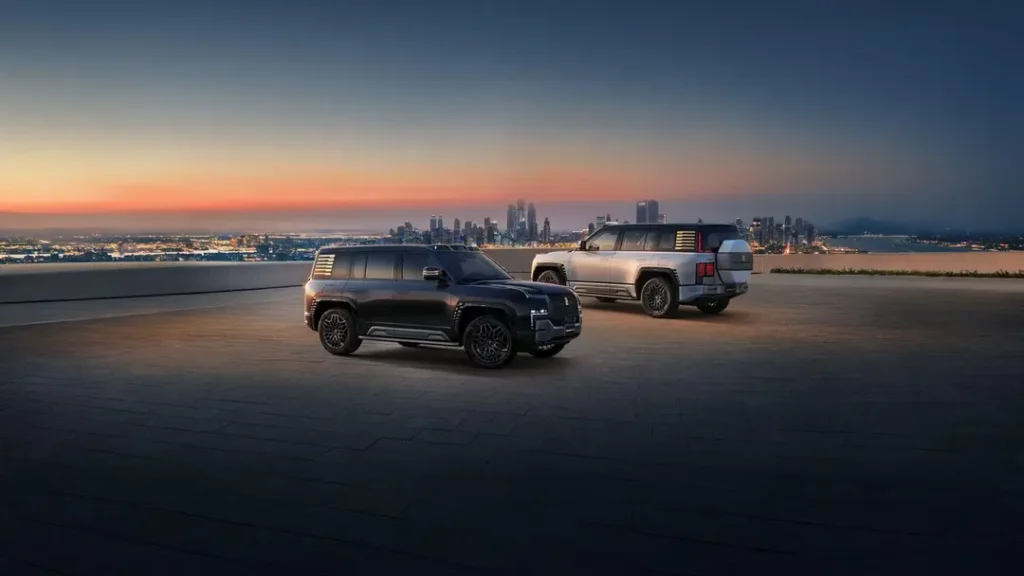
A real-world example is the BYD Yangwang U8L, launched in September 2025. This full-size luxury SUV, built on BYD’s e4 (Yisifang) platform, combines a 2.0-liter turbo engine with four electric motors and a 15.4 kWh Blade battery to deliver 1,180 horsepower and 1,120 lb-ft of torque. It provides 124 miles of electric-only range and 721 miles of total range. Its advanced single-piece aluminum frame cuts weight and boosts rigidity, enabling the SUV to manage its immense power while maintaining stability and long-distance comfort.
EVinfo.net’s Take: China Is Pulling Ahead in Automotive Innovation, and the U.S. Won’t Catch Up Without a Major Policy Reversal
Innovation is dying in the USA.
China’s rise as the global center of automotive innovation is no longer a forecast. It is reality. From electric vehicle technology to battery manufacturing, lightweight materials, software-defined vehicles, and next-generation production methods, China is widening its lead while the United States has fallen further behind every month since January 2025. Electrified vehicles now make up 43% of global auto sales as of Q1 2025, up from just 9% in 2019.
Without a dramatic reversal of anti-EV policies and regulatory rollbacks, America’s ability to compete in the future auto market will continue to erode.
For more than a decade, China has treated advanced automotive manufacturing as a national priority. Massive investments in EV production, battery supply chains, research institutes, and charging infrastructure have created an ecosystem that moves with speed and scale. Companies like BYD, CATL, Xiaomi Auto, Li Auto, and NIO are thriving. One example of how fast China’s EVs are capturing the global market is the recent news that a Ford dealer, Evans Halshaw Ford Bury in the UK, will be transitioning to a BYD dealership.
China’s OEMs aren’t just thriving. They are shaping global benchmarks for performance, cost efficiency, and technological integration. Breakthroughs are becoming routine.
Meanwhile, U.S. momentum has slowed. Political opposition to EV adoption, weakened emissions standards, delayed charging funding, and uncertainty around incentives have pushed automakers into defensive strategies. The push to weaken the nation’s Corporate Average Fuel Economy (CAFE) standards threatens to worsen some of the most persistent problems facing the United States: our dependence on oil, the high cost of gasoline, falling further behind on the global EV race, and the accelerating impacts of global warming.
Instead of accelerating innovation, many manufacturers are delaying EV launches, reducing investment, or returning focus to hybrids and legacy platforms. Policy instability further discourages long-term planning, especially in capital-intensive areas like battery plants and domestic rare-earth processing.
China faces challenges such as overcapacity, intense price competition, and global trade barriers, but the country’s unified industrial strategy continues to deliver results. Ultra-large aluminum castings, low-pressure frame manufacturing, high-volume solid-state battery lines, and sophisticated software ecosystems have already made Chinese vehicles cheaper to build and more advanced to drive. Even luxury and performance segments, once dominated by Western brands, are now seeing serious competition from Chinese automakers offering cutting-edge tech at radically lower prices.
If the U.S. hopes to compete, it will require more than isolated private investments or short-term subsidies. It will take a national, long-term commitment to electrification, innovation-friendly regulations, and policies that support domestic manufacturing rather than undermine it. Without that shift, China will continue to set the pace for the global auto industry, and American companies will increasingly find themselves following rather than leading.
If the government’s anti-EV and anti-renewable energy policies are not reversed, this will be a disaster for America’s economy and jobs, as the automotive and energy sectors are very large and important pieces of our economy.

Electric Vehicle Marketing Consultant, Writer and Editor. Publisher EVinfo.net.
Services