First Chinese 10,000-Tonne Container Ship With Electric Propulsion Begins Testing
In Jules Verne’s classic story Twenty Thousand Leagues Under the Sea, Captain Nemo commands the battery-powered submarine Nautilus, a vision of electric propulsion that long remained confined to science fiction. That narrative is beginning to shift.
The Ning Yuan Dian Kun, constructed by Jiangxi Jiangxin Shipbuilding, is China’s first 10,000-tonne electric-propulsion container vessel to enter sea trials. At 127.8 metres in length and 21.6 metres in beam, it is currently the largest all-electric container ship in operation.
The vessel is undergoing extended trials off Shanghai. Propulsion energy is supplied via containerized battery units supported by an onboard photovoltaic system that supplements auxiliary loads, although the builder has not disclosed the solar array’s output.
Up to ten battery containers provide a combined capacity of 19,000 kWh. These feed twin 875 kW permanent magnet motors driving the propulsion system. Charging can occur through high-capacity shore power connections or by swapping entire battery containers, effectively implementing a large-scale maritime battery exchange model.
According to the manufacturer, the ship integrates autonomous navigation capabilities for open-water operation, including real-time situational monitoring, all-weather perception systems, automated route planning, unmanned operational functions, and autonomous collision avoidance.
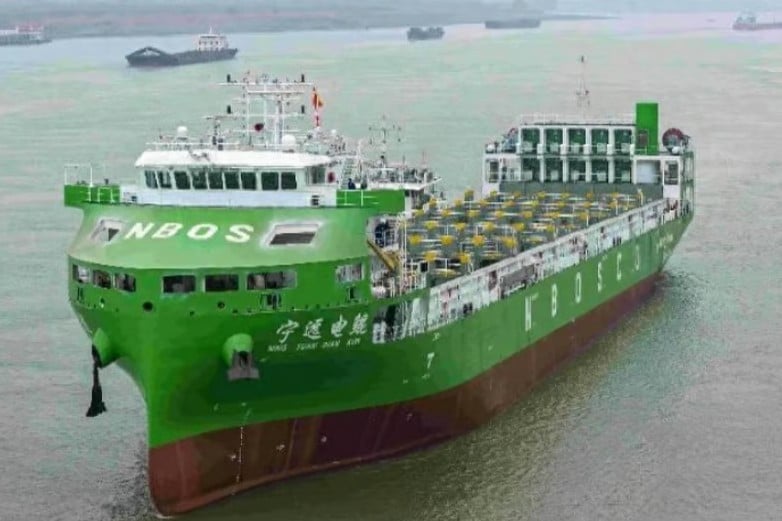
Upon delivery, the Ning Yuan Dian Kun will be operated by Ningbo Ocean Shipping Co., Ltd. on feeder routes connected to the Ningbo-Zhoushan Port. A sister vessel, Ning Yuan Dian Peng, is planned to follow.
The ship was launched for preliminary testing in September and completed mooring trials in January before receiving clearance for sea trials. With a capacity of 740 TEUs, it is modest compared with ultra-large container vessels such as MSC Irina, which carries 24,346 TEUs. However, scale comparisons can obscure operational relevance.
Mega-container ships dominate intercontinental trade lanes linking hubs such as Shanghai, Rotterdam, Long Beach, and Singapore. Yet their size precludes access to many smaller ports. Feeder vessels distribute containers from major hubs to regional destinations, forming a critical secondary logistics layer.
More than half of the global container fleet falls below 3,000 TEUs, the conventional upper threshold for feeder classification. The United Nations Conference on Trade and Development reported an average vessel size of 3,618 TEUs for ships calling at ports in 2023. Like narrow-body aircraft operating short-haul routes, feeder ships function as high-frequency backbone assets within the maritime transport network.
They are also material contributors to maritime emissions. Freight analytics firm Xeneta estimates that roughly half of annual container shipping emissions originate from vessels under 8,000 TEUs, with about one fifth from ships below 3,000 TEUs. Electrification at this scale therefore targets a segment with disproportionate environmental impact.
The Ning Yuan Dian Kun represents China’s second significant container ship electrification initiative. In 2025, China Ocean Shipping Group launched the Greenwater 01 on the Yangtze River. The 120-metre vessel carries a 50,000 kWh battery system expandable to 80,000 kWh, underscoring China’s strategic push into high-capacity maritime battery deployment.