AEON Humanoid Robots Begin Work on Car Production at BMW Group Plant Leipzig in Germany
BMW Group Plant Leipzig now has a new colleague. It’s human-like in form, built from metal and electronics, and travels on wheels rather than feet. Its name is AEON, and it marks the first deployment of a humanoid robot in BMW Group’s German manufacturing operations. BMW announced the news on September 3, 2026.
AEON is a product of Hexagon Robotics, the physical AI division of Hexagon, a longstanding BMW Group partner in sensor technologies and software. Standing 1.65 metres tall and weighing 60 kilograms, the robot moves through the production hall at speeds of up to 2.5 metres per second. Its torso can be fitted with a range of grippers, hands, or scanning devices, allowing it to perform varied tasks without changing its core structure. AEON made its operational debut at Leipzig in December 2025, initially supporting high-voltage battery assembly and component production. Additional testing is scheduled for April, with full pilot integration planned for the summer.
“Our aim is to be a technology leader and integrate new technologies into production early. Pilot projects help us test and evolve the use of adaptive AI-enabled robots – also known as ‘physical AI’ – in a real-world industrial setting,” says Michael Nikolaides, Senior Vice President Production Network, Supply Chain at the BMW Group.
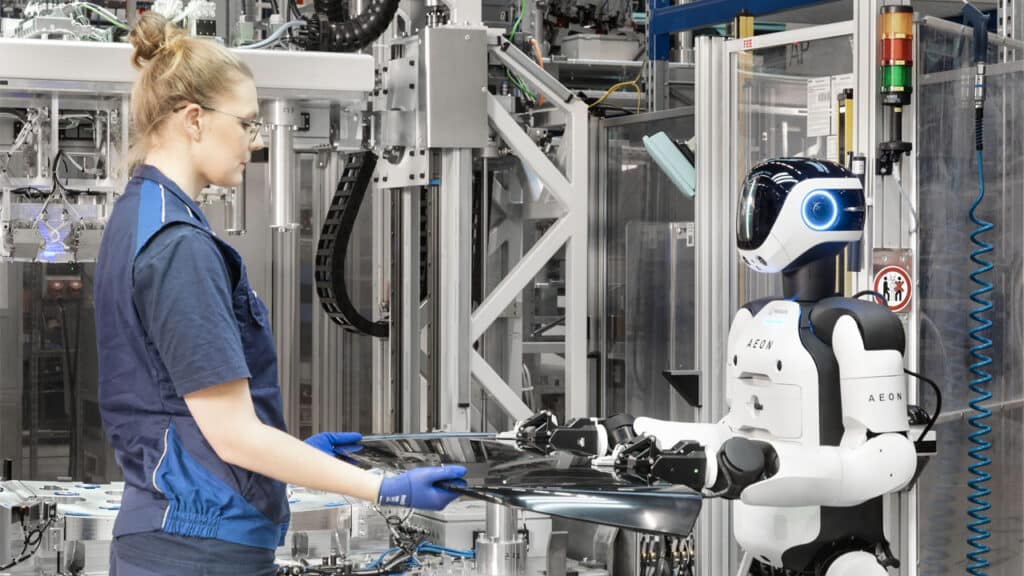
The Leipzig team is not assigning AEON a fixed role. Instead, it is being introduced into the existing production system gradually, from battery production for energy modules to component manufacturing for exterior parts. Teams are testing how workstations can be adapted, exploring which tasks are best suited to humanoid assistance, and actively involving employees in determining how the technology gets used. Rather than having the technology imposed on them, workers are shaping its integration from the start.
That approach reflects a broader principle at the heart of BMW Group’s physical AI strategy. As humanoid robots take on repetitive, physically demanding, or ergonomically difficult tasks, employees are free to direct their attention toward what the company sees as distinctly human work: understanding processes, steering workflows, checking quality, and integrating new technologies into daily operations.
The infrastructure making this possible has been years in the making. BMW Group has systematically converted its production system to a uniform IT and data model, consolidating what were once separate data silos into a shared platform where information is consistent, standardized, and accessible at any time. That architecture allows AI agents to operate across complex environments autonomously, connecting digital decision-making to physical action on the shop floor. The company calls the result physical AI.
To advance it, BMW Group has established a Centre of Competence for Physical AI in Production, where specialists in AI and robotics evaluate technology partners, develop pilot projects from concept through deployment, and build a growing library of modular physical AI solutions available to plants worldwide.
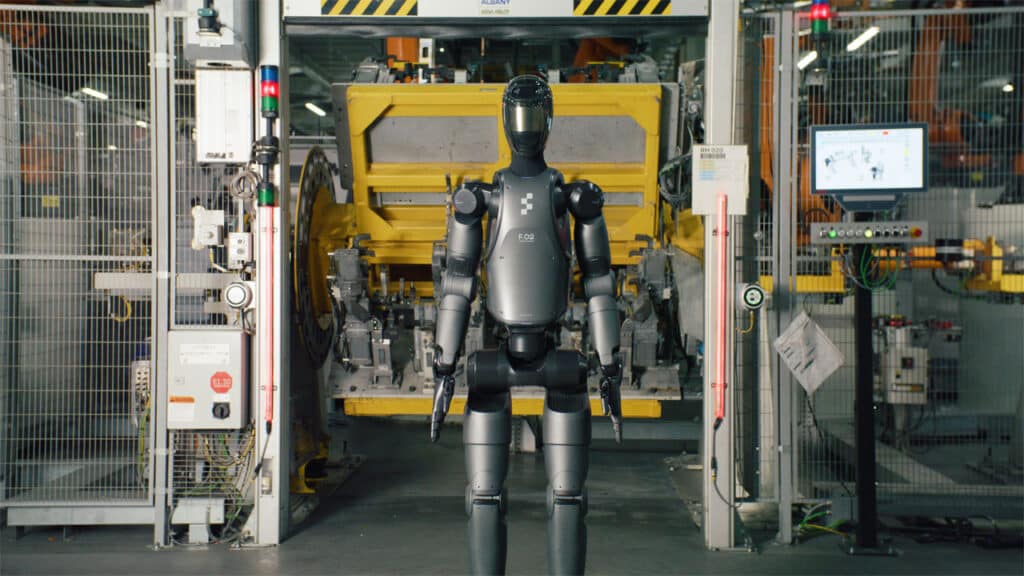
Leipzig is the first European node in that network, but it is not where the concept was proven. That happened in Spartanburg, South Carolina, where BMW Group Plant Spartanburg launched a pilot in 2025 with technology company Figure AI, marking the first deployment of humanoid robots in any BMW facility anywhere in the world. The robot, Figure 02, assisted in the production of more than 30,000 BMW X3 vehicles over ten months. Working five days a week on ten-hour shifts, it retrieved and positioned sheet metal parts for welding, moving over 90,000 components, logging roughly 1,250 operating hours, and accumulating approximately 1.2 million steps.
The pilot demonstrated that a humanoid robot could perform repeatable tasks, such as positioning components with millimetre accuracy, reliably and with consistent precision. The pilot also surfaced practical lessons: safety concepts were revised, additional barriers and partitions were added, and 5G coverage in the hall was improved. The transition from lab to line moved faster than the project team anticipated. Having learned the required motion sequences in a test environment, Figure 02 was soon performing them reliably on the production line, integrated into BMW’s smart robotics ecosystem through standardized interfaces.
Early curiosity among Spartanburg workers gave way to acceptance, and Figure 02 became a routine part of daily operations on the shop floor. Building on those results, BMW Group and Figure AI are now evaluating where the next-generation Figure 03 could add value in production.
EVinfo.net’s Take: North America Must Step Up Automated Automotive Plants
BMW Group Plant Spartanburg signaled a new phase in how vehicles may be built in the future. The implications extend far beyond a single plant. North America’s automotive sector has historically relied more heavily on human labor compared to highly automated manufacturing hubs in China. Chinese automakers and suppliers have aggressively scaled robotics, AI-driven quality control, and fully automated assembly lines, allowing them to increase production speed, reduce costs, and maintain consistent quality with fewer human workers.
Many modern Chinese auto plants, particularly for electric vehicles (EVs), are not fully automated today. However, these factories utilize “dark factory” (lights-out) technology for high-efficiency sections. These plants feature hundreds of robots, over 90% automation in core processes, and AI-powered quality checks. Fully autonomous production expected by 2030 in many of these plants.
By contrast, many U.S. plants still operate with a hybrid model that limits throughput and introduces variability. The Spartanburg pilot highlights a growing recognition that deeper automation is no longer optional. Humanoid robots, in particular, offer flexibility that traditional industrial robots lack. They can adapt to existing workflows, handle complex or variable tasks, and work alongside human operators without requiring entirely new factory layouts.
If North American manufacturers want to remain globally competitive, broader integration of robotics will be essential. This does not imply eliminating human labor but rather augmenting it. Skilled workers will increasingly shift toward supervisory roles, systems management, and maintenance of automated processes.
Leading robot companies in North America include industrial giants like FANUC America, Symbotic, and Rockwell Automation, alongside innovators such as Boston Dynamics, Agility Robotics, and Carbon Robotics.
The trajectory is clear. Facilities that invest early in advanced robotics and AI integration will gain significant advantages in efficiency, scalability, and cost structure. Spartanburg is not just a pilot site. It is an early indicator of where vehicle production in North America is heading.

Electric Vehicle Marketing Consultant, Writer and Editor. Publisher EVinfo.net.
Services