Kempower, Windrose, and EV Realty Complete North America’s First Megawatt Charging System (MCS) Charging Session
Kempower, Windrose, and EV Realty have completed the first Megawatt Charging System (MCS) session using a Kempower Mega Satellite unit in North America, marking a significant step toward commercial high-capacity charging for heavy-duty electric fleets. The session took place at EV Realty’s San Bernardino, California hub, reported Clean Trucking on March 25, 2026.
The MCS technology delivers more than 1 MW of power, designed to accelerate charging speeds while improving standardization and operational flexibility for fleet operators. The San Bernardino hub is equipped with a 1,200 kW Kempower Power Unit linked to two Mega Satellite MCS dispensers, capable of up to 1.2 MW and 1,500 amperes of continuous output, paired with liquid-cooled cables. The site is scheduled to open in April 2026.
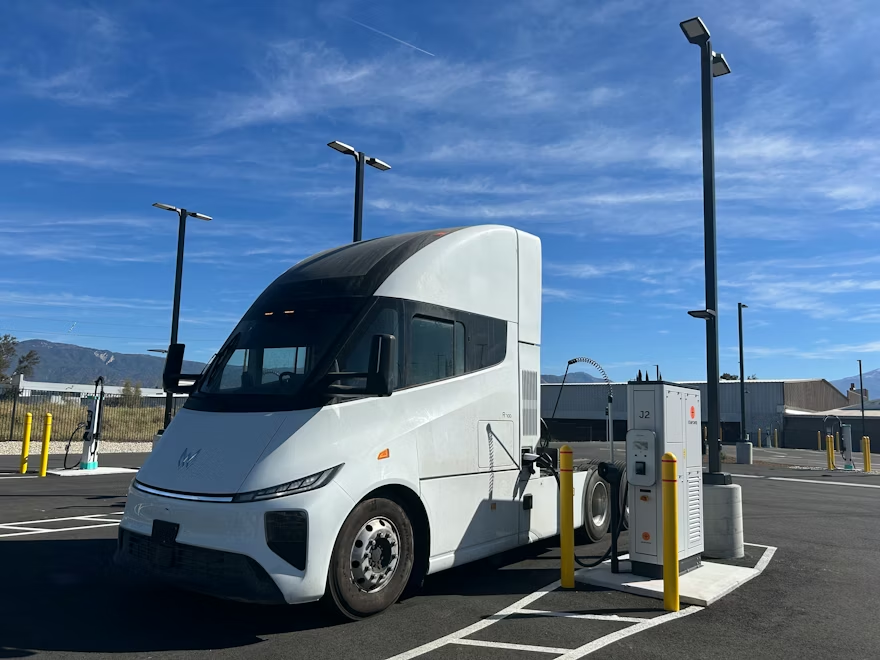
“This milestone marks a major step for heavy-duty charging in the region, demonstrating real-world interoperability and reliable delivery,” said Kempower VP of Markets and Products Jed Routh.
“MCS is a potential game changer for fleets looking to reduce dwell times and improve operational efficiency,” added EV Realty Chief Commercial Officer Suncheth Bhat. “This test confirms we will be ready for real-world MCS charging when the trucks hit the road later this year.”
EVinfo.net’s Take: The Charging Network Has to Keep Up With the Trucks
The heavy-duty EV truck story has largely been told through the vehicles themselves. Range figures, payload capacity, torque numbers, reservation counts. But the more consequential story for fleet operators is the one happening alongside the trucks, the charging infrastructure that determines whether those vehicles actually work in commercial operations.
The milestone arrives as the Tesla Semi moves closer to series production, a vehicle that will rely on megawatt-level charging infrastructure. Several manufacturers are already adopting MCS-compatible platforms, including Windrose, whose R700 semi-truck was used in the session. For the heavy-duty EV sector, the ability to charge at sustained megawatt levels is as important as the trucks themselves.
Windrose is building MCS-compatible platforms. Other manufacturers are moving in the same direction. As these vehicles reach fleets in meaningful numbers, operators are going to need somewhere to charge them, and not just at the one hub where the manufacturer ran its demo.
This is where interoperability becomes the central challenge. A fleet running mixed vehicles from multiple manufacturers needs charging infrastructure that works across all of them, reliably, in real-world conditions, not just in controlled test environments. MCS as a standard exists precisely to solve this problem. But a standard is only as useful as the infrastructure built around it.
The investment calculus for charging operators is straightforward on paper. Longer-range trucks mean fewer stops, but each stop demands more power delivered faster. Megawatt charging is not optional for heavy-duty commercial operations. It is the baseline that makes the economics work.
What the industry needs now is the unglamorous work of replicating what happened in San Bernardino across dozens, then hundreds, of locations along the routes that freight actually travels. That means capital, permitting, utility coordination, and time. The trucks will not wait. Fleet operators evaluating electric vehicles are evaluating the whole system, and a charging network that lags the vehicles is a reason to hesitate.
The milestone last week was genuine. The work ahead is substantial.

Electric Vehicle Marketing Consultant, Writer and Editor. Publisher EVinfo.net.
Services