New Study Examines Barriers to Home EV Charging for Renters and Impacts on Adoption
Access to home charging is one of the most consequential factors in whether someone buys an electric vehicle, and that access is not distributed evenly. Renters, multifamily residents, and people without dedicated parking face a set of overlapping obstacles that make home charging more expensive to install and, in many cases, practically out of reach. A new study using parcel-level data from Burlington, Vermont puts numbers to what has largely been characterized through surveys and aggregate statistics, finding that the barriers are substantial and that they fall disproportionately on populations already underserved by the clean transportation transition.
The study is titled Barriers to electric vehicle home charging and impacts on adoption, written by Parsa Pezeshknejad, Lilac Damon, Sarah Grajdura, and Dana Rowangould. It is published in Elsevier’s Transportation Research Part D: Transport and Environment, on ScienceDirect.
The research team, drawing on housing records, electrical permit data, and vehicle registration information tied to individual properties, pursued two questions: how do housing characteristics shape the cost of installing a home EV charger, and how do they shape the likelihood that a household acquires an EV at all?
On costs, the findings are stark. The single largest driver of installation expense is whether a home requires an upstream electrical upgrade, meaning an increase to the building’s service capacity or main panel. Permits involving that kind of work cost roughly 2.6 times more than permits that only required downstream changes like a new circuit or outlet. That matters enormously for older homes. Most electrical panels installed before 1960 were not built to handle the load a Level 2 charger demands, and Burlington’s housing stock skews old: 85 percent of its homes were built before 1990, compared to 65 percent nationally.

Rental properties present a compounding problem. Even after controlling for housing type and age, permits associated with rental homes cost approximately two to two and a half times more than those for owner-occupied properties. The reasons are not entirely clear from the data, but likely candidates include weaker existing infrastructure in rental stock, the scale of upgrades required to serve multiple tenants, and the absence of lower-cost options like permitted DIY work that homeowners can pursue. Homes with adequate on-site parking, meanwhile, saw installation costs roughly 50 percent lower than those without it, likely because shorter cable runs between the electrical panel and a driveway or garage reduce the complexity and materials required.
The adoption findings are, if anything, more consequential. Using a Bayesian spatial model that controls for home value, building quality, neighborhood, vehicle model year, and other factors, the researchers found that people living in fully rented homes were 60 to 70 percent less likely to have acquired a battery electric vehicle compared to people in owner-occupied homes. When the analysis was narrowed to only those who had purchased some form of electrified vehicle, the effect persisted: renters remained 50 to 65 percent less likely to have chosen a BEV over a plug-in hybrid or conventional hybrid. The relationship held across model specifications and was among the most robust findings in the study.
Inadequate parking also deterred BEV adoption, with residents of homes lacking sufficient on-site parking roughly 44 percent less likely to own a BEV than those with it, and nearly 80 percent less likely when compared only to other electrified vehicle buyers. Interestingly, those same residents showed a higher likelihood of owning a plug-in hybrid relative to a conventional vehicle, suggesting that some buyers facing home charging barriers are settling for a PHEV rather than abandoning electrification entirely. The authors note that this is an imperfect substitute: a PHEV owner who cannot charge at home regularly will rely more heavily on gasoline, diminishing much of the environmental and cost benefit that motivated the purchase.
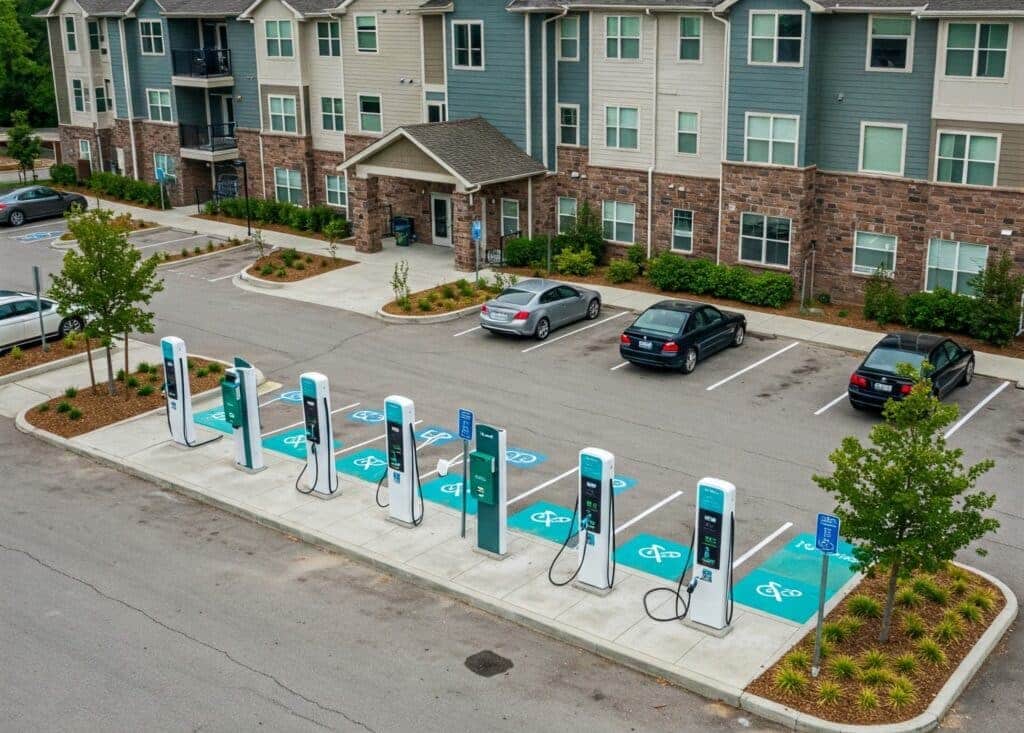
The picture for multifamily residents was more complicated once the models controlled for renting and parking, with the relationship between multifamily housing and BEV adoption present but weaker than expected and harder to interpret cleanly. The authors suggest that renting status and parking availability may be capturing much of what drives the multifamily effect.
Taken together, the findings trace a clear line between home type and charging access, and between charging access and EV adoption. That line also maps onto race and income. Renters are roughly twice as likely as homeowners to be Black, Native American, or Hispanic, and roughly twice as likely to be living below twice the federal poverty level. The cost and adoption gaps documented in this study therefore represent not just an infrastructure problem but an equity one.
The study was conducted in Burlington, a small city with unusually high EV adoption rates, strong purchase incentives, and dense public charging infrastructure, which means the barriers documented here likely understate what renters and multifamily residents face in less-resourced or less EV-friendly markets. Burlington’s experience does, however, offer one concrete example of a potential response: the city’s electric utility has installed chargers in public rights-of-way in high-rental neighborhoods, offered overnight parking allowances, and extended off-peak electricity pricing to those without private home chargers. Whether that approach scales, and whether it can replicate the convenience and cost advantages of true home charging, remains an open question the authors identify for future research.
What is clear from the data is that as EV adoption expands beyond early adopters, who are disproportionately homeowners with detached single-family homes and private parking, the populations that come next are precisely those for whom home charging is most difficult and most expensive to obtain. Policies that address only vehicle purchase costs while leaving the charging access gap unresolved will encounter a structural limit, one that the current study measures with more precision than the field has previously achieved.

Electric Vehicle Marketing Consultant, Writer and Editor. Publisher EVinfo.net.
Services