The State of EV Charging for Multifamily Dwellers
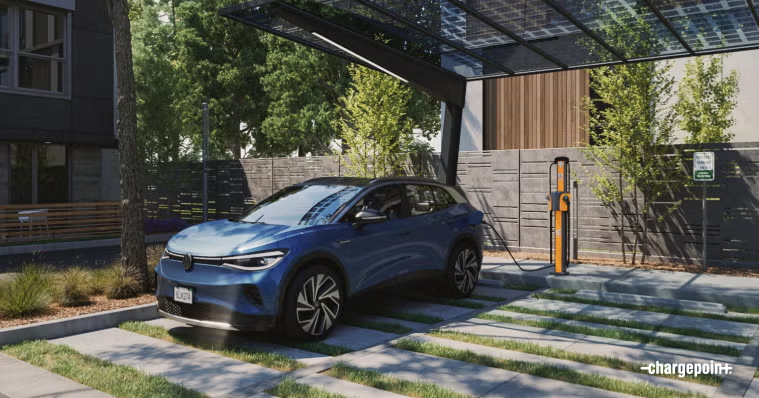
Living in an apartment complex can still be challenging for EV drivers. While nearly 80% of EV charging in the United States happens at home, many apartment residents lack access to Level 2 chargers and are forced to depend on public charging infrastructure.
To help address the problem, ChargePoint has partnered with OBE Power to deploy about 2,500 charging ports at multifamily housing properties across the U.S. beginning this year. Under the agreement, OBE Power will own and operate the chargers while handling energy reimbursement, carbon credit revenue, maintenance, insurance, and repairs at no cost to landlords.
The turnkey model is designed to simplify EV charger adoption for apartment owners and property managers. If drivers encounter charging issues, OBE Power, not the building operators, will manage customer support and maintenance. ChargePoint will supply the charging hardware, though drivers will still pay to charge their vehicles.
The companies already work together on EV charging deployments at hotels and hospitality properties and are now expanding their partnership into multifamily housing. The first installations are expected at condominium properties nationwide in the near future.
Alejandro Burgana, Managing Director, OBE Power, said: “At OBE Power, we’ve built something fundamentally different. We filled a void in the industry, and this is how. We fully own and operate the entire ecosystem—from design, engineering, and electrical upgrades to deployment, maintenance, and customer support—so property owners don’t have to take on cost, complexity, or risk.”
Burgana continued, “We partner with ChargePoint to deliver the most advanced Level 2 charging technology in the market, including high-power chargers with interactive screens and cable management systems, all at no cost to the host. What makes us different is that we don’t rely on subscriptions or hidden fees. Property owners pay nothing, and drivers get a reliable, affordable charging experience. When you remove cost, complexity, and risk, adoption follows. That’s what OBE Power delivers.”
According to the U.S. Department of Energy’s Alternative Fuels Data Center, ChargePoint currently operates more than 45,000 EV charging stations and over 80,000 charging ports across the country. More than 75,000 of those are Level 2 chargers, which are ideal for locations where vehicles remain parked for extended periods, such as apartment complexes, workplaces, and shopping centers.
The new deployments will further strengthen ChargePoint’s position in the Level 2 charging market, expanding its network to roughly 78,000 Level 2 ports nationwide.
EVinfo.net’s Take: Multifamily Housing, One of the Biggest Barriers to EV Adoption
For millions of Americans, owning an electric vehicle is no longer the biggest hurdle. Charging it at home is.
Multifamily housing has become one of the biggest barriers to EV adoption in the United States. While most EV owners charge overnight at home, apartment residents often do not have access to dedicated parking spaces or Level 2 chargers. That leaves many drivers relying on public charging stations, which can be more expensive, less convenient, and less reliable than home charging.
The challenge is massive because a large share of Americans live in apartments, condominiums, and other multifamily properties, especially in major urban areas where EV adoption could have the greatest environmental impact. According to a 2019 survey conducted by the American Housing Survey and the U.S. Census Bureau, approximately 43.9 million residences, or 31.4% of housing in the U.S. today, are multifamily.
Without reliable home charging, many consumers simply decide an EV is not practical for their lifestyle.
Installing chargers at multifamily properties is also more complicated than adding them to single-family homes. Property owners must deal with electrical upgrades, permitting, parking logistics, maintenance, insurance, and questions about who pays for the electricity. In older buildings, limited electrical capacity can make installations even more difficult and expensive.
For landlords, the return on investment has not always been clear. Many property owners are hesitant to invest thousands of dollars into charging infrastructure without guaranteed tenant demand. At the same time, tenants increasingly view EV charging as an essential amenity, similar to high-speed internet or in-unit laundry.
The good news is that the industry is beginning to respond. Companies like ChargePoint, OBE Power and SWTCH are rolling out turnkey solutions that remove much of the burden from property owners by handling installation, operations, maintenance, and billing.
SWTCH Energy Launches SWTCH Tap™: One-Tap EV Charging That Works Even Offline
In April, EVinfo.net had the honor of working with SWTCH, one of the greatest companies tackling the multifamily EV charging problem.
SWTCH Energy launched SWTCH Tap™, a new feature within its SWTCH Cortex platform that allows EV drivers to start charging sessions with a single smartphone tap, even in areas without cellular service.
The technology uses NFC to instantly identify both the charger and the driver’s account, eliminating the need for QR codes, app downloads, or cloud-based authentication delays. SWTCH says the system is designed to improve charging reliability in underground garages, parking structures, and remote locations where connectivity is often poor.
SWTCH Tap supports three connectivity scenarios: full online access, driver phones with no signal, and complete site-wide network outages. In outage situations, the system uses local intelligence and cached user data through SWTCH Nexus edge computing to authorize charging sessions without relying on the cloud. Billing and transaction data automatically sync once connectivity is restored.
According to CEO Carter Li, the goal is to eliminate charging interruptions caused by weak or unavailable network connections and create a seamless charging experience for EV drivers.
To learn more, visit https://swtchenergy.com.
Power Hero CEO Explains Value of Investments in Company’s Flexible Charging Access for 117M American Multifamily Residents
Power Hero aims to solve one of the biggest barriers to EV adoption in the United States: convenient charging access for the estimated 117 million Americans living in multifamily housing.
EVinfo.net had the honor of interviewing the company’s CEO and founder, Esmond Goei, who argues that apartment residents often avoid buying EVs because they lack reliable home charging. Power Hero’s strategy focuses on using existing infrastructure instead of building expensive new charging networks.
The article outlines several key technologies:
Cameo™, an adapter that turns existing private Level 2 chargers into shared, monetized neighborhood charging stations similar to an “Airbnb” model for EV charging.
PowerPac™, a patented portable system that converts standard 120V outlets into faster 240V charging solutions without major electrical upgrades or permits.
ePort™, a cloud-connected device that transforms ordinary outlets into reservable, revenue-generating charging points.
mPower™, a mobile roadside charging and emergency assistance platform.
Goei emphasizes that convenience matters more than simply adding more public chargers. He believes EV drivers want charging where they live, without waiting in line or relying on limited shared infrastructure. The company is targeting apartment dwellers, older homes with limited electrical capacity, and dense urban markets.
The article also discusses Power Hero’s patent portfolio, business model, and investor outreach efforts through Wefunder, where the company says it has working prototypes, and strategic partnerships.
it’s electric Deploying D.C.’s First Solar-powered Detachable Cable Chargers At Public Libraries Across Washington, D.C.
Curbside EV charging innovator it’s electric serves large cities, where most residents are multifamily dwellers.
it’s electric announced it received funding from the Washington, D.C. District’s Department of Energy, Environment and Climate Action as one of three companies selected to expand Level 2 curbside charging at and near District-owned city sites.
Thanks to a collaboration with Skyhook Solar, it’s electric will be deploying D.C.’s first solar-powered detachable cable chargers at public libraries across the district.
This award is part of the District’s broader push to scale up EV charging citywide and the timing could not be better – as of Q4 2025, EVs made up 20% of all new vehicle registration, the highest share in the US.
EVinfo.net recently reported on the company’s impressive major and historic agreement with the City of Philadelphia, Pennsylvania, to deploy as many as 1,000 Level 2 curbside electric vehicle (EV) chargers throughout the city.

Electric Vehicle Marketing Consultant, Writer and Editor. Publisher EVinfo.net.
Services