Hyundai Hosts Emergency Responders Extrication Training Using Six Crashed Electric Vehicles
On April 17, 2026, the Hyundai America Technical Center (HATCI) announced it hosted an extrication training for local firefighters at its Safety Test and Investigations Laboratory in Superior Township in Michigan. Led by the company’s EHS team, the program focused on helping emergency responders better understand the hazards associated with vehicle crashes and the protocols required to manage them safely.
Hyundai provided six crashed electric vehicles (EVs), which supported onsite emergency training exercises. Hyundai’s Environmental, Health, and Safety (EHS) department ensures workplace safety, environmental compliance, and emergency preparedness across its manufacturing and technical operations.
The training provided detailed instruction on operational steps, risk levels, and mitigation strategies aligned with NFPA 1006, the Standard for Technical Rescuer Professional Qualifications, which establishes minimum job performance requirements (JPRs) for emergency personnel to safely perform technical rescues.
First responders were guided through real-world scenarios involving patient extrication, vehicle stabilization, and hazards such as high-voltage systems, hazardous materials, and structural deformation of vehicle components including dashboards, glass, and roofs. Hyundai also supports responders with Emergency Response Guides and hands-on experience using its vehicles to reduce on-scene risks.
“Proactive training efforts with emergency response personnel is a valuable experience that improves accident site safety,” said Michael Cox, manager, EHS and Security, HATCI. “Not only do we strive to provide peace of mind to our customers with our SmartSense suite of advanced safety and convenience technologies, we also help to educate and provide resources to emergency responders through trainings such as this and Emergency Response Guidebooks specific to Hyundai vehicles. Each crash situation includes numerous variables requiring quick action and assessments. Having the opportunity to practice extrication steps in a safe, test environment furthers the safety of all involved.”
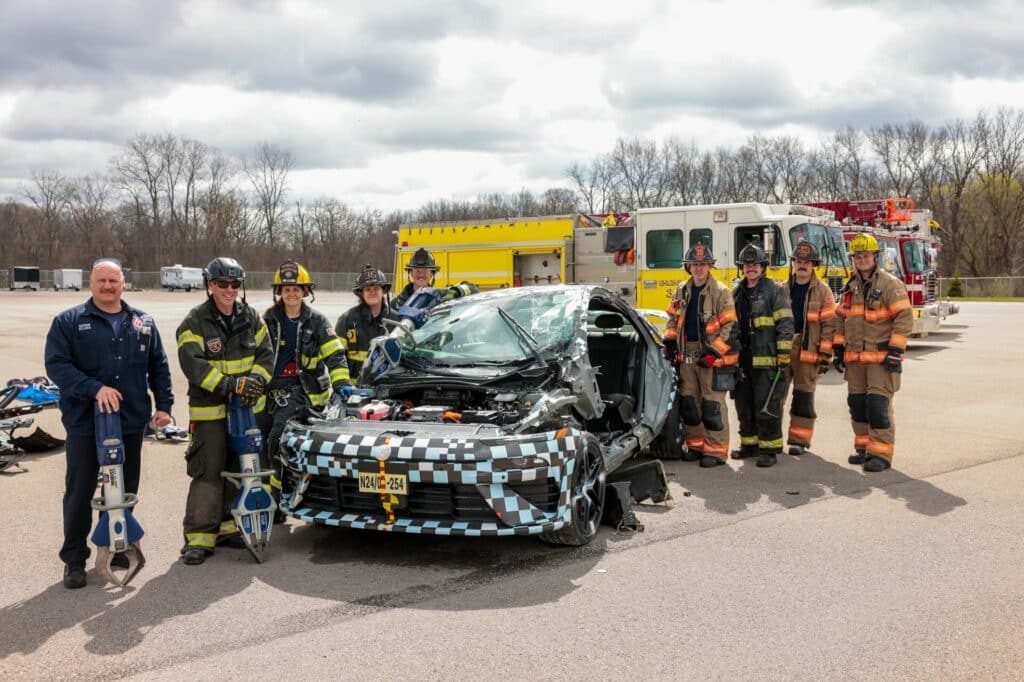
“The opportunity to work with Hyundai in a realistic training environment provided Superior Township and Ypsilanti City Fire Departments the first of its kind training on all electric vehicles,” said Dan Kimbal, fire marshal, Superior Township Fire Department. “The training provided firefighters with hands‐on experience for the types of vehicles they see on today’s roads. We usually do extrication training on old junk cars at a junk yard. Training at Hyundai gave us the ability to improve our extrication techniques providing more safety to the community with new electric vehicles.”
The training took place at Hyundai’s Safety Test and Investigations Laboratory, which opened in September 2024 as the first OEM facility of its kind in North America dedicated to field safety. The lab supports the North American Safety Office by identifying emerging issues, replicating real-world incidents, and accelerating solutions. The site includes a vehicle dynamics test area, an EV testing and electronics lab, and capabilities for full vehicle impact testing.
“We are pleased to offer our state-of-the art safety investigation facility to our community emergency first responders to help them gain a deeper understanding of the potential hazards at the scene of an accident as well as methods to quickly and safely assist our customers and other road users,” said Ben Michajlyszyn, director, STIL, Hyundai Motor North America.” Our vision of enhancing vehicle safety and quality through in-house root cause analysis and information gathering, will continue to foster a safety-first culture both internally and externally.”
Beyond the U.S., Hyundai Motor Group continues to support firefighter safety initiatives in South Korea. These include “A Safer Way Home,” a program highlighting an unmanned electric firefighting robot designed for high-risk environments such as fires involving collapse, explosions, extreme heat, toxic gases, or dense smoke. The robot can be deployed ahead of crews, remotely assess conditions, approach the source of a fire, and actively suppress it, helping protect both firefighters and civilians.
EVinfo.net’s Take: EVs Are Far Less Likely to Catch Fire Than Gas-Powered Cars
On the topic of hazards associated with vehicle crashes, the idea that EVs are a fire risk is a common EV myth. The reality is simple: EV battery fires are far less common than fires in gas-powered vehicles.
Data from fire agencies, insurance companies, and safety regulators consistently shows that internal combustion engine vehicles experience far more fires per mile, per vehicle, and per incident than EVs.
We commend Hyundai for conducting this important training, and hope other automakers follow this excellent example.