Meet the TEAL Team at ACT Expo, Las Vegas Convention Center May 4-7, 2026
ACT Expo, now in its 16th year, returns to the Las Vegas Convention Center, May 4 to 7, 2026, bringing together more than 12,000 transportation stakeholders for the commercial fleet industry’s most comprehensive annual event. The Expo Hall runs May 4 to 6.
The four-day program is designed to deliver months of market intelligence in a single venue, covering the technologies, regulations, and business strategies reshaping commercial electric and clean energy transportation. More than 300 expert speakers will address topics ranging from advanced powertrains and alternative fuels to digital fleet management, autonomous systems, and infrastructure deployment. Confirmed speakers include Rivian founder and CEO RJ Scaringe, Mack Trucks President Stephen Roy, and Aurora President Ossa Fisher, among others.
The Expo Hall will feature 400-plus sponsors and exhibitors showcasing battery-electric, hydrogen, and renewable-fuel vehicles alongside AI-powered platforms and autonomous systems. Advanced vehicles on display include the Rivian R2, Peterbilt 537EV, Volvo VNL Autonomous, and the Workhorse W56 All-Electric Step Van, among others.
Additional programming includes a Ride and Drive experience, Expo Hall Theater demos, technical sessions, and partner-hosted roundtables and networking events. The event draws more than 2,400 fleet operators and 120 media representatives annually.
Registration is now open. Select sessions are eligible for CAFM credits and GBCI continuing education hours.
Electric vehicle charging, and the problems surrounding it, has been a major topic of past ACT Expo events, and is sure to be a topic of much discussion again at the 2026 event.
Why EV Charging Reliability Is the Make or Break Factor for Fleet Electrification
Unreliable EV charging remains one of the most critical barriers to large-scale fleet electrification. While the total number of chargers continues to grow, uptime, consistency, and performance variability are still lagging behind what commercial fleet operators require for mission-critical operations.
For fleets, charging is not a convenience, it is core infrastructure. When a charger fails, delivers reduced power, or is unexpectedly occupied, the impact cascades across the entire operation. Vehicles can miss dispatch windows, routes may need to be reassigned, and backup internal combustion vehicles are often pulled in to maintain service levels. This erodes both the economic and environmental advantages that electrification is meant to deliver.
Unlike individual drivers, fleets operate on tightly optimized schedules with little tolerance for downtime. A single unreliable charger at a depot or along a route can disrupt dozens of vehicles. In last-mile delivery, transit, and drayage operations, even minor delays can translate into missed service-level agreements, financial penalties, and reduced customer satisfaction.
The issue is compounded in shared or public charging environments. Many fleets still rely on third-party infrastructure, where charger uptime is inconsistent and visibility into real-time availability is limited.
Demand charges and energy management also become harder to control when charging is unreliable. Fleets may be forced to charge at suboptimal times or locations, increasing electricity costs and straining local grid infrastructure. This unpredictability undermines one of the key advantages of EVs: lower and more stable operating expenses.
To address these challenges, the industry must prioritize reliability as much as expansion. This includes deploying higher-quality hardware, enforcing stricter uptime standards, and leveraging advanced software for predictive maintenance and real-time monitoring.
Ultimately, fleet electrification will not scale on charger count alone. It will depend on trust in the infrastructure. Until charging becomes as reliable and predictable as fueling a conventional vehicle, fleets will remain cautious in fully committing to electric transitions.
Connectivity Failures Account for More Than 55% of All EV Charging Outages, Industry Analysis Finds
An industry analysis reveals that more than 55% of public EV charging failures are caused not by broken hardware, but by connectivity issues that prevent stations from authenticating sessions and processing payments.
Most public chargers rely on a single cellular connection to communicate with central network systems. When that connection fails due to poor reception, modem failure, or power interruption, the station cannot authorize a charge even when the physical equipment is fully functional. The result for drivers: a plug that works but a session that never starts.
The findings point to a significant and underappreciated vulnerability in the public charging infrastructure. As EV adoption grows, unreliable network connectivity is fueling what the industry calls “charging anxiety,” the fear that a charger will be available but unusable. These everyday digital failures erode driver and fleet confidence and undermine the broader promise of EV convenience.
Connectivity solutions provider TEAL is addressing this gap through its Network Orchestration Service (NOS), a platform that enables compatible devices to connect seamlessly to data networks worldwide. By integrating partnerships with more network operators than any competing platform, TEAL allows businesses to remotely deploy and switch between networks, maintaining reliability across IoT deployments in EV charging, fleet management, healthcare, agriculture, smart cities, and other sectors.
EVinfo.net Interviews Robb Monkman, Chief Marketing Officer at TEAL
EVinfo.net had the great honor of interviewing Robb Monkman, Chief Marketing Officer at TEAL, about TEAL’s solutions for EV charging reliability.
Monkman said about EV charging stations failing: “Surprisingly, over 55% of failures are due to connectivity issues. Charging stations rely on cellular networks for critical functions: authenticating payments, transmitting operational data, and updating availability in real-time. When connectivity fails, the charging station becomes unusable, even if the hardware is fine. It’s not just an inconvenience, it’s a systemic reliability problem.”
Monkman continued, “TEAL flips the script by giving charging stations carrier freedom and redundancy. With our NOS (Network Orchestration Service), a charger isn’t locked into a single carrier. If one network goes down, the station can automatically switch to another available network all over-the-air, without the need to swap out a SIM card. That means chargers stay online, drivers stay happy, and operators don’t have to worry about downtime.”
TEAL’s Vision
TEAL envisions a world reshaped by the freedom of connectivity, a future where choice and control redefine how we interact with global networks and unlock boundless possibilities.
“The connected world is exploding exponentially and somewhere around 50 billion devices will be connected to the internet by 2030. 5G remains the most ground-breaking evolution to date in the history of wireless networking and TEAL believes that businesses everywhere should have the ability to access secure and high-performance mobile networks while simultaneously unlocking the benefits of network orchestration,” said Michael Johnston, Co-Founder and Chief Business Officer of TEAL.
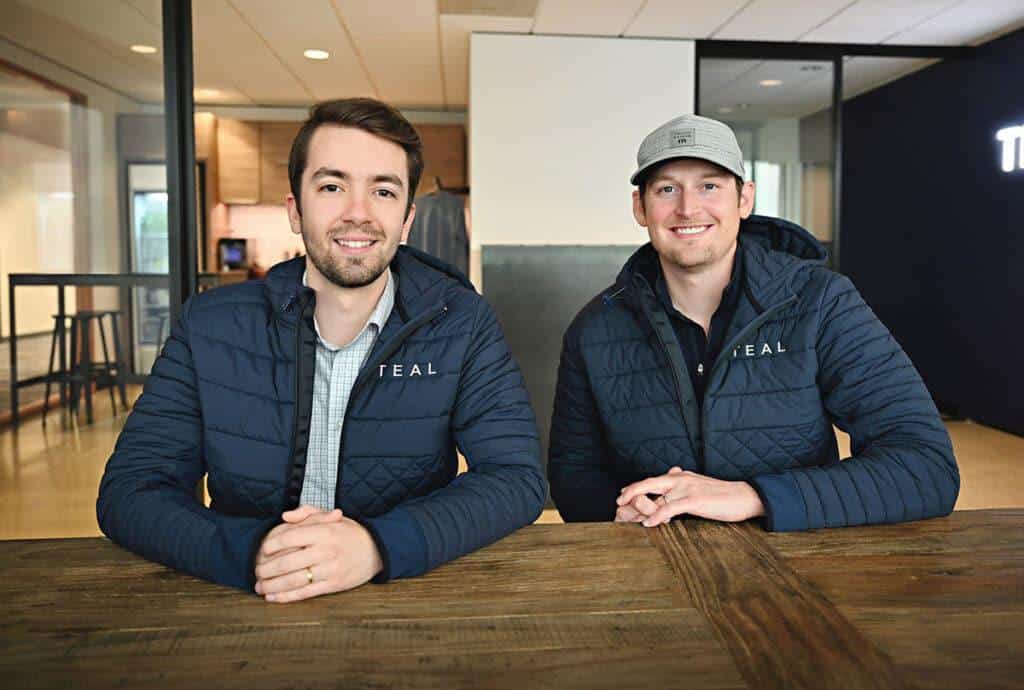
TEAL was founded in 2018 by Robby Hamblet and Michael Johnston, Jr. with a mission to revolutionize eSIM technology and build a new kind of connectivity platform, one that offers true programmability and control. With TEAL, businesses gain the power to connect to any network in the world through programmatic control, opening the door to seamless global connectivity.
Before starting TEAL, Robby played a pivotal role in deploying some of the world’s first SGP.02 eSIM platforms. His career included work with companies offering white-label platform-as-a-service (WPaaS) solutions for global IoT applications, focusing on connectivity, device management, and edge intelligence for major automotive manufacturers.
While collaborating on projects with GM, Daimler, and other OEMs, he saw a major opportunity: the advanced connectivity platforms being designed for automotive could, and should, be made accessible to every IoT application. That realization became the foundation for TEAL’s vision of a more connected world.
Connect with Robb Monkman and the TEAL team at ACT Expo.
Schedule a meeting here in advance of the show: Meet TEAL at the ACT Expo 2026

Electric Vehicle Marketing Consultant, Writer and Editor. Publisher EVinfo.net.
Services