The U.S. Network of Fast EV Chargers Grew 34% in Q1 2026 vs. Q1 2025
Bloomberg reported on April 8, 2026 that America’s public fast-charging network is expanding rapidly, and a convergence of geopolitical tension and rising fuel costs has added fresh urgency to the buildout.
Some 605 high-speed public charging stations came online in the first quarter, a 34% jump over the same period last year, according to a Bloomberg News analysis of federal data. The country now has nearly 13,500 fast-charging locations, 25% more than a year ago.
The timing proved significant. As conflict with Iran roiled oil markets in March, gas prices spiked and Americans turned to search engines to research electric vehicles in large numbers. The charging network, still racing to meet existing demand, suddenly found itself at the center of renewed public interest.
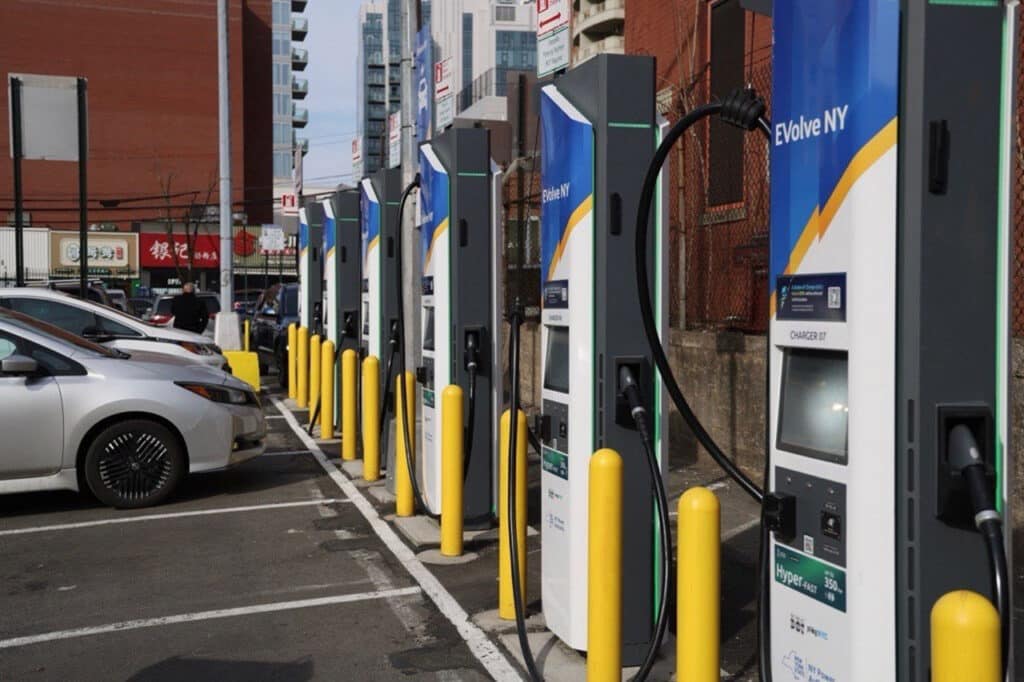
Much of the momentum is private-sector driven. Truck stops have emerged as a particularly aggressive segment, recognizing that EV road trippers waiting on a charge are a captive audience for snacks and drinks. Pilot Flying J added chargers to nearly 30 locations in the first quarter alone, spanning sites from North Carolina to Nebraska. The company now operates nearly 1,200 charging stalls, roughly half its stated target.
Retail is another growing sector. EV Charging Stations reported that Walmart’s public EV charging footprint in the United States has expanded sharply over the past several months, with the retail giant now operating 31 stations and more than 200 individual stalls.
That figure represents roughly 50% growth in just two months. The network had 20 stations as of February 2026, 10 in early November 2025, and only a handful the previous spring. Seven new locations opened in March alone, according to data from the Alternative Fuels Data Center.
The 31 stations collectively offer 224 charging stalls, averaging 7.2 stalls per site. That average has dipped slightly from the 8.1 to 8.6 range seen in previous months, reflecting variation in site size as the rollout spreads to new locations.
The business case for networks is also improving. Newer EV buyers are more likely to live in apartments and rely on public charging, while more efficient hardware is delivering more power in less time, making each session more profitable.
“The charge-point operators we talk to are not building for 2025 or 2026; they’re building for 2035,” Paren cofounder and Chief Technology Officer Bill Ferro told Bloomberg. “They may slow down their deployment, but they’re still going to deploy.”
That dynamic is feeding a virtuous cycle. Faster, more reliable charging encourages more drivers to go electric, which in turn justifies further infrastructure investment. Data platform Paren projects US fast-charging capacity will grow another 8% in 2026, even after several months of softer EV sales.
Industry veteran (Chargepoint, Voltrek, SWTCH) Brandon Terrazas joined Paren in March 2026 as Founding Enterprise Account Executive.

Electric Vehicle Marketing Consultant, Writer and Editor. Publisher EVinfo.net.
Services