Stellantis Plans $70 Billion Comeback, 29 New EVs Over the Next Five Years
Stellantis, the parent company of brands including Jeep, Ram, and Dodge, has unveiled an ambitious $60 billion turnaround strategy centered on next-generation EVs, advanced software platforms, and higher levels of vehicle autonomy.
The automaker plans to launch dozens of new electric vehicles, hybrids, and extended-range models over the next five years using a new software-defined vehicle platform known as STLA One. Stellantis is also expanding its partnership with Qualcomm to improve infotainment systems, cockpit technology, and advanced driver-assistance features.
The company has struggled to compete effectively in the increasingly competitive EV market. Several recent U.S. launches, including the Jeep Wagoneer S and Dodge Charger Daytona EV, faced criticism over unfinished software and disappointing sales performance. Earlier this year, Stellantis also discontinued several plug-in hybrid models in the U.S., including the Jeep Wrangler 4xe and Chrysler Pacifica PHEV, as it shifted focus back toward profitable gasoline trucks and SUVs.
Now the automaker is attempting a full reset. Stellantis says it will introduce 29 new EVs, 15 plug-in hybrid or extended-range models, 24 traditional hybrids, and 39 combustion-powered vehicles built on the new STLA One architecture.
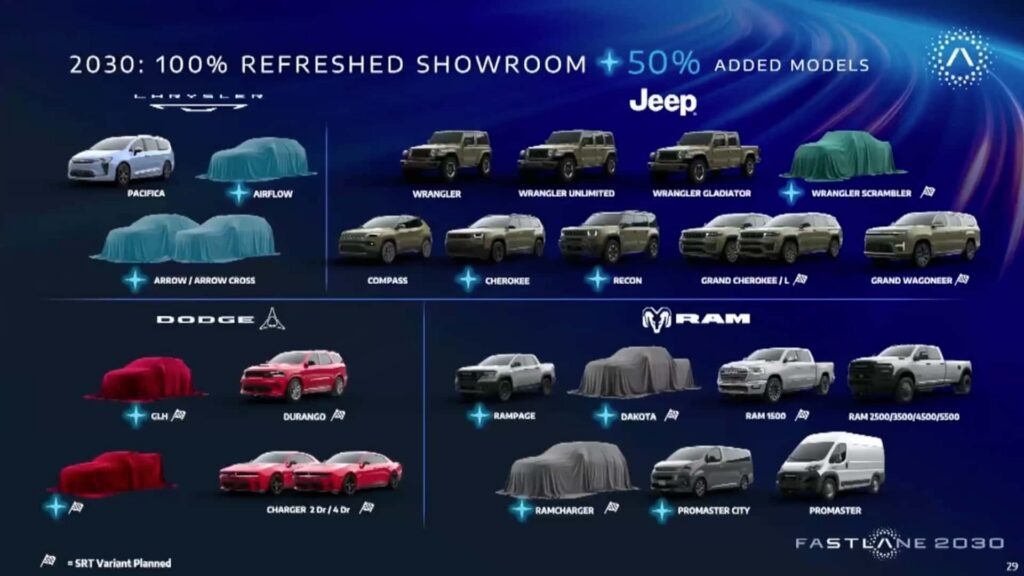
The platform will consolidate five existing vehicle platforms into one scalable system supporting subcompact, compact, and large family-oriented vehicles. It will use an 800-volt electrical architecture for faster charging and improved efficiency, while sharing roughly 70% of components across segments to reduce costs and complexity.
For EVs, the platform will utilize lithium iron phosphate batteries, or LFP batteries, which are becoming increasingly dominant due to lower costs and reduced reliance on expensive materials like nickel and cobalt. Stellantis also plans to adopt a cell-to-body battery design that integrates battery cells directly into the vehicle structure to improve energy density and reduce weight.
On the software side, Qualcomm’s Snapdragon Digital Chassis will power infotainment and cockpit systems, while Qualcomm Ride Pilot and U.K.-based startup Wayve will support advanced hands-free driving technology similar to Tesla’s Full Self-Driving system.
The roadmap is one of the most aggressive recovery efforts yet announced by a legacy automaker. Whether Stellantis can successfully execute the plan remains uncertain, but the company is clearly betting heavily on software, electrification, and autonomy to regain competitiveness in the rapidly evolving automotive market.