Rivian Boosts GA Plant Capacity To 300,000 Units, Reveals R2 Costs 50% Less to Build Than R1
Rivian has increased the planned output of its upcoming Georgia manufacturing facility, signaling stronger production ambitions for its next generation of electric vehicles. The company said its second U.S. plant will begin with an annual capacity of 300,000 units, a notable increase from the previously announced 200,000.
The update was shared alongside Rivian’s first-quarter earnings report. The automaker also revised its financing strategy, stating it now expects to secure $4.5 billion in loans from the U.S. Department of Energy to support construction, down from an earlier estimate of $6.6 billion. In addition, Rivian plans to begin drawing on those funds sooner, starting in 2027.
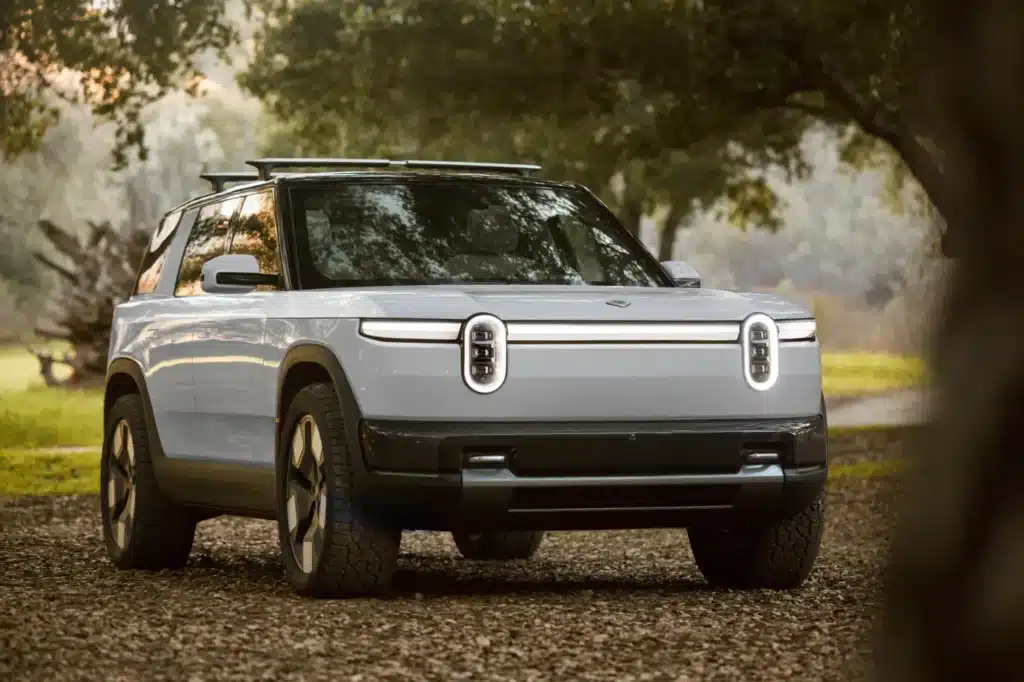
Construction timelines remain unchanged, with production in Georgia still scheduled to begin by the end of 2028. The facility will manufacture vehicles built on Rivian’s midsize platform, including the R2 crossover and a robotaxi variant tied to a 50,000-unit partnership with Uber. Meanwhile, production of the R2 has already started at Rivian’s expanded plant in Normal, Illinois, with customer deliveries expected later this spring. That facility currently has the capacity to produce up to 155,000 R2 vehicles annually.
With the addition of the Georgia plant, Rivian’s total production capacity is projected to reach 515,000 vehicles per year. According to Chief Financial Officer Claire McDonough, that scale is expected to support the company’s path toward positive free cash flow. In the first quarter, Rivian reported $1.38 billion in revenue and a net loss of $416 million.
The company is counting on the more affordable R2 lineup to deliver the economies of scale that its higher-priced R1T pickup and R1S SUV have not yet achieved. Looking ahead, Rivian expects continued growth driven by the R2, the upcoming R3, and future models.
Although the initial Georgia plan included two construction phases of 200,000 units each, the revised approach increases early capacity while still preserving room for future expansion at the site.

The Rivian R2 Costs Half As Much To Build As The R1S, Company Says
Rivian approached development of its R2 crossover with a clear objective: retain the appeal of the premium R1 lineup while significantly lowering both production costs and the eventual purchase price. Based on early impressions, including prototype evaluations, the company appears to have executed on that strategy.
According to Rivian, input costs for the R2 have been reduced by roughly 50% compared with the R1T and R1S. That cost compression is expected to support a starting price around $45,000 over time, though the higher-spec R2 Performance variant will launch first at approximately $58,000 when deliveries begin in the near term.
In its latest earnings update, Rivian provided deeper insight into the engineering decisions behind those savings. A major example is the redesigned electrical architecture. By adopting a more consolidated zonal computing system, the company reduced total wiring harness length by 2.3 miles and cut connector usage by 60%. High-voltage cabling was also reduced by 70% after integrating multiple power conversion components into a single unit.
The new Maximus drive unit reflects similar efficiencies, featuring 41% fewer parts than the Enduro units used in the R1 platform. Rivian integrated the inverter directly into the drive unit, improving packaging and thermal management while reducing component count. Additional cost reductions came from replacing ultrasonic sensors with corner radar systems, lowering sensing costs by about half.
Mechanical simplification played a major role as well. The front suspension switches from a double wishbone setup to a MacPherson strut design, delivering significant savings. Large-scale die castings reduce underbody complexity by 90% in terms of part count, while rear door assemblies have been simplified by cutting roughly 65% of components.
CEO RJ Scaringe said these changes reflect a broader focus on design for manufacturing and scaling efficiencies, enabling Rivian to deliver the R2 profitably at a more accessible price point. The company also benefits from improved supplier leverage as it grows, reducing component costs such as the windshield, which is now roughly half the cost of the R1 equivalent.
Combined with its smaller size and lower material requirements, the R2 represents Rivian’s push toward true mass-market scale. The remaining question is execution as the vehicle moves into full production.

Electric Vehicle Marketing Consultant, Writer and Editor. Publisher EVinfo.net.
Services