Wisk Aero Announces Successful First Flight of Its Autonomous and Electric Second Generation 6 Aircraft
On May 4, 2026, Wisk Aero announced the successful first flight of its second Generation 6 aircraft, marking another key milestone in the company’s expanding flight test program. The flight took place at its facility in Hollister, California, and included vertical takeoff, hover, and chirp maneuvers, providing early data to evaluate aircraft performance.
The addition of a second active Gen 6 aircraft significantly increases Wisk’s ability to gather data, validate onboard systems, and accelerate overall testing. With two aircraft now operating, the next phase will focus on broadening the flight envelope, including transitions from hover to wing-borne flight, while continuing to refine control laws and system behavior.
“Seeing the second Gen 6 aircraft take to the skies is a proud moment for Wisk,” said Sebastien Vigneron, CEO of Wisk. “This pace of execution is exactly what is required to meet the rigorous safety standards of commercial aviation. Having multiple aircraft in flight testing allows us to move faster, learn quicker, and stay on the leading edge of autonomous aviation. Every flight provides crucial data that matures our aircraft and autonomous system, bringing us one step closer to delivering a certified, autonomous air taxi service.”
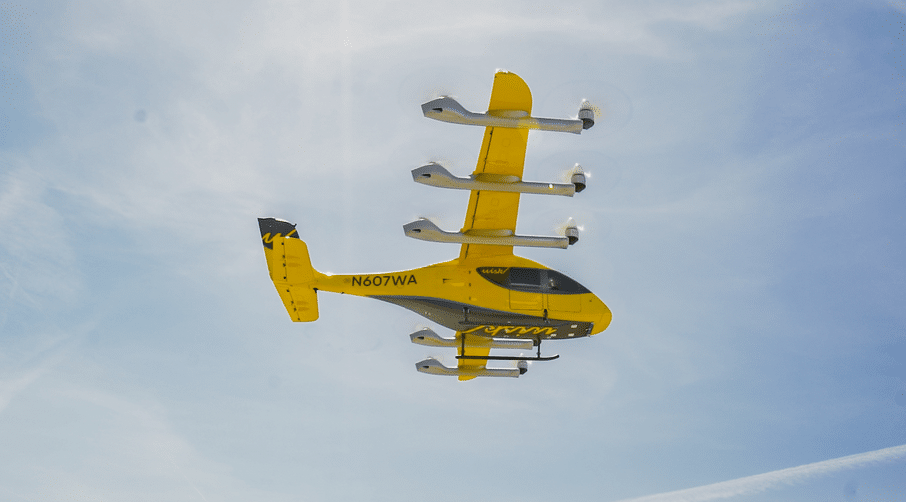
Wisk’s Generation 6 aircraft is fully electric and designed for autonomous operation, with human oversight provided by a ground-based operator. The company states this model is central to achieving high safety standards while enabling scalable and cost-effective operations that meet or exceed current commercial aviation requirements.
Expanded flight testing also supports Wisk’s path to commercialization. The U.S. Department of Transportation recently selected the Texas Department of Transportation, a Wisk partner, for its Electric Vertical Takeoff and Landing and Advanced Air Mobility Integration Pilot Program. Wisk will contribute its aircraft and autonomous systems to support real-world operations within U.S. national airspace.
The company is also working closely with Federal Aviation Administration and NASA to help advance regulatory frameworks and reinforce U.S. leadership in advanced air mobility.
Wisk Aero, a wholly owned subsidiary of Boeing, is focused on developing autonomous, electric air travel solutions aimed at improving accessibility, safety, and sustainability in aviation.
EVinfo.net’s Take: Aviation is The Final Frontier for Electric and Autonomous Travel
Electrification has reshaped passenger vehicles, and autonomy is steadily advancing on roads. Aviation, however, remains the most complex and consequential frontier. The technical, regulatory, and operational hurdles are higher, but so is the potential impact. If electric and autonomous systems can scale in the air, they will redefine mobility, energy use, and urban infrastructure.
Aviation is difficult to decarbonize because energy density matters. Jet fuel still far exceeds current battery capabilities, which is why most early efforts focus on short-range, lower-capacity aircraft. This is where electric vertical takeoff and landing, or eVTOL, platforms are gaining traction. Companies like Wisk Aero are developing fully electric, autonomous aircraft designed for urban and regional trips, targeting use cases such as air taxis and short-haul transport.
Autonomy adds another layer of transformation. Unlike ground vehicles, aircraft operate in a tightly controlled environment governed by strict safety protocols and air traffic management systems. Fully autonomous flight requires not only advanced onboard systems but also integration with regulators and national airspace frameworks. Organizations like the Federal Aviation Administration and NASA are actively working with industry to define certification pathways and operational standards.
The safety case is central. Electric propulsion reduces mechanical complexity, with fewer moving parts than traditional turbine engines. Autonomous systems, paired with ground-based human oversight, aim to minimize human error while maintaining redundancy and control. Companies are designing aircraft to meet or exceed existing commercial aviation safety benchmarks, not bypass them.
Infrastructure is another critical piece. Urban air mobility will require new takeoff and landing hubs, charging systems, and grid integration strategies. Unlike EV charging on roads, aviation demands higher power throughput and tighter scheduling precision. These systems must be built in parallel with aircraft development to enable real-world deployment.
Economics will determine scale. Electric aircraft promise lower operating costs over time due to reduced fuel and maintenance expenses. When combined with autonomy, which removes onboard pilot costs, the model begins to resemble a scalable transportation network rather than a premium service. This shift could make short-distance air travel more accessible, especially in congested metropolitan regions.
Still, timelines remain uncertain. Battery advancements, certification processes, and public acceptance will dictate how quickly adoption occurs. Early deployments will likely be limited, carefully controlled, and focused on specific corridors before broader expansion.
Aviation has always pushed the boundaries of engineering and regulation. Today, it stands at the intersection of electrification, autonomy, and sustainability. The path forward is complex, but the trajectory is clear. What once seemed experimental is steadily becoming operational, positioning aviation as the next major domain to undergo a fundamental technological shift.

Electric Vehicle Marketing Consultant, Writer and Editor. Publisher EVinfo.net.
Services