Geely’s 16-in-1 Intelligent E-Drive Sets Guinness World Records for Energy Efficiency and Wet-Surface Performance
China’s Geely Auto Group has announced that its new 16-in-1 Intelligent E-Drive system has achieved two Guinness World Records, highlighting the company’s efforts to improve electric vehicle efficiency, performance, and scalability. The advanced 800V electric-drive system recorded energy consumption of 8.20 kWh per 100 kilometers, equivalent to approximately 7.6 miles per kWh, in a battery electric sedan.
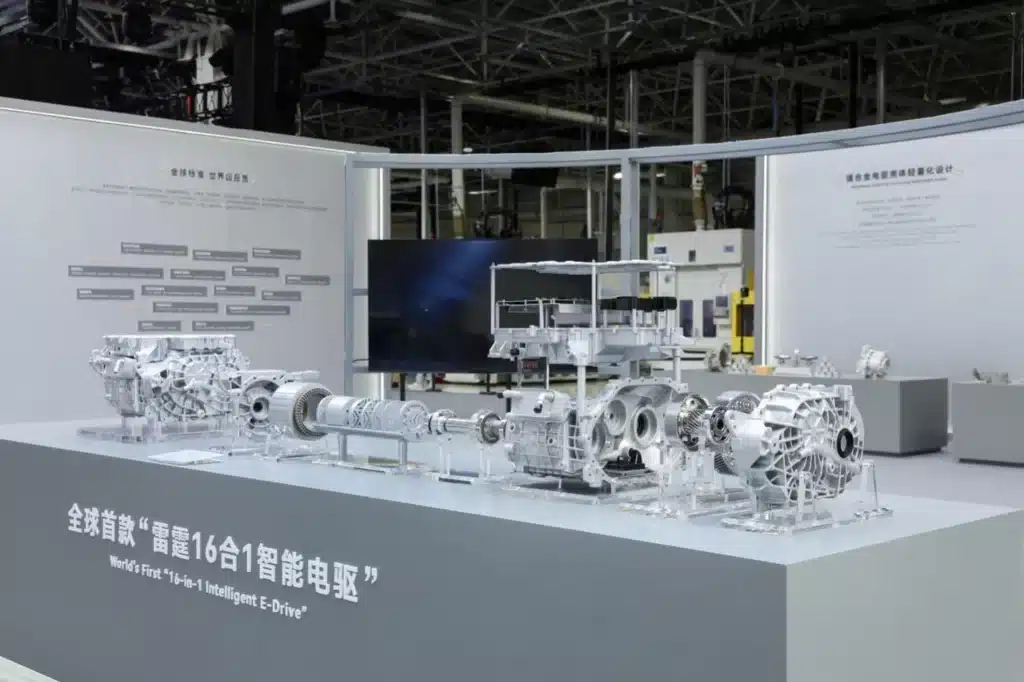
The system will debut in the Geely TT and was developed with support from InfiMotion, Geely’s core ecosystem partner. By combining major electric-drive components and functions into a single 75-kilogram (165-pound) unit, Geely says the architecture reduces weight, simplifies power transmission, and minimizes energy losses.
Built around an 800V high-voltage platform, the 16-in-1 Intelligent E-Drive integrates key hardware into a compact design while achieving a reported 93.8% CLTC comprehensive efficiency rating. The system supports dual-motor all-wheel drive with a combined output of 425 kW, allowing the Geely TT to accelerate from 0 to 100 km/h (0 to 62 mph) in 3.8 seconds.
During an efficiency challenge around Qinghai Lake, the Geely TT achieved the record-setting energy consumption result. Geely says the vehicle earned a Guinness World Records title for the lowest energy consumption while completing a Qinghai Lake route with a mass-produced battery electric sedan.
The electric-drive system was also engineered for high-performance applications. Geely developed a 54-channel directional cooling system that can reduce maximum motor temperatures by up to 15°C (27°F), helping maintain performance during demanding driving conditions. Active lubrication for the shaft and gear system further improves thermal stability, while the company says the platform has been designed for a durability target of 5 million kilometers (3.1 million miles).
In a separate performance test, the Geely TT completed a continuous twin-vehicle drift lasting more than 46 kilometers (28.6 miles) on a wet surface, earning a second Guinness World Records title for the longest continuous twin-vehicle drift on a wet surface by electric vehicles.
Li Chuanhai, Vice President of Geely Auto Group and President of Geely Automobile Research Institute, said the new drive system strengthens Geely’s capabilities in electric powertrain development, intelligent controls, and advanced manufacturing. The company views the technology as an important step toward developing safer, smarter, and more efficient electric vehicles for global markets.
The launch reflects the accelerating competition among global automakers to develop lighter, more efficient, and higher-performing EV platforms as electric transportation continues expanding worldwide.
EVinfo.net’s Take: Geely’s EV Breakthroughs Highlight the Growing Technology Gap Facing the U.S. Auto Industry
Geely Auto Group’s latest electric vehicle technology achievements highlight the rapid progress being made by Chinese automakers and raises important questions about America’s ability to compete in the next generation of transportation.
While Geely’s achievement represents a major milestone for the company, it also underscores the widening gap between China’s rapidly advancing EV industry and the current state of the U.S. automotive market. Chinese automakers have invested heavily in battery technology, electric motors, software, manufacturing efficiency, and supply chains, creating an ecosystem that allows them to develop and launch advanced EVs at remarkable speed.
The United States remains home to some of the world’s most innovative automotive companies, but competition in the global EV market is intensifying. China’s automakers are producing more models, reducing development timelines, and introducing new technologies at a pace that challenges traditional industry leaders.
For the United States to regain a leadership position in the global auto industry, greater focus will be needed on advanced manufacturing, battery production, electric powertrain development, artificial intelligence, charging infrastructure, and domestic supply chains. The future of transportation will be shaped by the companies and countries that can innovate the fastest.
Instead of accelerating the transition away from fossil fuels, the U.S. administration is loosening incentives and standards that protect public health and the climate. These decisions are not minor regulatory adjustments. These policies will increase harmful smog, worsen air pollution, undermine climate progress, and cost drivers more money over time, because they discourage EV production and EV adoption.
The competition with China is not simply about producing more electric vehicles. It is about developing the technologies that will define mobility for decades. Geely’s achievement serves as a reminder that the United States must correct its misguided federal anti-EV policies, accelerate innovation and strengthen its automotive ecosystem if it intends to remain a global transportation leader.

Electric Vehicle Marketing Consultant, Writer and Editor. Publisher EVinfo.net.
Services