Why EV Charging Warranty Strategy Is Becoming a Critical Business Decision
On May 20, 2026, the International Energy Agency (IEA) reported in its Global EV Outlook 2026 that electric car sales grew by 20% globally to exceed 20 million in 2025, meaning one-quarter of all new cars sold were electric.
Global new electric vehicle sales are expected to continue growing rapidly through 2030, driven by falling battery costs, expanding model availability, and increasing consumer acceptance. Industry forecasts generally project annual global EV sales to more than double between 2026 and 2030, with electric vehicles accounting for a significantly larger share of new vehicle purchases in major markets such as China, Europe, and North America.
At the same time, the used EV market is expected to expand even faster as millions of first-generation EVs enter the secondary market, making electric transportation accessible to a broader range of buyers. In North America, growing inventories of used EVs from vehicles coming off leases, improving battery durability, and declining resale prices are expected to accelerate adoption among cost-conscious consumers.
As both new and used EV sales rise, the total installed base of electric vehicles on the road will increase substantially, creating greater demand for reliable charging infrastructure, service networks, and long-term equipment support. This growth is expected to place additional emphasis on charger uptime, maintenance programs, and warranty protection as charging providers work to support a rapidly expanding population of EV drivers through the end of the decade.
Regulatory Attention is Increasingly Focused on EV Charging Warranty Programs
As the electric vehicle charging industry expands, warranty programs are attracting a level of regulatory and financial scrutiny that barely existed a few years ago. What was once viewed primarily as an operational issue is increasingly becoming a strategic business decision with important implications for finance, compliance, customer satisfaction, and long-term growth.
State insurance regulators are paying closer attention to ancillary service products, including warranty and extended-service programs offered directly by charging hardware manufacturers. As a result, Original Equipment Manufacturers (OEMs) are beginning to recognize that the structure of a warranty program can carry significant risks if not designed correctly.
Several factors are driving this shift. Federal requirements for National Electric Vehicle Infrastructure (NEVI) projects require funded charging stations to achieve 97% uptime. Charge Point Operators (CPOs) are responsible for meeting those standards, and equipment reliability plays a direct role in their success. When chargers remain offline because warranty claims move slowly or repair funding is insufficient, operators often hold the equipment manufacturer accountable.
The commercial impact can be just as significant. Drivers who encounter broken chargers may choose alternative charging locations in the future. Reduced customer confidence can lead to lower utilization, lost revenue for charging operators, and fewer repeat orders for the hardware manufacturer.
Warranty Exposure Can Cost OEMs Significantly, Working With a Licensed Insurer Removes Risk
For OEMs, the key question is not whether warranty exposure exists. It does. The more important question is whether the manufacturer should retain that exposure internally or transfer a portion of the risk through a specialized warranty structure.
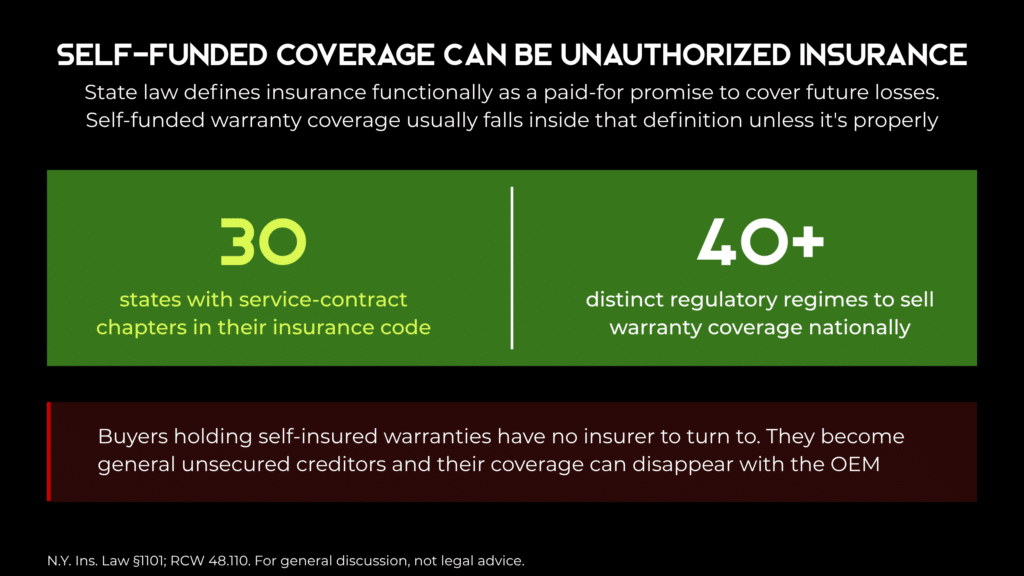
When a manufacturer self-underwrites its warranty program, it effectively assumes responsibilities similar to those of an insurance provider. That means maintaining reserves, estimating future repair costs, managing claims obligations, and navigating regulatory requirements. These responsibilities can create both financial and legal challenges.
From a financial perspective, self-insured warranty reserves remain on the manufacturer’s balance sheet throughout the coverage period. Those reserves are based on estimates that may change as failure rates, repair costs, labor expenses, and component prices evolve over time. As programs grow, those liabilities can become increasingly material to financial reporting and business planning.
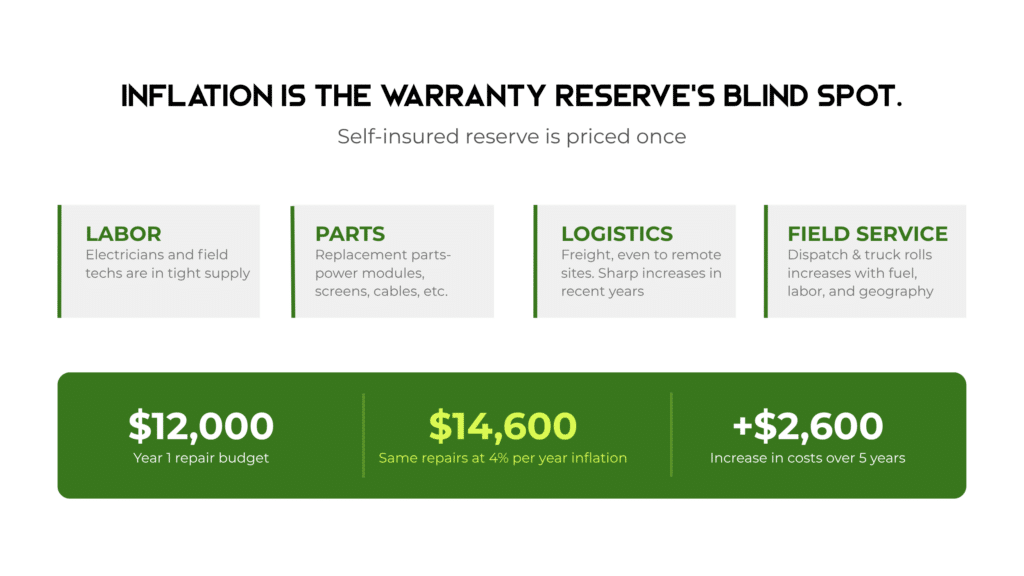
Warranty obligations can also create earnings volatility. If actual repair costs exceed expectations or a component experiences widespread failures, manufacturers may be forced to increase reserves and recognize additional expenses. Inflation can further amplify the challenge by increasing labor, logistics, replacement parts, and field-service costs over multi-year warranty terms.
Regulatory considerations add another layer of complexity. Extended-service and warranty programs are regulated differently across states, often requiring specific licensing, disclosures, filings, cancellation provisions, and record-keeping procedures. Companies operating nationally may need to comply with numerous state-specific requirements, creating an ongoing administrative burden.
EVSTAR’s Insurance-Backed Extended Service Contracts Assume Risks, Provide Several Advantages
To address these challenges, EVSTAR offers insurance-backed extended service contracts for EV charging infrastructure, underwritten by AIG Warranty. Rather than keeping all warranty obligations on the OEM’s books, the covered layer of risk is transferred to a licensed insurance carrier.
EVSTAR released a white paper in July 2026, Self-Insuring Warranty Programs. The white paper details several potential advantages of insurance-backed extended service contracts.
Risk transfer moves covered warranty reserves off the manufacturer’s balance sheet and onto the insurer’s books. The OEM replaces uncertain future repair costs with a defined contractual expense, improving financial predictability.
The approach can also provide tax and accounting benefits. Instead of carrying reserves that may not generate deductions until claims are paid, manufacturers may be able to treat premiums as current business expenses, subject to applicable tax and accounting guidance. Fixed contract pricing can also reduce earnings volatility caused by changing warranty assumptions.
Another benefit is inflation protection. Once coverage is established, future increases in labor costs, replacement parts, logistics, and service expenses become part of the insurer’s risk profile rather than the OEM’s. This can help companies better manage long-term financial planning.
Compliance responsibilities are also streamlined. Licensing, contract filings, disclosures, cancellation procedures, and record-keeping requirements are managed within the insurance-backed framework, reducing the regulatory burden on the manufacturer.
The decision ultimately comes down to where warranty exposure should reside. Every OEM pays for warranty risk in some form. The choice is whether that risk remains on the company’s balance sheet as an estimated liability subject to changing assumptions and compliance requirements, or whether a defined portion is transferred through an underwritten structure supported by a trusted and licensed insurer, such as EVSTAR.
As EV charging infrastructure becomes increasingly important to transportation networks, warranty strategy is evolving from a back-office function into a critical component of financial management, regulatory compliance, and customer confidence. Companies that carefully evaluate how warranty risk is structured may be better positioned to support reliable charging operations while managing the growing demands of a rapidly expanding industry.
EVSTAR Offers EV Charger Warranty Protection Everywhere, Every time
EVSTAR is a national renewable energy service and warranty company focused on protecting EV charging infrastructure through insurance-backed warranty solutions. The company serves OEMs, charge point operators, distributors, resellers, fleet operators, infrastructure developers, and service providers by offering extended protection plans designed to reduce financial risk and improve charger reliability.
Unlike traditional self-funded warranty programs, EVSTAR’s coverage is underwritten by AIG Warranty, allowing companies to transfer a defined layer of warranty exposure to a licensed insurance provider while gaining access to comprehensive coverage for mechanical and electrical failures, power surges, accidental damage, parts, and labor.
EVSTAR’s product portfolio includes comprehensive protection plans, OEM warranty backstop programs, and liability-transfer solutions for companies that have previously sold self-underwritten warranties. The company positions these offerings as a way to improve uptime, create more predictable operating costs, reduce compliance burdens, and strengthen customer confidence in EV charging infrastructure.
See EVSTAR’s white paper, Self-Insuring Warranty Programs, detailing several potential advantages of insurance-backed extended service contracts.
By providing nationwide coverage and warranty administration across multiple charger brands and manufacturers, EVSTAR aims to help the EV charging industry manage risk more effectively while supporting the continued expansion of reliable charging networks across North America. Contact EVSTAR today for more information.

Electric Vehicle Marketing Consultant, Writer and Editor. Publisher EVinfo.net.
Services