American Battery Startup Seeks to Break China’s Dominance of the EV Supply Chain
China dominates the global EV battery industry because it controls much of the supply chain, from critical mineral processing and cathode and anode production to battery cells and finished packs. Chinese companies such as CATL and BYD operate at enormous scale, helping drive down manufacturing costs while rapidly improving energy density, charging speed and battery longevity. China also dominates production of lithium iron phosphate (LFP) batteries, which are increasingly popular because they are cheaper and avoid the need for nickel and cobalt.
Massive domestic EV demand gives Chinese battery manufacturers a huge home market in which to scale new technologies before exporting them worldwide. This combination of supply-chain control, manufacturing scale, technical expertise, government support and intense competition has given China a substantial advantage in EV batteries, making it difficult for manufacturers in the U.S. and Europe to quickly develop comparable capacity.
Pure Lithium Targets Graphite-Free Battery With 9,315-Cycle Lifespan
Chicago-based battery startup Pure Lithium is developing a potentially disruptive battery that it says could be cheaper and more energy dense than today’s conventional lithium-ion batteries while relying on a North American supply chain. The technology is not solid-state and does not use a silicon anode. Instead, Pure Lithium is developing a lithium iron phosphate (LFP) battery that eliminates the graphite traditionally used in lithium-ion battery anodes.
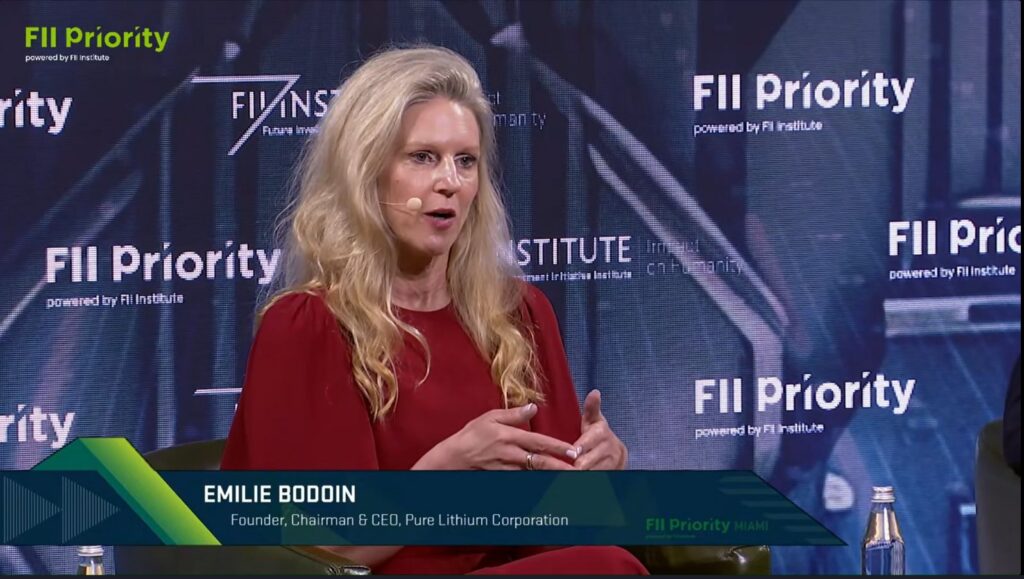
The company announced a potentially significant breakthrough this week, reporting that one of its lithium-metal batteries reached 9,315 charge-discharge cycles during laboratory testing. That is more than three times the cycle life of a conventional lithium-ion battery. Pure Lithium called the result unprecedented, saying that, to its knowledge, no other lithium-metal battery in development has achieved comparable results under equivalent testing conditions.
The development could have major implications for the North American battery industry. The vast majority of lithium-ion batteries currently depend heavily on Chinese supply chains, creating a push in the United States to both reduce that dependence and develop battery technologies capable of giving EVs greater range, faster charging and longer lifespans.
Pure Lithium’s approach focuses on eliminating graphite, which the company says is expensive and environmentally damaging to mine. More than 90% of the world’s graphite is processed in China, according to the U.S. Energy Information Administration. Graphite also adds weight and occupies valuable space inside battery cells. While graphite provides a structure that allows lithium ions to be stored and released during charging and discharging, it does not actively participate in the battery’s electrochemical reaction.
By eliminating graphite, Pure Lithium says it can free up space inside the cell for additional energy-producing material. CEO Emilie Bodoin told Bloomberg that the company’s technology is “half the weight and double the energy density” of the batteries currently in widespread use. The company is not yet selling batteries commercially. Pure Lithium is building a pilot production line in Chicago and looking for manufacturing and automotive partners to help commercialize the technology.
For the cathode, Pure Lithium uses LFP chemistry. LFP batteries have historically depended heavily on Chinese supply chains, although production is gradually becoming more localized in the United States. The chemistry also eliminates the need for several expensive and environmentally problematic materials used in other battery chemistries, including nickel, manganese and cobalt, in addition to graphite on the anode side.
Nickel-rich batteries still offer higher energy density than conventional LFP cells. Pure Lithium believes its lithium-metal design can narrow or eliminate that disadvantage by freeing up space on the anode side and replacing graphite with lithium metal.
The company’s 9,315-cycle laboratory test used a 1C charge and discharge rate. In simple terms, the battery was fully charged in approximately one hour and then fully discharged in approximately one hour, repeatedly. That represents a demanding test of the cell. Real-world EV batteries are rarely subjected to that level of continuous stress.
The test results showed the battery retaining nearly all of its discharge capacity after more than 9,000 cycles. The testing was not continuous, however. Pure Lithium paused the experiment at approximately 6,000 cycles while relocating its headquarters from Boston to Chicago. The battery remained at room temperature for four months before testing resumed. After the pause, the cell showed even greater capacity retention compared with the point at which testing stopped.
Pure Lithium also acknowledged that larger fluctuations during the early portion of the test resulted from a lack of temperature control and multiple power failures at its Boston laboratory.
The latest result builds on an earlier test conducted in January 2025. At that time, Pure Lithium reported that one of its batteries retained more than 80% of its capacity after 2,200 cycles at a similar 1C charge and discharge rate. The newer cell therefore appears substantially more durable.
The company did not disclose the specific energy density of the cell used in the 9,315-cycle test. Pure Lithium says its Gen 1 battery reaches 300 Wh/kg, while its Gen 2 technology is expected to reach 425 Wh/kg.
Pure Lithium’s battery is graphite-free, but it is not technically anode-free. Instead, the company uses electrodeposition to manufacture its lithium-metal anode. Lithium metal is deposited directly onto a copper current collector until the desired thickness is reached, effectively creating the anode as part of the manufacturing process.
Bodoin said more than 40 companies are currently in discussions with Pure Lithium about scaling the technology. She said battery manufacturers are already familiar with lithium-metal technology, but Pure Lithium’s objective is to make the technology inexpensive while simplifying production. The company says its electrodeposition process can create the lithium anode, which is a complete battery component, in a single step.
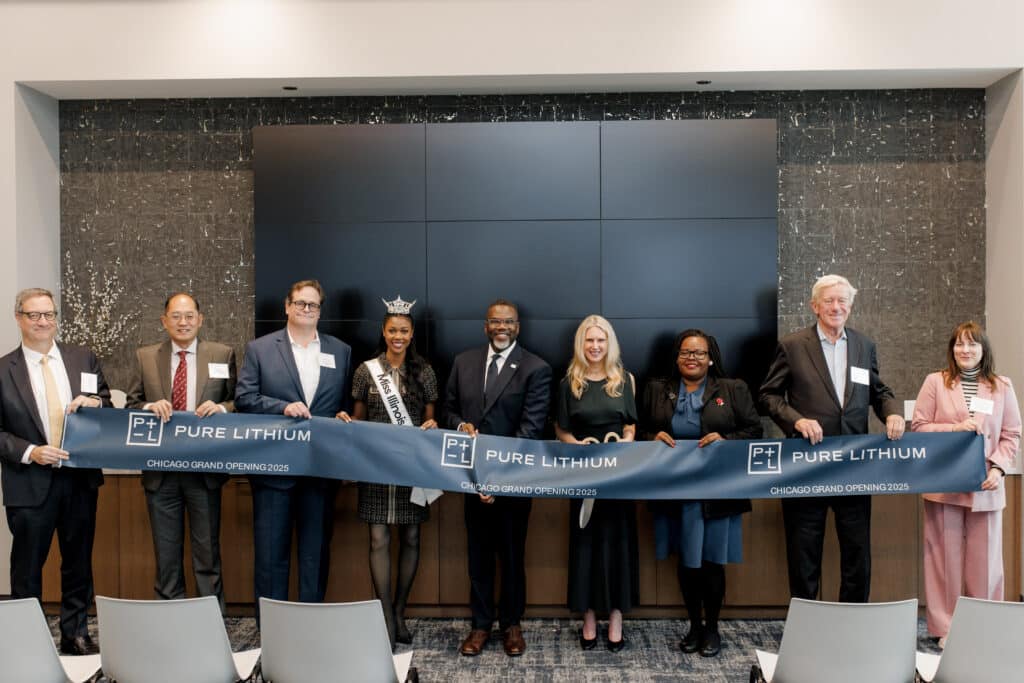
In October 2025, EVinfo.net reported Pure Lithium Corp. officially opened its new headquarters in Chicago’s Fulton Market district. A ribbon-cutting ceremony was held at the company’s 21,000-square-foot facility at 400 N. Aberdeen St.
Pure Lithium is not alone in pursuing graphite-free lithium-metal batteries. Battery manufacturers and startups around the world are exploring different chemistries and manufacturing approaches to improve performance and regionalize supply chains. Some companies are developing silicon or synthetic-graphite anodes, while several U.S. startups are working on lithium-metal technologies designed to reduce North America’s dependence on China.
Factorial, Solid Power and QuantumScape are also developing graphite-free lithium-metal batteries, although their approaches differ from Pure Lithium’s. Factorial and QuantumScape are pursuing solid-state or semi-solid-state electrolytes. Solid Power is developing both silicon-anode and lithium-metal technologies around a sulfide solid electrolyte.
Pure Lithium is taking a different path. Its battery uses a liquid electrolyte and puts much of its emphasis on the manufacturing process for the lithium-metal anode. If the company can translate its laboratory cycle-life results, energy-density targets and electrodeposition process into affordable mass production, its technology could provide another path toward longer-lasting, higher-energy EV batteries while helping North America reduce its dependence on China’s battery supply chain.

Electric Vehicle Marketing Consultant, Writer and Editor. Publisher EVinfo.net.
Services