BYD Upgrades Popular Small Electric SUV With More Range, Starting at $11,000
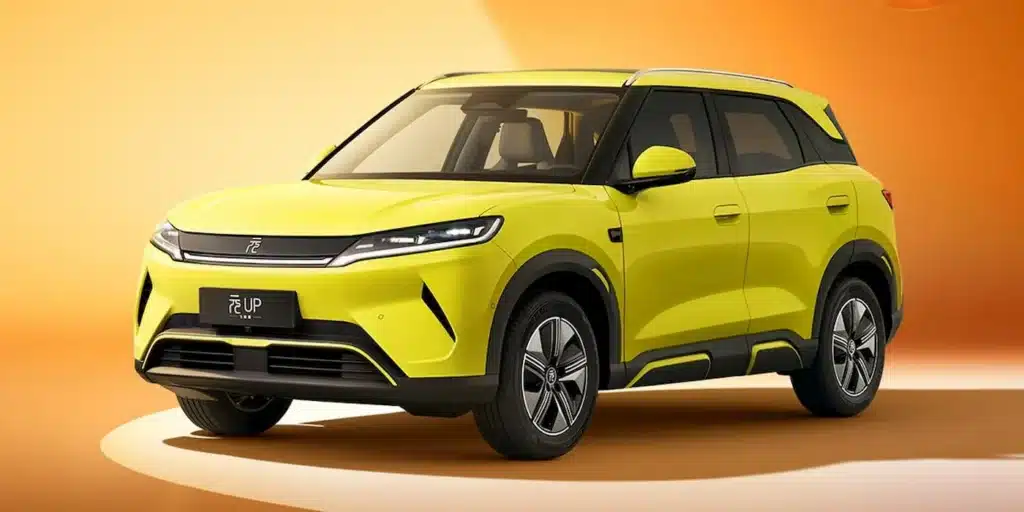
BYD has upgraded its Yuan Up small electric SUV, sold as the Atto 2 in Europe and other markets, adding a longer-range version while lowering the price of one of its existing configurations.
The 2027 BYD Yuan Up Flying Spur is offered in five trims in China, priced from 74,800 to 104,800 yuan, or about $11,000 to $15,500. A limited-time 5,000-yuan replacement subsidy reduces the range to approximately $10,000 to $14,500.
The compact SUV is already a strong global seller, ranking fifth among the world’s best-selling EVs during the first half of 2026, according to CleanTechnica data.
The updated model retains 32 kWh and 45.12 kWh battery options, providing CLTC ranges of 301 and 401 kilometers. A new Excellent version uses a 51.13 kWh battery to deliver up to 501 kilometers of CLTC range. The 401-kilometer version is about 18,000 yuan, or $2,500, cheaper than the current model.
The Yuan Up remains the same size as its predecessor, roughly comparable to a Hyundai Kona. Inside, it gains a new two-spoke steering wheel, column-mounted electronic shifter, 12.8-inch infotainment display and 8.8-inch digital instrument cluster.
All versions feature BYD’s DiLink 100 Advanced Smart Cockpit with voice control and smartphone connectivity. Available technology includes a 360-degree panoramic imaging system and BYD’s God’s Eye C driver assistance system with features such as highway Navigate on Autopilot and Remote Parking Assist.
The upgrade highlights the rapid expansion of affordable EV choices in China, where automakers continue competing on price, range and technology.
China’s growing electric vehicle exports may be starting to affect global gasoline demand, according to Reuters analysis of 2026 trade data. Several countries, including Australia, Brazil, South Korea, the UAE, Canada, Nigeria and Japan, have increased imports of Chinese EVs while reducing gasoline imports.
The trend is particularly notable in Australia, where gasoline imports fell 15% while Chinese EV imports surged nearly 200%. South Korea cut gasoline imports about 44% while significantly increasing Chinese EV purchases, while Japan reduced gasoline imports 11% as Chinese EV purchases jumped 90%.
Even oil-producing economies are seeing increased EV adoption. The UAE’s gasoline imports fell 61% during the first half of 2026 while Chinese EV imports reached more than $1.4 billion.
Emerging markets are also beginning to adopt Chinese EVs. Pakistan increased Chinese EV imports 549% to nearly $500 million while reducing gasoline imports. Nigeria similarly increased EV imports as gasoline imports fell.
EVinfo.net’s Take: Detroit’s EV Retreat Could Cost America the Future of the Auto Industry
EVinfo.net wrote recently that while Detroit pulls back on EVs, the rest of the world continues moving forward.
The U.S. auto industry is pulling back on electric vehicle investments while global competitors, particularly Chinese automakers, continue growing fast, advancing EV technology, batteries, software and manufacturing. Several Detroit automakers have delayed or canceled EV programs and shifted greater attention toward hybrids and gasoline vehicles, raising concerns about long-term competitiveness.
The situation echoes earlier periods when U.S. automakers underestimated major changes in consumer demand and allowed foreign competitors to gain market share. Today, rising fuel costs and growing EV adoption are driving another major global transformation, but the industry now has established electric alternatives and rapidly improving technology.
China has emerged as the global EV manufacturing leader, with companies such as BYD benefiting from vertically integrated battery and vehicle production. Continued investment will further expand China’s advantages in EV costs, technology and supply chains.
The U.S. still has substantial engineering, manufacturing and automotive capabilities, with companies including Ford, Rivian and Lucid continuing to develop EVs. More affordable models, improved batteries and expanding charging infrastructure could support further growth.
The direction of the global auto industry is increasingly tied to electrification, making continued investment in EVs, batteries, manufacturing capacity and supply chains vital to maintaining U.S. competitiveness.

Electric Vehicle Marketing Consultant, Writer and Editor. Publisher EVinfo.net.
Services