Smart EV Load Management Could Save Europe €10 Billion in Electricity Grid Investment
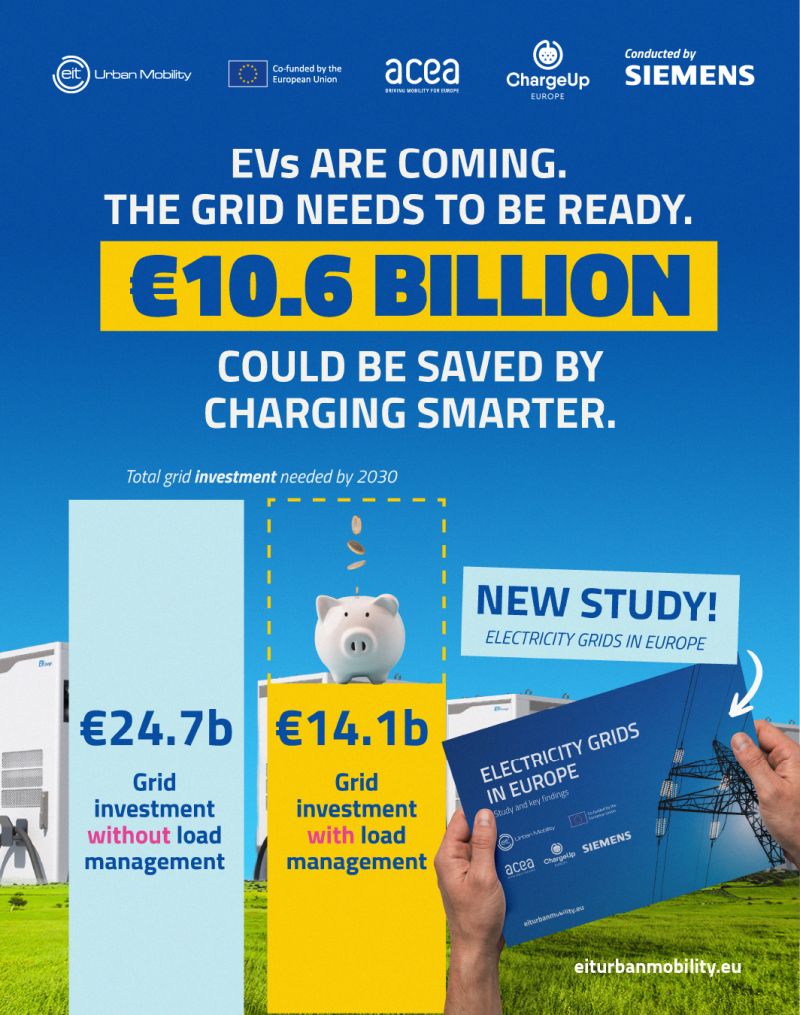
Europe could avoid more than €10 billion in electricity grid investment by using existing capacity more efficiently as electric vehicle adoption accelerates.
A study commissioned by EIT Urban Mobility, ChargeUp Europe and ACEA and conducted by Siemens estimates that accommodating projected EV growth by 2030 would require about €24.7 billion in electricity distribution grid investment. Intelligent EV Load Management could reduce that requirement to approximately €14.1 billion, avoiding €10.6 billion in investment.
The study, Electricity Grids in Europe, examined the impact of passenger and light-duty vehicle electrification across the EU27 and three EEA countries. Researchers modelled electricity demand in 64 representative European cities, examining residential, workplace, public, en route and depot charging.
EV Load Management coordinates when and how quickly vehicles charge, helping prevent local grid overloads during periods of peak demand. Combined with grid digitalization and smart charging, the approach can make better use of existing network capacity while reducing the need for costly grid reinforcement.
The study estimates that BEV numbers across the 64 cities will increase 3.8 times by 2030, with every city requiring some level of grid reinforcement. The greatest pressure will fall on low-voltage networks, which account for 77.7% of projected physical grid reinforcement investment, largely because of residential EV charging.
Residential charging is expected to remain particularly important, with 55% to 62% of EV owners in the representative cities projected to have access to home charging by 2030.
The findings show that EV adoption and charging behavior are closely linked to grid investment. Smarter charging can help Europe integrate millions of electric vehicles while making more efficient use of the electricity infrastructure already in place.
EIT Urban Mobility Accelerates Europe’s Shift to Sustainable Transportation
EIT Urban Mobility is working to accelerate the transition to sustainable urban mobility by connecting businesses, startups, universities, research organizations and public-sector partners with funding, talent, markets and knowledge. Founded in 2019 as an initiative of the European Institute of Innovation and Technology, EIT Urban Mobility is focused on helping European cities develop and deploy solutions to increasingly complex transportation challenges.
The organization works with more than 250 partner organizations and a wider network of more than 1,250 organizations across 33 countries. Its goal is to support more livable, sustainable and decarbonized urban environments while strengthening Europe’s mobility innovation ecosystem.
EIT Urban Mobility focuses on four areas: connecting stakeholders, developing talent, bringing innovations to market and helping startups scale. Its programs support real-world pilots, education and training, access to funding, startup investment and partnerships between cities, researchers and businesses.
The organization also operates five Innovation Hubs in Amsterdam, Munich, Copenhagen, Barcelona and Prague, providing regional connections and support for local mobility innovation. Its startup portfolio includes more than 140 companies working on sustainable urban mobility solutions.
For the growing electric vehicle market, EIT Urban Mobility’s work highlights the importance of connecting EVs, charging infrastructure, energy systems, cities and transportation services. Its research and innovation programs help address the infrastructure and mobility challenges that will accompany Europe’s transition to cleaner transportation.
With urban populations growing and transportation systems facing increasing pressure, EIT Urban Mobility is focused on moving mobility innovations from development into practical use across European cities.

Electric Vehicle Marketing Consultant, Writer and Editor. Publisher EVinfo.net.
Services