BYD’s Ultra-Fast Flash EV Charging Network Surpassed 10,000 Stations
BYD is preparing to expand its Flash Charging technology beyond China, with plans to bring the chargers to markets including Europe and Canada. EVinfo.net reported that Jan Haugen Ihle, Head of Flash Charging, Northern Europe at BYD, is looking for partners to establish the BYD Flash Charging Network across Northern Europe.
Not long ago, BYD celebrated the rollout of its 5,000th ultra-fast Flash Charger in April. Just five months later, on August 28, 2026, the Chinese EV giant doubled that number, reaching 10,000 Flash Chargers across more than 300 cities, according to Chinese news outlet IT Home.
BYD said the milestone makes it the Chinese automaker with the largest self-built charging network and the broadest geographical charging coverage. The company is not stopping at 10,000 chargers. BYD plans to install 20,000 Flash Chargers across China by the end of 2026.
Reaching that goal will require a significant increase in the company’s deployment pace. Since April, BYD has installed roughly 34 charging stations per day. With about 125 days remaining in the year, doubling the network again would require the company to deploy at least 80 chargers every day.
Even if BYD falls short of its 20,000-charger goal, the expansion is remarkable. These are not conventional 350-kilowatt DC fast chargers like those commonly found in the United States. BYD’s Flash Chargers can deliver as much as 1.5 megawatts of power through a single charging cable, more than three times the output of many high-powered consumer EV chargers in the U.S.
The Flash Charging stations also incorporate on-site battery storage. The batteries act as a buffer for the electrical grid while helping the chargers deliver extremely high amounts of power without placing the entire load directly on the grid at once.
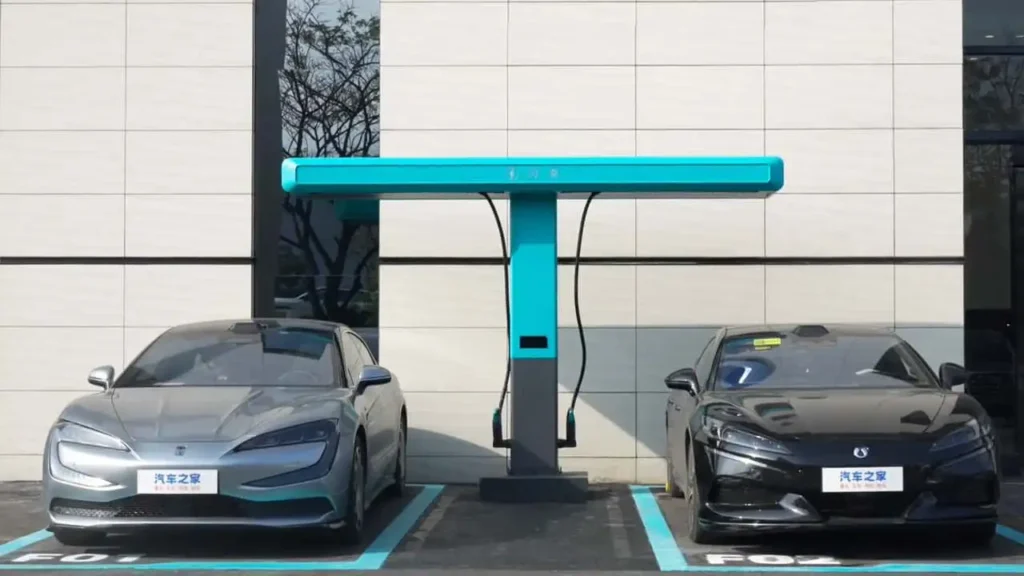
BYD’s Flash Chargers feature a distinctive T-shaped design with rails and sliding cables. According to BYD, the design keeps charging plugs from hitting the ground while making the heavy cables easier to maneuver.
The technology can deliver extremely fast charging for BYD’s newest vehicles equipped with Blade 2.0 batteries. Those vehicles can reportedly charge from 10% to 97% in approximately nine minutes.
The company also recently provided encouraging data regarding battery durability under repeated high-power charging. Over nine days, BYD used Flash Chargers to recharge a Yangwang U7 350 times while the vehicle traveled 30,000 kilometers. The results were encouraging and suggest that extremely rapid charging does not necessarily lead to the severe battery degradation some might expect.
Importantly, BYD’s charging network is not limited to BYD vehicles. The automaker reported delivering 210 gigawatts of electricity to 1.83 million drivers during the first six months of operation. About 33% of those drivers used the chargers with vehicles from other manufacturers.
EVinfo.net’s Take: BYD’s 10,000 Flash Chargers Show How Far Behind the U.S. Is in the EV Race
BYD reaching 10,000 ultra-fast Flash Chargers across more than 300 Chinese cities is more than an impressive charging milestone. It is a warning about the widening gap between China and the United States in the global electric vehicle transition.
The scale and speed of this deployment demonstrate what can happen when EVs, charging infrastructure, automakers and government policy move in the same direction. China is building an enormous domestic EV ecosystem, supporting vehicle manufacturing, batteries, charging equipment, software, electrical infrastructure and thousands of related businesses and jobs.
The United States remains a major player in the automotive industry for now, but inconsistent federal EV policy threatens its ability to compete. Rather than establishing a long-term industrial strategy for electrification, U.S. policy continues to fluctuate, creating uncertainty for automakers, charging companies, battery manufacturers, suppliers and investors. The federal administration’s cutbacks of EV support, while increasing support for gas-burning vehicles, has been a disaster.
That uncertainty and mistakes like those carry a tremendous economic cost. The global automotive industry is rapidly transitioning toward electric propulsion. Countries that build the factories, batteries, charging networks and technologies needed for that transition will capture a significant share of the resulting economic growth and employment.
The U.S. should therefore view EV policy as an economic competitiveness issue, not simply an environmental one. Strong federal support for EV manufacturing, battery production, charging infrastructure, research and development, and consumer adoption could help American companies compete globally while creating high-quality domestic jobs.
BYD’s 10,000 Flash Chargers should be a wake-up call. If the United States allows China and other countries to dominate the technologies and infrastructure powering the next generation of transportation, America risks surrendering manufacturing capacity, technological leadership and economic opportunities.
The global EV transition is happening regardless of whether the United States chooses to lead it. The question is whether American workers and businesses will benefit from that transition or watch much of the economic growth go elsewhere.

Electric Vehicle Marketing Consultant, Writer and Editor. Publisher EVinfo.net.
Services