CA Passes Bill Integrating Customer-Owned Clean Energy Technologies Directly Into Electricity Capacity Market
California lawmakers passed landmark legislation designed to lower electricity costs and strengthen grid reliability by integrating customer-owned clean energy technologies directly into the state’s electricity capacity market and resource planning.
Senate Bill 913, authored by Senator Josh Becker, Democrat of Menlo Park, directs the California Public Utilities Commission to reform California’s Resource Adequacy framework.
The legislation modernizes resource adequacy rules so customer-owned resources, including home batteries, electric vehicles and smart thermostats, can compete alongside traditional power generation to provide grid reliability at the lowest possible cost.
Under the revised framework, investor-owned utilities including Pacific Gas and Electric, Southern California Edison and San Diego Gas and Electric would be required to incorporate distributed energy resources into peak-demand capacity planning.
The legislation specifically targets customer-sited technologies such as residential solar-plus-storage systems, bidirectional EV chargers, smart thermostats and grid-connected heat pumps. By aggregating these devices into Virtual Power Plants, grid operators can dispatch stored electricity back to the grid or reduce electricity demand during periods of extreme weather and peak evening demand.
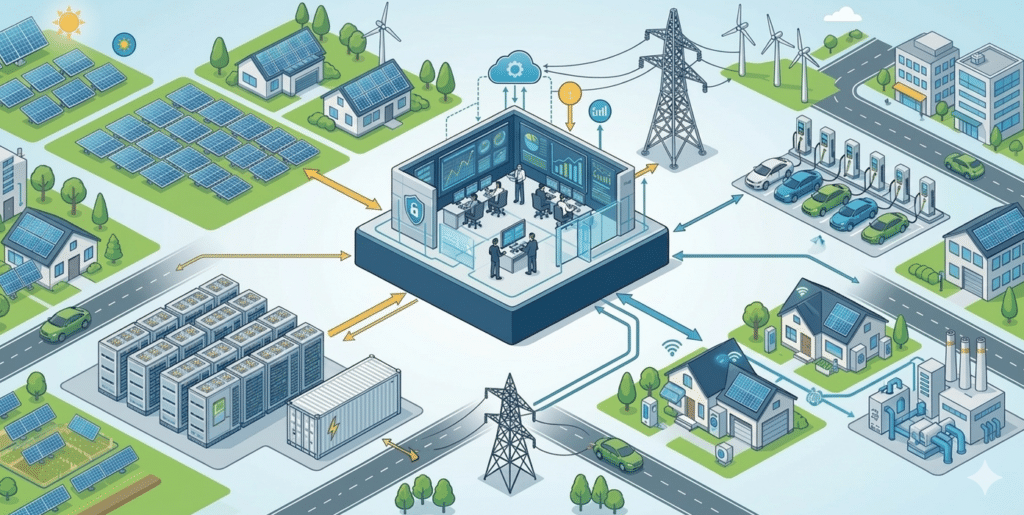
California households install more than 8,000 energy storage systems each month, representing nearly 100 MW of additional capacity every month. However, regulatory barriers and restrictive enrollment requirements have historically limited the ability of home batteries and vehicle-to-grid systems to receive capacity credit for exporting electricity during peak demand events.
Senate Bill 913 addresses those barriers through four major market reforms.
First, the legislation formally recognizes bidirectional EV charging as an eligible capacity resource, moving beyond traditional demand response toward active electricity exports during peak periods.
Second, it streamlines registration for residential property owners and third-party Virtual Power Plant aggregators.
Third, the bill allows multiple distributed energy technologies at a single property to be combined into one managed resource. A household, for example, could combine an EV charger, smart thermostat and solar-plus-storage system into a single grid-managed profile.
Fourth, the legislation requires metering and export compensation to be calculated at the device level during high-demand grid events.
Supporters, including trade groups and environmental organizations such as The Climate Center, Environment California and Advanced Energy United, argue that making greater use of customer-financed energy resources could reduce the need for utilities to build expensive gas peaker plants and additional transmission infrastructure. Those investments can ultimately increase costs for ratepayers through higher electricity bills.
Brandon Garcia, California Director at Advanced Energy United, said the legislation could help address rising electricity costs by giving customer-owned energy resources a greater role in the electricity system.
“California families and businesses across the state are struggling to keep up with rising electricity bills,” Garcia said. “SB 913 takes an important step toward changing that by giving customer-owned resources a fair opportunity to compete and deliver reliable energy at an affordable price.”
Senator Becker similarly pointed to the potential benefits of using clean energy resources that Californians have already installed in their homes. The approach could provide another way to manage grid reliability while limiting the need for more costly infrastructure investments.
Following passage of the legislation, the California Public Utilities Commission will begin formal rulemaking proceedings to establish specific compensation tariffs and aggregation protocols for participating utilities and Virtual Power Plant technology providers across California.
Electric Vehicle Marketing Consultant, Writer and Editor. Publisher EVinfo.net.
Services