How Three Colorado Districts Are Charging Electric School Buses (and Why None of Them Did It the Same Way)
Electric school buses in Colorado are past their pilot stage: Denver Public Schools now runs the largest electric fleet in the state, Thompson School District in Loveland is running its first electric routes on three chargers, and Weld County RE-5J is installing bidirectional chargers so its buses can back up an emergency shelter.
Over the past year, Winn-Marion Companies has had a hand in all three. Each one needed different equipment and different power, because each district needed the buses to do something different. As Winn-Marion put it in an earlier piece on EVinfo.net, the solution fits the fleet, not the other way around.
What’s the same is the order of operations. Before anyone picks a charger, someone has to look at the routes, the site, the utility service, and the funding rules, and decide what the charging actually needs to do. The three projects below started with that same question and ended up in three very different places.
Thompson School District: Three Chargers, Sized to the Fleet
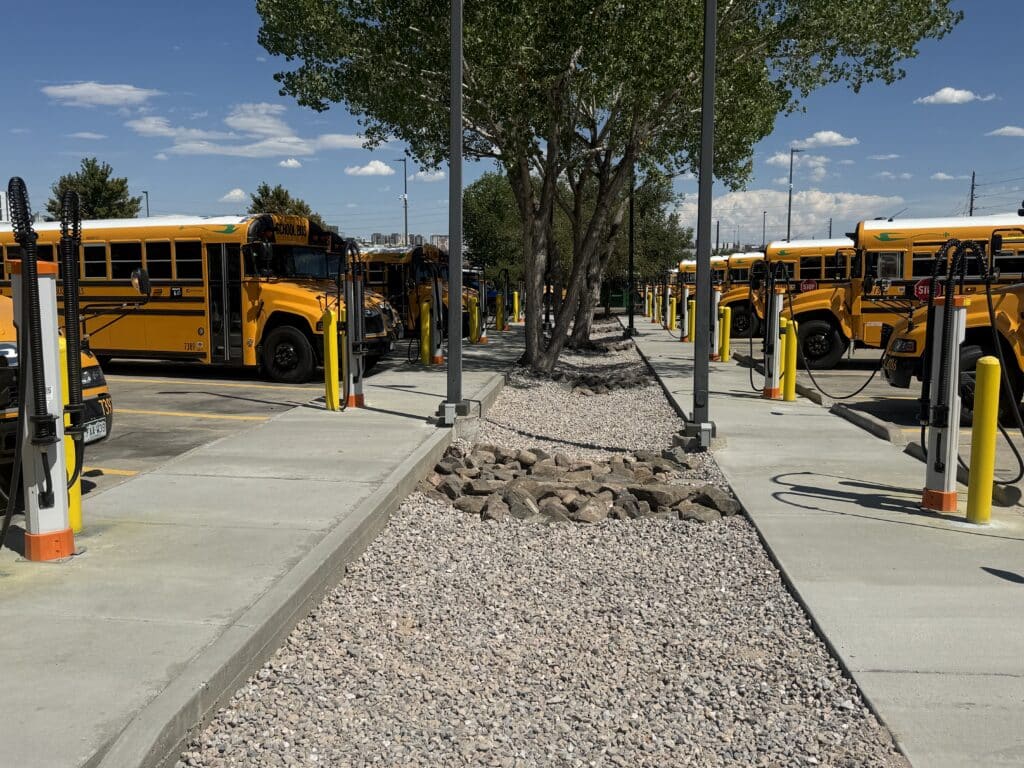
Thompson School District, based in Loveland, added Type A electric buses to its fleet in 2025 and needed charging at its transportation facility that would be ready for the start of the school year. The district’s routes and overnight dwell times made the sizing decision clear: three 30 kW Tellus Power DC fast chargers, pedestal-mounted, with ChargePilot smart charging software from The Mobility House managing the load across all three.
A Type A bus that comes back in the afternoon has all night to charge, and at 30 kW it’s full with hours to spare ahead of morning pickup. Thompson’s transportation team understood that going in. What Winn-Marion added was the site work behind that decision: walking the transportation facility with the district, confirming the routes and dwell times matched the sizing, checking the existing electrical service, and designing the civil (trenching, conduit, and concrete pads), switchgear, and software around three chargers rather than the larger service and trenching that higher-power equipment would likely have required.
The result was a build scaled to the fleet the district actually runs, with a clear path to add capacity when the fleet grows. Winn-Marion self-performed the full scope, from trenching and switchgear through electrical, commissioning, and driver training, and delivered it against the district’s July 2025 deadline with a five-year service agreement behind it.
Dan Blanchard, EV Business Development Manager, Winn-Marion Companies, said: “Thompson is what most districts’ first project looks like, and it’s the one we point to when someone asks where to start. Get the first buses charging reliably, size the site for what’s actually there, and leave yourself room to grow.”
When Denver Public Schools needed the same result at close to ten times the size, Winn-Marion started in the same place: the routes, the site, the service, and what the buses actually needed.

Denver Public Schools: 26 Plugs, One Shared Pool of Power
Denver Public Schools has been adding electric buses since 2021, and this August it added 25 at once. The new Blue Bird Vision buses arrived over about two weeks, bringing the district’s electric fleet to 28, roughly 12% of its yellow buses, and every one of them had to be charged and ready at the Hilltop Bus Terminal before classes started on August 24.
The order of operations looked the same as Thompson’s, with more riding on each answer. Twenty-six plugs on one site meant the electrical service, the depot layout, and how power gets shared between buses all had to be decided together, and a fleet this size would never charge evenly, with some buses coming back nearly empty and others barely used. Winn-Marion recommended a Kempower distributed system for exactly that reason: it treats the whole depot as one pool of power and moves it to where the buses need it.
The system delivers 650 kW of centralized power to 13 dual-port Kempower Satellite dispensers, one at each pair of bus stalls, for 26 plugs. The power units allocate energy in 25 kW increments and move it continuously to wherever it’s needed, so as one bus tops off and its draw falls, that capacity shifts to the next one. The district gets fast overnight charging for the whole fleet on an electrical service sized for how the buses actually charge, and it doesn’t have to build for a worst-case night when all 26 plugs want full power at once.
Behind the dispensers, the build included a new 750 kVA Xcel Energy service, all switchgear and wiring from the transformer to each stall, and ChargePilot scheduling sessions around Xcel’s peak windows. Winn-Marion’s crew finished the installation on August 5, nearly three weeks before the first day of school.
Jim Hussey, Electrification Solutions Specialist, Winn-Marion Companies, said: “We couldn’t be more pleased with the entire team’s performance on this significant project. Denver Public Schools is a smart, organized group, Kempower has been highly supportive from day one, and The Mobility House has proven to be an outstanding partner in the Smart Charging and Energy Management space.”
Weld County representatives asked the same questions and arrived at a different kind of answer. There, the buses had a second job: keeping the lights on at an elementary school when the grid goes down.

Weld County RE-5J: the Bus is the Battery
Weld County School District RE-5J serves about 4,000 students in Johnstown and Milliken, northeast of Denver. In 2025 Xcel Energy selected the district for what RE-5J describes as a first-of-its-kind electric school bus resilience pilot in Colorado. The selection criteria say a lot about the purpose: districts had to be in Xcel’s service territory, in a wildfire-prone area, and have a school building that could serve as an emergency shelter. Through Xcel’s Transportation Electrification Plan and a state Clean Fleet grant, the district is receiving six Blue Bird Vision electric buses along with the chargers and the bidirectional infrastructure to go with them, at no cost to local taxpayers.
Winn-Marion designed and built both sites. At the Roosevelt Middle School bus barn in Johnstown, three InCharge Energy ICE-44 bidirectional chargers handle managed overnight charging for the fleet. At Milliken Elementary, two InCharge ICE-66 bidirectional chargers do double duty. On a normal day they provide supplemental charging for buses passing through. When the grid goes down, they reverse power flow and draw from the buses’ batteries to run a defined set of loads inside the school: the gymnasium, the cafeteria, the IT and fire system room, and the boiler controls. Those are the spaces that turn an elementary school into a shelter.
The part of this that makes it work safely is what happens before any energy leaves a bus. Those critical loads sit on their own sub-panel, and a set of islanding switchgear separates that panel from the Xcel grid the moment an outage is detected, so the school can run on bus power without backfeeding onto utility lines. Winn-Marion fabricates that switchgear in its own UL-certified panel shop rather than ordering it from a third-party manufacturer. On a grant-funded project with a hard completion date, that decision kept the most schedule-sensitive component of the whole system under Winn-Marion’s control.
Limiting the islanded loads to the shelter spaces rather than the whole building is also what makes the stored energy last. With both Milliken chargers discharging, the system is designed to deliver up to 132 kW to those loads.
Both sites run ChargePilot, with a local controller in each electrical room that keeps managing charging even when the internet is down. At Milliken, the software also manages the switch between grid-tied and islanded operation and enforces a minimum state of charge on the buses, so that even in an extended outage the fleet keeps enough energy in reserve to move students if an evacuation is called.
Josh Cole, EV Division Supervisor and Master Electrician, Winn-Marion Companies, said: “Bidirectional chargers are the part everyone sees, but the part that matters is the switchgear that isolates the building and the commissioning that proves it works. Building that in-house meant we controlled the schedule instead of waiting on someone else’s lead time.”
The charging infrastructure at both sites is in place, and the district expects its six buses to arrive by the end of September. Once they do, Milliken Elementary becomes something few schools in Colorado can claim: a shelter with its own power supply parked in the lot.
What the Three Have in Common
Three districts, three fleets, three different sets of hardware. What stayed constant was the approach: start with the routes, the site, and the utility service, work through Xcel Energy design and permitting, build it with Winn-Marion’s own electricians, and commission it with the charge management software running before handoff.
Winn-Marion’s Blanchard said: “If your district is thinking about electric buses, or already has a grant and a delivery date but isn’t sure what comes next, we’d like to hear about it. Every one of these projects taught us something, and the districts asking the questions now are going to shape what the next round looks like. We’d rather be part of that conversation early than show up with a quote later.”
For Colorado districts weighing their own next step, two things are worth knowing. The Colorado Energy Office’s Fleet-ZERO program opens its next application round on October 12, and it funds charging for school buses. And Winn-Marion’s NASPO ValuePoint contract lets districts procure charging equipment and installation directly, without running a separate competitive bid. Either way, it starts with a conversation.
Winn-Marion, an EV Charging Industry Leader
Winn-Marion brings more than 50 years of industrial engineering, electrical, automation, and controls expertise to the growing EV charging market. The company provides end-to-end EV charging solutions for commercial, industrial, municipal, and fleet applications, working with leading manufacturers. Its offerings range from Level 2 AC charging to high-power DC fast charging, with services covering engineering, site assessments, equipment selection, permitting, installation, commissioning, testing, maintenance, and ongoing technical support.
For fleet operators, Winn-Marion can design charging infrastructure for electric buses, delivery vehicles, taxis, rental vehicles, service fleets, and heavy-duty trucks. Its approach is designed to help businesses reduce fuel and operating costs while lowering emissions and preparing for increased electrification. The company also helps customers evaluate available incentives and financing opportunities, while its engineering and electrical teams can assess existing infrastructure and develop charging systems that can expand as fleet and energy needs grow.

Electric Vehicle Marketing Consultant, Writer and Editor. Publisher EVinfo.net.
Services