Kia Unveils PV7 Electric Van at IAA Transportation 2026
Kia Corporation unveiled the Kia PV7 at IAA Transportation 2026 in Hannover, Germany, on September 14, 2026. The second model in Kia’s dedicated, all-electric Platform Beyond Vehicle (PBV) lineup, the PV7 expands the company’s presence in the light commercial vehicle segment with Cargo and Passenger variants designed for business and mobility applications.
Built on Kia’s PBV-dedicated E-GMP.S architecture, the PV7 features a flat floor that maximizes interior space and flexibility. The vehicle combines electric performance, connected technology and productivity-focused solutions for fleet, logistics, shuttle, small- and medium-sized business and personal mobility applications. Kia plans to launch the PV7 in Korea and Europe in the second half of 2027, followed by additional markets and derivatives.
The PV7 builds on the foundation established by the PV5, which was named the 2026 International Van of the Year. Kia describes its PBV strategy around three pillars: hardware, software and service. The hardware uses the E-GMP.S architecture and Kia’s Flexible Body System (FBS), a modular body architecture designed to support multiple body styles, derivatives and conversion models.
On the software side, Kia Business Solutions Portal supports fleet management, charging, maintenance and daily operations. Standardized Fleet Management System capabilities and connected vehicle data APIs are designed to improve fleet visibility and operational efficiency. Kia also provides Uptime services using real-time monitoring, predictive diagnostics and proactive maintenance management to reduce disruptions.
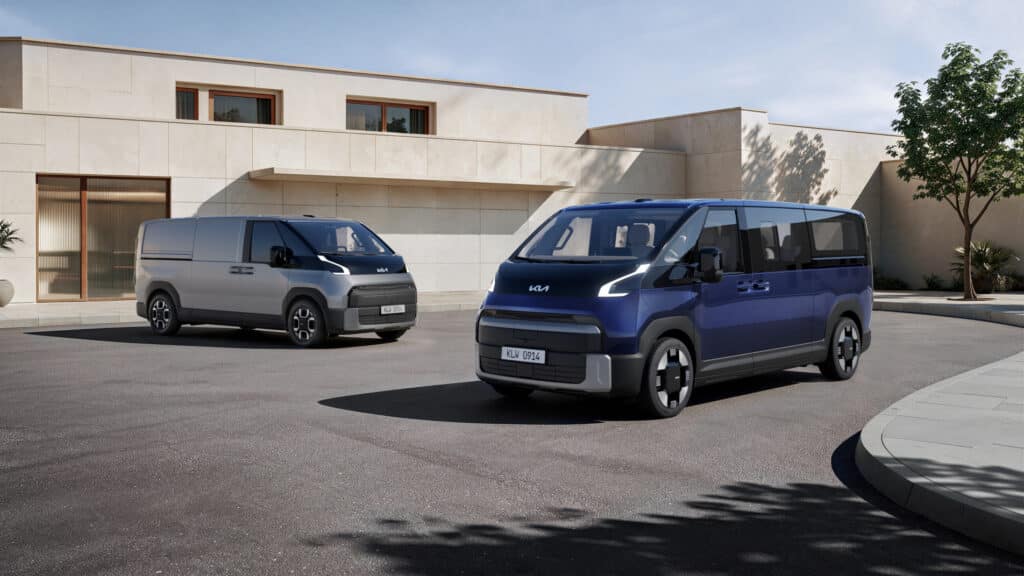
Kia plans to expand the PV7 lineup to 23 variants following its 2027 launch, with the PV9 scheduled to follow in 2029. The company says its business-tailored services are intended to lower total cost of ownership and support higher vehicle uptime.
The PV7 follows Kia’s “Tool Box” development concept, which focuses on vehicles optimized for specific customer requirements. While the PV5 uses an “Open Box” concept emphasizing urban flexibility, the PV7 provides greater capacity and payload for more demanding operating environments and larger-scale applications. The design also addresses driver, operator and passenger needs by reducing physical strain during entry and loading while improving usability, convenience and safety.
The PV7 is available with 71.5 kWh and 96.2 kWh nickel cobalt manganese (NCM) battery packs. Depending on market and configuration, its electric powertrain delivers up to 200 kW and 420 Nm of torque to the front wheels. Front-wheel drive is standard, while an all-wheel-drive version is planned for later. The Long Range Cargo variant offers more than 460 km of all-electric range under the WLTP cycle, based on internal testing and subject to homologation.
Its 800V architecture enables 10-to-80% charging in the mid-20-minute range using a 350 kW DC fast charger, based on Kia’s internal testing. The PV7 also introduces dual charging ports, with a front AC/DC port and an optional rear-side AC charging port to provide greater flexibility in different parking and charging environments.
The vehicle incorporates Pleos Connect, based on Android Automotive OS, providing connected navigation, flexible screen layouts, an open app marketplace and over-the-air updates. Gleo AI, an AI-powered voice assistant, enables natural-language control of vehicle, navigation and messaging functions, although availability varies by market, model and trim. Vehicle-to-Load (V2L) functionality can power tools, business equipment and other devices through interior and exterior outlets. A heavy-load driving mode helps the Cargo model maintain stable driving performance by adapting to varying payload conditions.
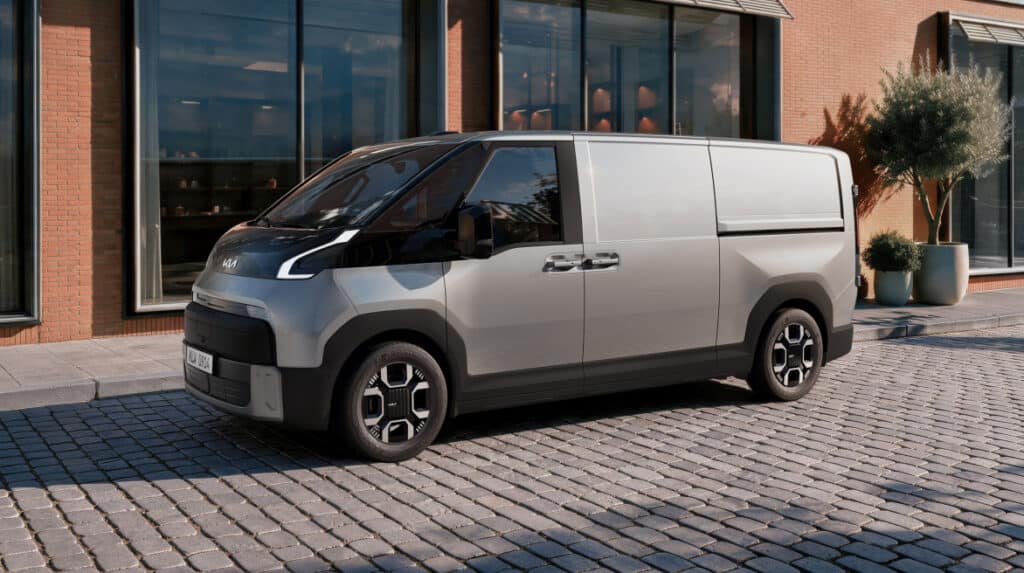
The PV7 Cargo is designed for logistics, delivery, fleet and small- and medium-sized business operations. Global configurations include two- and three-seat versions. The Cargo Long provides up to 6.1 m³ of cargo space under the VDA standard, while the Cargo High Roof provides up to 8.0 m³. Maximum payload capacity reaches 1,165 kg for the Long and 1,200 kg for the Compact variant.
The Cargo Long has a 550 mm loading height and can carry up to three Euro pallets measuring 800 × 1,200 mm. Floor materials can be tailored to different applications. Buyers can choose a full-open twin-swing tailgate for loading in confined spaces or a conventional lift-up tailgate. Smart Walk Away automatically closes the power sliding door when the driver leaves with the smart key, while cargo-door status monitoring allows remote checks. A load-through bulkhead is available on three-seat configurations, and independent cargo-door locking and unlocking adds cargo security.
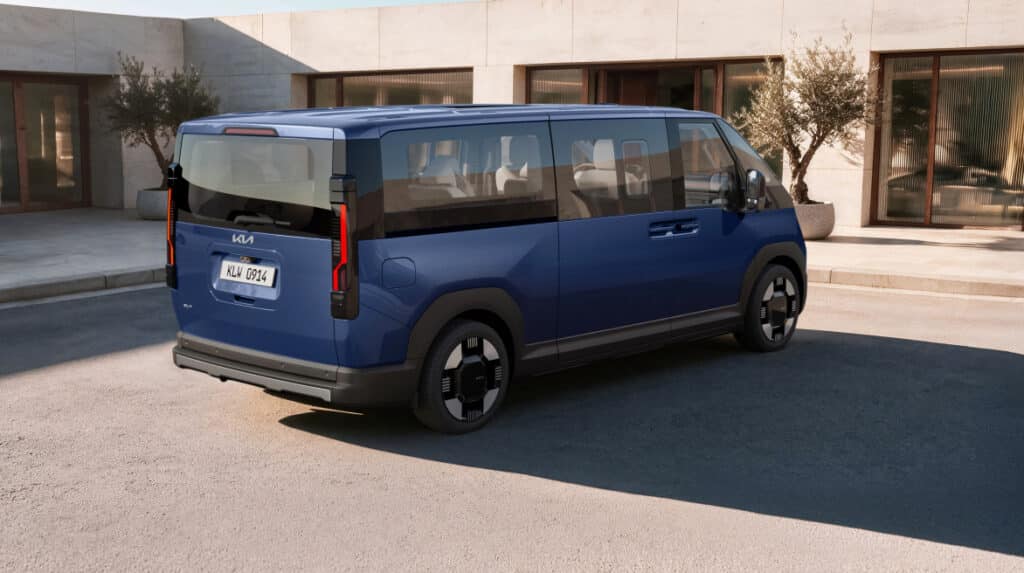
The PV7 Passenger is designed for crew transport, shuttle and rental services, tourism and family use. It accommodates up to nine occupants globally and up to 11 in Korea, with multiple seating configurations. The seven-seat version features Long-Rail Easy Remove Seats that allow flexible interior arrangements. The nine-seat model can be configured with or without a fourth row. Rear climate control, available 100W USB-C charging ports and storage solutions further support passenger use.
Safety equipment includes seven airbags, including a roof-mounted front passenger airbag, and Pedal Misapplication Safety Assist 2.0 (PMSA 2.0), designed to help reduce unintended acceleration caused by incorrect pedal operation. Available ADAS technologies include Forward Collision-Avoidance Assist, Lane Keeping Assist 2.0, Navigation-based Smart Cruise Control, Highway Driving Assist 2.0, Front, Side and Rear Parking Distance Warning, Remote Smart Parking Assist, Rear View Monitor and Surround View Monitor. Built-in Cam 3.0 allows drivers to capture and review driving footage. Availability varies by market, derivative and vehicle specification.
The PV7 was developed under Kia’s “Opposites United” design philosophy, combining bold, upright proportions with a squared-off cab-forward silhouette and flat roofline. The design builds on the PBV identity established by the PV5 while emphasizing interior space, accessibility and usability.
At the front, the PV7 uses the black hood treatment shared with the PV5. A visual connection between the A-pillars and daytime running lights reinforces the one-box form, while the black hood and pillar garnish contrast with the body color. Signature Kia lighting, hidden headlamps and a robust lower treatment give the vehicle a distinctive appearance. A protective skid plate below the bumper adds to its durable character.
The side profile incorporates a floating-roof graphic. On the Passenger model, the effect comes from visually connecting the black fender and D-pillar trim with the wraparound glazing. A lowered front beltline and kick-down graphic improve openness and visibility, while expansive glazing enhances outward and corner visibility. Pronounced fenders, black wheel-arch cladding and different glazing and trim treatments distinguish Passenger and Cargo versions.
At the rear, variant-specific door and tailgate designs balance practicality and visual consistency. Technical rear-light graphics, exposed hinges and defined opening layouts emphasize functionality. Replaceable bumper corners, wheel-arch sections and door cladding are designed to simplify repairs and reduce downtime.
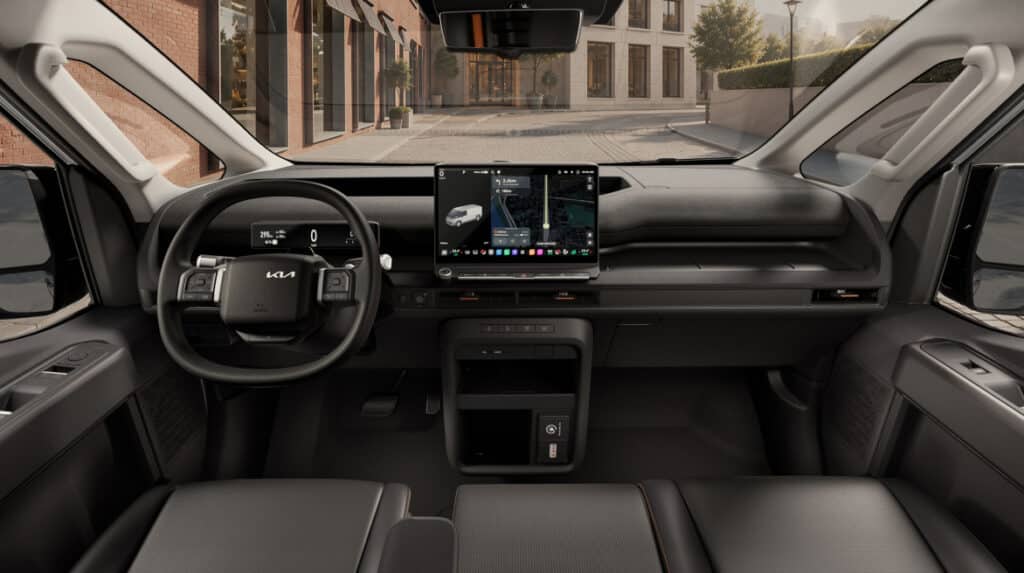
The interior creates organized, purpose-built spaces for Passenger and Cargo applications. Both variants feature practical storage and user-focused technologies, including 12.9-inch and 14.6-inch displays for vehicle information and connected services. The driver environment includes an A-pillar grab handle, optimized seating position and refined step geometry to make frequent entry and exit easier. Physical controls for frequently used functions complement Pleos Connect.
The PV7 Cargo uses a “Mobile Workspace” concept with a layered dashboard and center fascia designed to maximize usable space. Open storage keeps essential items accessible, while three-seat models feature a fold-down center seatback that creates an open tray.
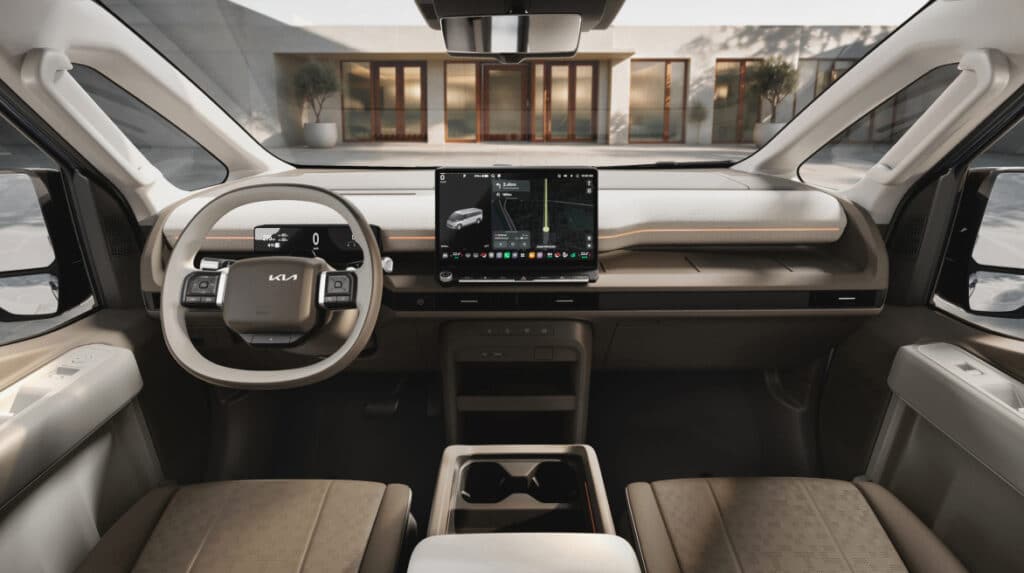
The PV7 Passenger emphasizes comfort and refinement with two-tone finishes, enclosed storage, available ambient lighting and an optional center console that can function as a table. The roof-mounted airbag permits additional dashboard storage, complemented by an overhead driver storage compartment. Rear features include roof-integrated climate controls, available power-sliding doors and newly developed seats.
Kia’s color, material and finish strategy gives the Cargo and Passenger models a shared design language while creating distinct identities. Exterior colors include newly developed Fjord Blue, Solid Moonrock Gray and Lush Green, with matte body finishes also available.
The Cargo model uses an Onyx Black One-Tone interior as standard, with Deep Navy One-Tone also available. Orange accents add contrast, while a speckled open tray is designed to resist dirt and s
EVinfo.net’s Take: Americans Are Not Likely to Have These Great Vehicles
The PV7 Passenger and Cargo models are planned for launch in Korea and Europe in the second half of 2027, no plans to release these in the U.S. were announced. A new article spells out the reasons why and how to fix America’s EV problem.
In their article “Planning Ahead: How to Revitalize America’s EV Industry before ‘China Shock 2.0’, released September 14, 2026, authors Greg Pollock and Joshua Busby give a great breakdown why America’s auto industry is in dire trouble due to current federal administration mistakes, and automakers’ drastic over-reaction to those blunders, causing EV cutbacks costing billion-dollar losses.
The United States faces a growing challenge from China’s dominance of electric vehicles and battery supply chains, making the competitiveness of America’s EV industry a strategic as well as economic concern. The authors argue that revitalizing the sector will require more than restoring consumer subsidies: policymakers should prioritize affordable EVs, encourage automakers to produce lower-cost models, expand reliable charging infrastructure, diversify battery supply chains through domestic production and allied partnerships, and provide greater long-term policy certainty for manufacturers making major investments.
They also highlight the need to improve access to home charging for consumers without private garages, build dependable fast-charging corridors, strengthen domestic battery-material processing and recycling, and reconsider regulations that may limit competition or new market entrants. While tariffs and other trade measures may provide U.S. automakers with time to adjust, the authors argue that this window should be used to improve productivity, reduce costs and build an EV industry capable of competing globally rather than relying indefinitely on protection or subsidies. Their central concern is that allowing the U.S. EV market to stagnate could leave American automakers and battery manufacturers increasingly dependent on technologies and supply chains controlled by China, creating a broader industrial and strategic vulnerability.

Electric Vehicle Marketing Consultant, Writer and Editor. Publisher EVinfo.net.
Services