AI and Robots Push Automotive Plants Toward Automated Manufacturing
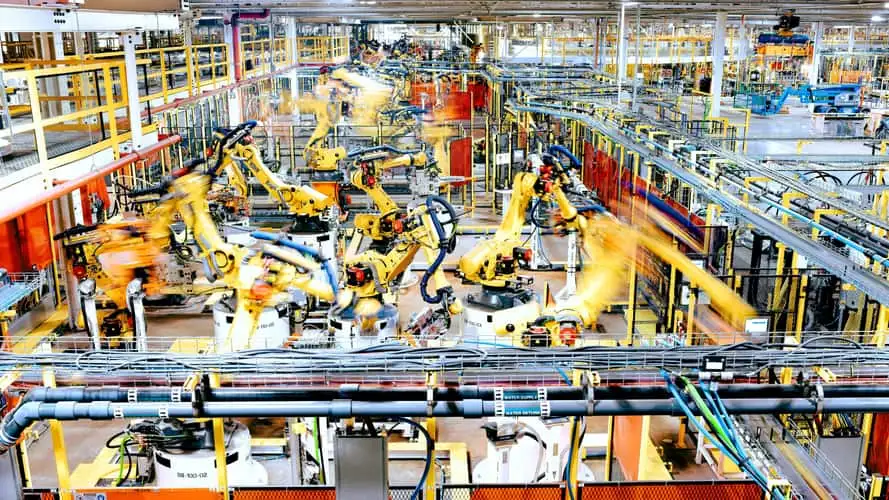
Chinese automakers, including Zeekr, BYD, and Xiaomi, are automating large portions of vehicle production, moving the industry closer to factories that can operate with minimal human involvement. Advances in artificial intelligence (AI) and robotics are accelerating the shift, putting pressure on traditional automakers in the United States, Germany, and Japan to improve manufacturing efficiency.
Finance & Commerce reported September 28, 2026, that although fully lights-out mass-production automotive factories do not yet exist, some Chinese plants already operate extensive automated production areas with little or no lighting because robots perform the work. Final assembly still generally requires human workers, but automation levels are reportedly higher than many Western observers realize.
“There are entire sections where lights aren’t on or you don’t see people,” Tu Le, managing director of consulting firm Sino Auto Insights, said to Finance & Commerce. He noted that Chinese factories still employ people in final assembly, although robots handle more tasks than many Western workers might expect.
Automakers and suppliers are increasingly exploring AI-powered robotics, collaborative robots, and automated quality-control systems. The technology could improve productivity and reduce manufacturing costs, but it also raises concerns about job losses, retraining, and the future role of human workers.
United Auto Workers President Shawn Fain warned at a Detroit conference over the summer that AI could threaten union jobs on a scale comparable to the effects of the North American Free Trade Agreement decades ago. He said workers and their union must respond quickly as the technology advances.
Ford, GM, and Stellantis Expand Automation
Ford Motor Co. is investing $2 billion to overhaul its Louisville Assembly Plant to produce the new Fathom electric pickup using a highly automated manufacturing process. The modernization is expected to reduce staffing by approximately 600 workers.
The changes come as Ford CEO Jim Farley has repeatedly praised China’s manufacturing capabilities while warning that the country’s growing automotive industry poses a serious threat to Ford’s future.
General Motors has also expanded automation, adding dozens of collaborative robots, or cobots, at its Factory ZERO facility in Detroit. The move drew criticism from the UAW because more than 1,000 workers remained on layoff.
Stellantis is deploying AI-powered robotics for tasks including quality inspection and tracking parts inventory inside factories.
AI-driven automation has also become a central issue in UAW leadership elections scheduled to conclude in October 2026. Presidential candidate Greg Mooney has called for stronger AI-specific language in union contracts and retraining programs that would help workers transition into jobs involving robotics and AI.
“We need to have a seat at the table on how it’s going to be implemented,” Mooney said. “AI’s not going away.” He described the technology as the greatest labor issue of the current generation.
Automotive Suppliers Explore Lights-Out Factories
Bosch, the German automotive supplier, is expanding automation while emphasizing collaboration between workers and robots. Paul Thomas, president and CEO of Bosch in North America, said a fully automated factory would be an ideal long-term objective, but the company’s current approach focuses on balancing cost, quality, and social responsibility.
Thomas said automation has also allowed Bosch to expand workers’ technical skills. Employees who previously assembled parts are increasingly taking responsibility for programming and controlling the programmable logic controllers that operate automated equipment.
Forvia, a French automotive supplier with a significant Michigan presence, is developing AI systems that automatically inspect weld quality and identify defects in products such as vehicle seats. The company is also studying robots capable of handling diverse materials, including metal, plastic, foam, and leather.
Chad Durkee, Forvia’s technology scouting director in North America, said AI gives automation capabilities that were previously unavailable, allowing the technology to scale more quickly.
However, moving toward lights-out manufacturing will take time. Durkee said automakers may need to redesign components and subassemblies so robots can assemble them more easily.
According to a recent PwC report, automakers have invested more than $100 billion in AI across their operations over the past five years, with investment continuing to increase. Applications include automated quality inspections and other systems designed to improve factory efficiency.
C.J. Finn, PwC’s U.S. automotive industry leader and a report co-author, expects AI-powered robots to attract further investment. However, he cautioned that smart robotics will not transform manufacturing overnight and that fully lights-out automotive factories remain a longer-term prospect.
Industries with simpler manufacturing processes are likely to achieve lights-out production before automakers, he said.
China Has an Advantage in Factory Automation
Many Chinese automotive factories were built from the ground up with automation in mind. Strong demand for electric vehicles, which have far fewer mechanical components than conventional combustion-engine vehicles, also creates opportunities for greater robotic involvement in assembly.
China’s industrial robotics deployment has expanded rapidly. In 2024, the country accounted for more than half of all industrial robot installations worldwide.
Older U.S. factories often present greater automation challenges because their layouts and production systems were not originally designed around extensive robotics. American consumers have also shown less demand for electric vehicles than Chinese consumers, limiting some opportunities to streamline production around EV-specific manufacturing processes.
Nevertheless, Le expects the United States to have a lights-out automotive factory within 15 years. He argued that automakers must automate their factories to remain competitive.
Jeff Burnstein, president of the Association for Advancing Automation in Ann Arbor, Michigan, supports robotics but questions whether completely eliminating human involvement in manufacturing is desirable.
He warned that a future in which robots perform nearly all work could create broader economic problems, including reducing the number of people earning wages and able to purchase the products factories manufacture.
The automotive industry is therefore confronting two challenges at once: adopting AI and robotics quickly enough to compete with increasingly automated Chinese manufacturers while managing the employment and economic consequences of replacing human labor. Lights-out factories remain a longer-term goal, but the transition toward more automated production lines is already underway.

Electric Vehicle Marketing Consultant, Writer and Editor. Publisher EVinfo.net.
Services