China’s BYD ATTO 8 Brings FLASH Charging to Europe, as USA’s Automotive Industry Declines
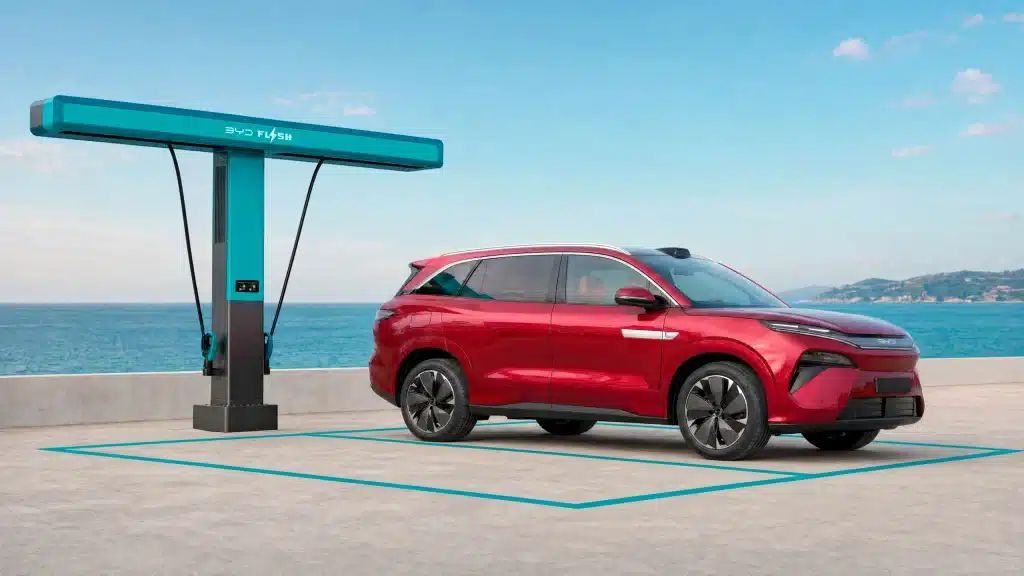
BYD unveiled its ATTO 8 seven-seat electric SUV at the Paris Motor Show on October 12, 2026, introducing a 115 kWh second-generation Blade Battery, up to 405 miles of WLTP range and FLASH Charging that the company says can charge the battery from 10% to 97% in nine minutes. The ATTO 8 becomes the flagship of BYD’s European SUV lineup, above the ATTO 2, ATTO 3, SEALION 5 and SEAL U. Deliveries across European markets are expected to begin in the first quarter of 2027.
FLASH Charging Delivers Rapid Charging
BYD describes its technology with the phrase “ready in 5, full in 9, cold add 3.” The company says the ATTO 8 can charge from 10% to 70% in five minutes and from 10% to 97% in nine minutes. At temperatures as low as -22°F (-30°C), a charge from 20% to 97% reportedly takes 12 minutes. BYD plans to deploy 3,000 FLASH Charging stations across Europe by the end of 2027 and claims the ATTO 8 can charge from 10% to 97% in approximately one-third the time rival SUVs need to charge from 10% to 80%.
BYD Executive Vice President Stella Li said the ATTO 8 combines the company’s latest powertrain, second-generation Blade Battery, cabin technology and seven-seat flexibility. She described FLASH Charging as a breakthrough intended to make recharging as fast as refueling.
Powertrain, Performance and Range
Both ATTO 8 versions use the 115 kWh battery. The Design RWD has a single rear motor producing 456 hp (462 PS/340 kW) and 269 lb-ft (365 Nm) of torque. It accelerates from 0 to 62 mph in 8.0 seconds and delivers up to 405 miles of WLTP Combined range.
The Excellence AWD adds a front motor for a combined 764 hp (775 PS/570 kW) and 572 lb-ft (775 Nm) of torque. It reaches 62 mph in 4.6 seconds, with a WLTP range of up to 374 miles. WLTP figures use the European testing cycle and are not directly comparable with EPA ratings.
Seven-Seat Cabin and Practicality
The ATTO 8 measures 198.4 inches (5,040 mm) long, 78.6 inches (1,996 mm) wide and 69.3 inches (1,760 mm) tall. Exterior features include matrix-LED headlights, an illuminated rear BYD logo and an integrated roof spoiler. BYD says the rear quarter-panel edges improve airflow to help maximize range.
Inside, equipment includes a 10.25-inch digital instrument panel, a 26-inch head-up display and a 15.6-inch central touchscreen with Google built-in. Both versions feature genuine leather upholstery, heated and ventilated front seats with massage functions, and heated, ventilated and massaging outer second-row seats. The third row receives adjustable headrests.
Standard tri-zone climate control includes a rear control panel. A front refrigerator can cool to 21°F (-6°C) or warm to 122°F (50°C). The Design RWD has a 10-speaker audio system, while the Excellence AWD receives 21-speaker DiSound audio. Two 50W wireless phone chargers and dual 60W front USB-C ports are joined by 18W and 60W USB-C ports in the rear. A 25.7-square-foot (2.39-square-meter) panoramic glass roof completes the cabin.
Cargo capacity is 9.5 cubic feet (270 liters) with all three rows in use and 69.2 cubic feet (1,960 liters) with the second and third rows folded. The front trunk adds another 4.8 cubic feet (136 liters).
BYD SHARK DMO Pickup Makes European Debut
BYD also presented the SHARK DMO plug-in hybrid pickup for the European market. Its Super Hybrid DMO powertrain combines a 228 hp (231 PS) front motor, a 201 hp (204 PS) rear motor and a longitudinally mounted 1.5-liter turbocharged four-cylinder gasoline engine that primarily operates as a generator.
Combined output reaches 430 hp (436 PS) and 479 lb-ft (650 Nm), enabling acceleration from 0 to 62 mph in 5.7 seconds. A 32.2 kWh Blade Battery is integrated into the ladder-frame chassis using Cell-to-Chassis construction.
BYD quotes 56 miles of electric-only range and 419 miles of total range with a fully charged battery and full fuel tank. Weighted fuel economy is rated at 67.2 mpg using U.S. gallons (80.7 mpg imperial). At 55 kW, DC charging takes 21 minutes to raise battery charge from 30% to 80%. Vehicle-to-Load functionality supplies up to 6 kW to external equipment. BYD expects sales to begin in selected markets within three months, followed by a broader European rollout in the first half of 2027.
Five-Seat DOLPHIN SURF Debuts
BYD also displayed a five-seat version of its entry-level DOLPHIN SURF. The range-topping Comfort trim upgrades to a 12.8-inch touchscreen with Google built-in and an 8.8-inch instrument display, replacing the previous 7-inch display. All versions move the gear selector to a steering-column stalk, while Boost and Comfort trims add a heated steering wheel. BYD will offer four-seat and five-seat versions side by side, depending on market requirements.
EVinfo.net’s Take: America Falls Further Behind as China and Europe Advance EV Technology
On October 4, 2026, OilPrice.com reported that the share of gasoline-only cars in global new vehicle sales fell below 50% for the first time ever as the Strait of Hormuz crisis and resulting record-high fuel prices accelerated the shift toward electric vehicles (EVs) outside China. Globally, the automotive trend is shifting toward cost-saving, clean electric vehicles.
ABC News reported on October 12, 2026, that China’s passenger car exports rose 64% in September compared with the year-earlier period, according to a Chinese industry association, as automakers increasingly rely on overseas markets to drive growth amid sluggish domestic sales.
In February 2026, Bloomberg reported that for the first time ever, Chinese automaker BYD has overtaken Ford Motor Company in global sales in 2025, edging the U.S. carmaker out by 200,000 vehicles for a total of 4.6 million units sold, pushing BYD up to sixth place among the world’s largest automakers, while Ford dropped to seventh as its global sales fell by nearly 2% to 4.4 million units.
America risks falling further behind in the global automotive industry as China and Europe advance electric vehicle technology, battery innovation, and ultra-fast charging while foolish U.S. federal policy continues to favor gasoline-powered vehicles. The latest foolish policy came in September 2026, as fuel economy standards were eased. This will increase driver costs as gas prices continue to skyrocket, while adding more pollution to the atmosphere, increasing the effects of global human caused climate change and increasing health risks.
Meanwhile, European automakers and charging providers are wisely expanding electric vehicle offerings and infrastructure, giving consumers more options and helping make electric driving increasingly practical.
In the United States, federal policy shifts away from supporting EV adoption are weakening domestic competitiveness at the worst possible time, just as global rivals invest heavily in next-generation vehicles, batteries, and charging networks.
The consequences extend beyond vehicle sales. EV leadership affects manufacturing jobs, battery supply chains, energy security, technological innovation, and the ability of American companies to compete in international markets.
Gasoline vehicles are not the future of automotive technology. Electric vehicles offer efficient operation, reduced tailpipe emissions, and the potential for lower operating costs. Ultra-fast charging can further reduce one of the remaining obstacles to adoption by making long-distance travel more convenient.
America has the engineering talent and industrial capacity to compete. What it needs is consistent policy, investment in charging infrastructure, and a commitment to innovation rather than protecting outdated, polluting, and increasingly expensive to drive gas vehicles.
The global automotive transition is accelerating. If the United States fails to keep pace, American consumers and manufacturers risk losing access to the benefits and economic opportunities created by the next generation of electric transportation.

Electric Vehicle Marketing Consultant, Writer and Editor. Publisher EVinfo.net.
Services