Rivian Buys Startup to Turn 400,000 Daily Clips Into 3D Simulations
Rivian has acquired Third Dimension, a 15-person UK startup that transforms real-world driving footage into detailed 3D environments for autonomous driving simulation. First reported by TechCrunch, the acquisition supports Rivian’s efforts to accelerate development of its self-driving technology. Rivian has not disclosed the purchase price.
Third Dimension was founded in 2024 and developed generative AI technology that creates 3D environments ready for use in game engines. When the company raised a $7 million seed round led by Felicis in October 2024, it targeted customers in gaming, film, the U.S. military, and autonomous vehicle development.
The founders bring experience in both video game development and autonomous driving simulation. CEO Tolga Kart spent more than two years at Tesla working on Autopilot simulation after five years as a senior director on Activision’s Call of Duty franchise. He later led engineering at synthetic data company Parallel Domain.
Cofounder Piotr Sokólski spent four years at Wayve developing photorealistic neural simulators for self-driving vehicles.
The entire Third Dimension team will join Rivian’s autonomy and AI organization under James Philbin. Most team members are based in the UK, giving Rivian a larger engineering presence in London.
“Simulation is central to how we train and validate our autonomous driving systems,” Philbin told TechCrunch. He added that Third Dimension “has built impressive technology that turns real-world data into detailed 3D environments.”
400,000 Daily Clips and the Challenge of Rare Events
Rivian collects driving footage from owners of R1S, R1T, R2, and commercial vans who opt into camera data sharing. Philbin told TechCrunch that the company’s fleet returns more than 400,000 sequences daily.
Most driving footage contains routine situations. The unusual events that challenge autonomous driving systems are much less common, including a mattress falling into a highway lane, a police officer directing traffic through a red light, or a child running between parked cars.
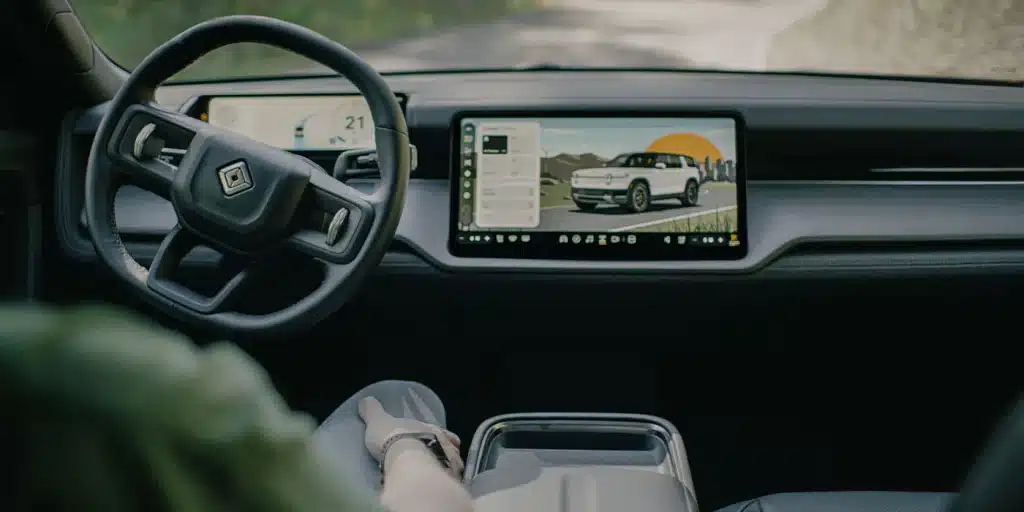
Automakers can wait months for their fleets to encounter enough unusual situations, or reconstruct real-world scenes in 3D and change individual variables to test different outcomes. Third Dimension’s technology is designed to support that second approach.
Rivian is not alone in pursuing this strategy. Waymo introduced its Waymo World Model in February 2026, using Google DeepMind’s Genie 3 to generate scenarios its vehicles have never encountered. Tesla has also demonstrated a neural world simulator for its Full Self-Driving system.
The Uber Robotaxi Deadline
Rivian faces pressure to advance its autonomous driving capabilities as it prepares for its partnership with Uber. In March 2026, Uber agreed to invest up to $1.25 billion in Rivian to support the deployment of R2 robotaxis, although only $300 million is provided upfront. The remaining investment is tied to autonomy milestones.
The companies plan to deploy 10,000 driverless R2 vehicles on Uber’s network in San Francisco and Miami beginning in 2028.
Rivian’s consumer autonomy schedule has also changed. Its point-to-point driving feature is scheduled to reach a small group of invited Autonomy+ owners later in 2026, with participants required to sign a nondisclosure agreement.
Rivian CEO RJ Scaringe had targeted eyes-off driving for 2026 when discussing the technology in January 2025. That capability is now targeted for 2027, with Level 4 autonomous driving planned for 2028 using Rivian’s third-generation hardware, detailed during its AI and Autonomy Day.
EVinfo.net’s Take
This appears to be a targeted acquisition that gives Rivian a team with direct experience developing autonomous driving simulations at Tesla and Wayve. For an automaker with a smaller vehicle fleet than Tesla, getting more value from each of the 400,000 daily driving sequences it collects could be a practical way to accelerate development. Waymo’s parallel investment in world-model technology suggests that simulation is becoming an increasingly important part of autonomous driving development.
However, simulation is a training and testing tool, not proof of safety. A system can perform well across millions of generated scenarios and still make mistakes on real roads. Publicly available real-world performance data will ultimately be necessary to evaluate how well Rivian’s technology works.
Reconstructing real-world scenes from actual driving data offers a particularly useful approach because it starts with genuine road environments rather than creating an entirely fictional world. Engineers can then modify conditions and test how the system responds to different situations.
It is still simulation, and it cannot fully reproduce the complexity and unpredictability of real-world driving. Nevertheless, reconstructing actual scenes from real-world data is a promising way to bring simulation closer to the conditions autonomous vehicles encounter on public roads.
The Tesla approach to autonomy is to just use cameras and AI. But a 2025 InsideEVs article by Patrick George, titled “This Video Shows Exactly Why Lidar Is Necessary For Self-Driving Cars,” stated that Rivian demonstrated why the camera/AI-only approach may not be enough.

Electric Vehicle Marketing Consultant, Writer and Editor. Publisher EVinfo.net.
Services