Study Demonstrates Aluminum-Intensive Vehicle Design Reduces Body-in-White Mass by 41%
A joint theoretical study by Alumobility and Stellantis demonstrates how aluminum-intensive vehicle (AIV) design could significantly reduce electric vehicle (EV) weight, improve structural efficiency, and enable smaller batteries without sacrificing driving range.
Presented October 22, 2026, at EuroCarBody 2026 in Bad Nauheim, Germany, the study uses Stellantis’ STLA Medium platform as its steel-based reference to evaluate the benefits of redesigning a vehicle architecture around aluminum. Conducted over one year, the study explored opportunities to reduce vehicle weight, simplify manufacturing, and develop a commercially viable design while maintaining customer performance.
The resulting concept reduced body-in-white mass by 41%, from 652 kilograms to 405 kilograms. When the resulting weight savings across other vehicle systems were included, total vehicle mass fell by approximately 20%, from 2,103 kilograms to 1,682 kilograms, a reduction of 421 kilograms. A lower body-in-white (BIW) mass refers to the total weight of the lower structural and floor assembly of a vehicle’s bare metal frame before painting, interior trim, engine, suspension, or exterior skin panels are added.
The lower vehicle weight also created the potential to reduce battery capacity by 15% while maintaining equivalent driving range under the study’s assumptions.
“The study shows that the greatest value of lightweighting is not limited to the mass removed from the body structure. It lies in what that lower mass enables engineers to optimise across the complete vehicle, from the battery and electric drive to the chassis and suspension,” said Christophe Patois, Senior Vice President and Global Head of Body, Safety & Quality at Stellantis.
Redesigning the Entire Vehicle System
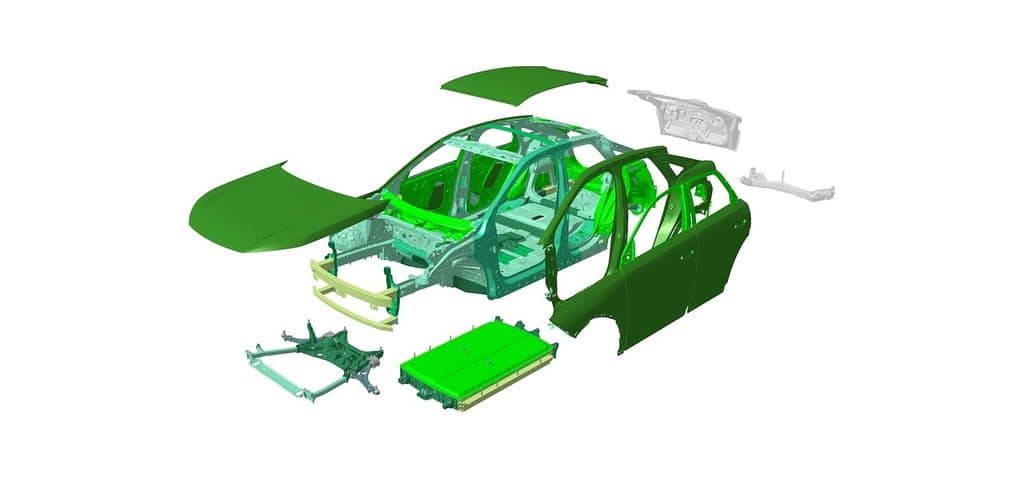
Rather than simply replacing steel components with aluminum equivalents, the study adopted a “less is more” approach focused on integrating parts and optimizing the use of aluminum sheet, castings, extrusions, and joining techniques.
The aluminum-intensive design reduced the body-in-white part count by 27%, while decreasing the number of joints and simplifying the range of material thicknesses and grades required. The battery enclosure was reduced from 53 parts to 29, with substantial reductions in joints and fasteners.
Structural efficiency also improved. The concept’s Lightweight Index declined from 2.2 to 1.4, representing a 36% improvement compared with the reference body.
The findings demonstrate how reducing the body’s primary mass can create additional opportunities to reduce weight throughout the vehicle. Beyond battery right-sizing, potential savings include changes to the electric drive motor, brakes, suspension, and other chassis systems.
“Aluminium creates the greatest value when it is considered early in the vehicle architecture. This approach allows engineering teams to capture benefits across the entire system, rather than evaluating the body structure in isolation,” said Mark White, Technical Director at Alumobility.
Maintaining Performance and Structural Integrity
The study assessed aluminum components and manufacturing processes across the body-in-white, closures, chassis subframes, and battery enclosure. Its technical evaluation included cold- and hot-forming aluminum sheets, extrusions, castings, and established joining technologies.
The concept met or exceeded its crash-performance targets. Torsional stiffness, fatigue resistance, noise, vibration and harshness (NVH), and overall structural performance remained competitive or improved compared with the reference design.
The study also concluded that the evaluated aluminum components could be manufactured using technically feasible processes. Only limited geometry adjustments were required for the assessed components covered by the agreed feasibility evaluations.
Potential Cost, Energy, and Carbon Benefits
Reducing battery capacity by 15% could deliver a comparable reduction in battery-related costs and lower the carbon footprint associated with battery production, according to the study’s assumptions.
Lower vehicle mass can also reduce energy consumption during operation. The study found that energy consumption could decline from 140 watt-hours per kilometer to 122 Wh/km while maintaining comparable driving range. Alternatively, manufacturers could use the weight savings to increase range or add customer features.
The researchers suggest that aluminum-intensive vehicle architecture could benefit mainstream battery-electric vehicles, not just premium models. Combining lower weight, smaller batteries, and simpler structures could help manufacturers address vehicle cost and efficiency requirements.
Combustion-engine and plug-in hybrid vehicles could also benefit from lower vehicle weight, potentially reducing CO2-related penalties and weight-based taxes, depending on local regulations.
About the Study
The joint Alumobility and Stellantis study examined the conversion of a steel-intensive vehicle architecture based on the STLA Medium platform into an optimized aluminum-intensive design. The analysis considered vehicle mass, structural performance, manufacturing feasibility, design complexity, battery-sizing opportunities, vehicle-system benefits, and carbon performance.
The study is theoretical, and its findings reflect the specific design parameters and assumptions used in the analysis. Cost and pricing information was based on generic, aggregated third-party study data or publicly available information.
About Alumobility
Alumobility is a global ecosystem of aluminum producers and downstream technology partners that works with automotive manufacturers to develop lighter, safer, smarter, and more sustainable vehicles. The nonprofit association focuses on theoretical technical studies designed to advance the adoption of aluminum automotive body sheet.
More information is available at Alumobility.com.

Electric Vehicle Marketing Consultant, Writer and Editor. Publisher EVinfo.net.
Services