Michigan Awards $1.84M for 201 New Charging Stations at 31 Multifamily Properties
On November 05, 2025, the Michigan Department of Environment, Great Lakes, and Energy (EGLE) announced that the first two funding rounds of Michigan’s Clean Fuel and Charging Infrastructure (CFCI) Program have awarded more than $1.84 million to install 201 new electric vehicle charging stations at 31 multifamily properties across the state.
These investments expand charging access for residents who often do not have the ability to install chargers at home. The program also advances the MI Healthy Climate Plan goal of having infrastructure in place to support 2 million electric vehicles on Michigan roads by 2030. The MI Healthy Climate Plan outlines Michigan’s strategy to reach a carbon neutral economy by 2050.
Launched in 2024, the one-time, 30 million dollar state-funded CFCI Program is designed to increase charging availability, with at least 40 percent of all funding directed to disadvantaged communities. The first four funding rounds, two awarded and two in the final stages, concentrate on multifamily housing, where demand for reliable at-home charging is growing rapidly.
A revised request for proposals allocates an additional 5 million dollars for nonpublic Level 2 charging stations at multifamily properties. The Michigan Department of Environment, Great Lakes, and Energy (EGLE) has expanded program eligibility to include both existing multifamily properties and new developments. The agency also broadened applicant eligibility so that property owners, developers, and community organizations can participate. These changes are intended to make EV ready infrastructure easier to include during construction and more accessible statewide.
Grant awards are capped at 300,000 dollars. Applicants must provide a 30 percent match unless the project is located in an environmental justice community. Grants may be used for EV charging and fueling infrastructure for fleets and public transit systems, charging at multifamily housing, and projects that close gaps in fast charging networks away from designated alternative fuel corridors.
Any organization may apply. Applicants must have a Unique Entity Identifier number from the federal System for Award Management website. Applications will be accepted on a first come, first served basis until all available funds have been committed. Funds must be spent by September 30, 2027.
EGLE plans to release another request for proposals focused on public charging in the coming months.

EVinfo.net’s Take: Why Multifamily EV Charging Matters
As electric vehicle adoption grows, access to reliable charging is becoming a basic expectation for renters. Nearly 30 percent of U.S. households live in multifamily housing such as apartments and condos, yet most lack the ability to charge at home. Without dedicated chargers, residents must rely on public stations or workplace charging, creating uncertainty and limiting EV ownership for millions of people.
Multifamily EV charging solves this access gap. When charging is available where people live, EV ownership becomes practical and affordable. Residents can plug in overnight, wake up to a full battery, and avoid the inconvenience of searching for public stations. Charging at home is also significantly cheaper than fast charging and helps drivers manage energy costs.
For property owners, adding EV charging improves tenant satisfaction, increases property value, and enhances competitiveness in the rental market. Multifamily buildings that offer EV charging attract higher-income, longer-term tenants and appeal to companies and residents seeking sustainability commitments.
Beyond convenience and property value, multifamily charging delivers broader benefits. It supports transportation electrification, reduces emissions, and helps states and cities meet climate and air quality goals. Installing charging at multifamily properties also helps ensure that the transition to electric vehicles is equitable by opening access to residents who do not have garages or private driveways.
Multifamily EV charging is essential not only for EV drivers, but for communities and the future of clean transportation. It makes electric vehicles more accessible, more affordable, and more practical for everyone.
Pando Electric Leads Multifamily EV Charging
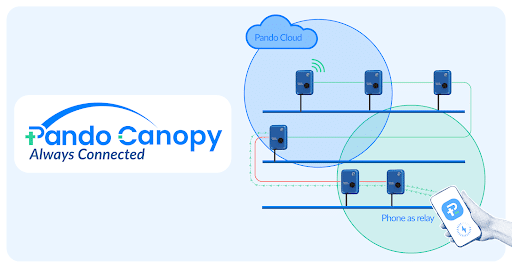
On October 21, 2025, Pando Electric, a leader in affordable and intelligent EV charging solutions for multifamily properties, announced the launch of Pando Canopy, a proprietary wireless mesh connectivity system that removes the need for WiFi or cellular networks in EV charging.
Pando Canopy was designed for multifamily buildings where chargers are often placed in locations that make connectivity difficult. Underground garages and concrete parking structures routinely disrupt WiFi and cellular signals, resulting in failed charging sessions and frustrated residents. Pando Canopy solves this problem by creating a local wireless mesh that keeps every charger connected at all times. The result is consistent charging, fewer support tickets, and better protection of charging revenue for property owners.
Unlike traditional EV charging systems that rely on expensive IT networks and cloud connections, Pando Canopy operates locally within the building. It is included with every Gen2 installation at no additional cost to owners.
“Property owners have told us for years that network failures are one of their biggest frustrations with EV charging,” said Aaron Li, CEO of Pando Electric. “With Pando Canopy, that problem disappears. Residents get reliable charging every time, and property managers finally get peace of mind without extra IT costs or complexity.”
Pando Canopy maintains charger uptime through a dual layer system. The chargers form a wireless mesh that keeps them connected within the building, even if only one device has access to the internet. If the entire site goes offline, the system automatically switches to peer to peer communication that allows residents to tap and start a charging session. When connectivity returns, usage data syncs back to the cloud.
“With Pando Canopy, we have solved one of the biggest blockers to multifamily EV charging, which is unreliable connectivity,” said Yifan Zhang, Head of Product. “The mesh network heals itself and ensures that every charger is ready to use. Our goal is to make EV charging invisible. It should just work.”
Pando Canopy is part of the company’s Gen2 ecosystem and integrates with Pando’s smart outlets, the modular Pando Plus Charger, and the Pando Pulse energy management platform. Together, these products create a complete charging solution that is affordable, reliable, and future ready.
Pando Canopy is available now with all Gen2 deployments. Property owners and managers can request a demo or learn more at pandoelectric.com.
By making charging infrastructure effortless for multifamily building owners and accessible for drivers, the forward-thinking State of Michigan and Pando Electric are helping communities prepare for the shift to electric transportation. Their shared mission is to ensure that EV charging is no longer viewed as a premium amenity but as an essential service that supports sustainability, cost savings, and a better living experience.

Electric Vehicle Marketing Consultant, Writer and Editor. Publisher EVinfo.net.
Services