Historic V2H Mass Market Breakthrough Announced by Kia and Wallbox
On October 27, 2025, UC Irvine announced that six homes in Menifee, California, are now equipped with the ability to draw power directly from an electric vehicle, marking a breakthrough in the real-world use of vehicle-to-home (V2H) technology. The demonstration showcases how energy stored in an EV can power household loads during both grid-connected and off-grid (islanded) conditions, making it the first mass-market V2H deployment using two commercial-ready products—a bidirectional charger and a V2H-capable SUV.
The milestone comes after a four-year collaboration between Kia America, Hyundai America Technical Center, Hyundai Motor Group, and the UC Irvine Advanced Power and Energy Program (APEP). Kia supplied an EV6 with prototype V2H software, while Wallbox developed the bidirectional charger. APEP researchers first ran controlled tests in their Residential Laboratory before conducting field trials with a prototype Kia EV9 in a model home. The project was part of the APEP-led U.S. Department of Energy “Connected Microgrid” initiative in Menifee.
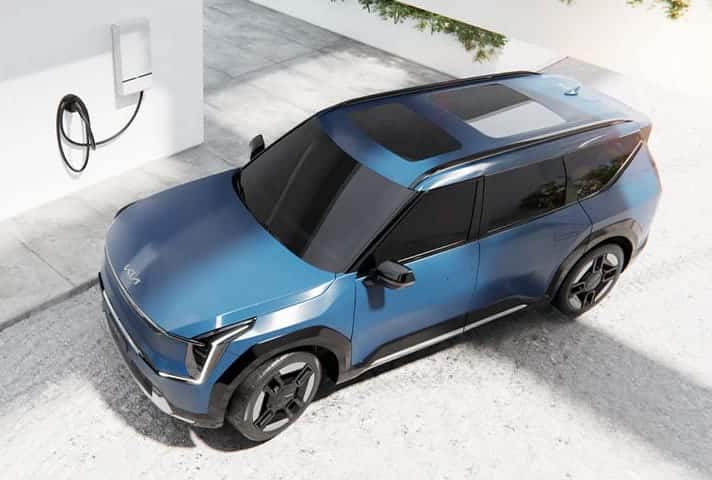
Following the research phase, published this month in the Journal of Energy Conversion and Management, a commercial Wallbox Quasar 2 charger was installed in May with a commercial Kia EV9 at the APEP lab. By August, six Menifee homes had been equipped with Quasar 2 chargers and Kia EV9s for a two-year evaluation focused on performance, efficiency, and homeowner experience.
V2H technology offers multiple benefits. Homeowners can save on electricity costs by using stored EV energy during expensive peak-rate hours or by storing excess solar power generated during the day for later use. This approach not only reduces utility bills but also helps ease strain on the electric grid. During outages, the system can power a home for several days—thanks to EV batteries that hold up to ten times more energy than traditional home batteries.
Beyond financial and resilience benefits, V2H contributes to a cleaner environment by reducing reliance on fossil-fueled power plants and eliminating the need for gasoline-powered backup generators. The Menifee project represents a key, historic step toward making bidirectional energy sharing a practical feature for everyday homeowners.
EVinfo.net’s Take: Why V2H and V2G Are Global Game Changers for Transportation, Emergency Power, and the Grid
The shift to electric vehicles is already transforming transportation, but a new frontier, vehicle-to-home (V2H) and vehicle-to-grid (V2G) technology, is set to redefine how we produce, store, and use electricity. These innovations allow EVs to do more than move people; they can now power homes, stabilize grids, and provide backup energy in emergencies.
At its core, V2H technology enables a vehicle’s battery to supply electricity to a home, powering essential appliances and systems during both normal operation and grid outages. Vehicle-to-grid takes this a step further, allowing EVs to send power back to the grid itself. Together, they turn every plugged-in car into a mobile energy resource.
The implications are enormous. For homeowners, V2H means resilience and savings. Instead of relying on expensive backup generators or stationary batteries, drivers can use their EVs to keep the lights on during storms or outages and draw from stored energy when utility rates spike. This transforms an electric vehicle into both a transportation solution and a home power cost-saving personal energy asset.
On a broader scale, V2G is a potential cornerstone of a smarter, cleaner energy ecosystem. With millions of EVs expected on the road over the next decade, their collective storage capacity could surpass that of traditional power plants. By returning energy to the grid during peak demand or absorbing excess renewable power when supply is high, V2G-enabled vehicles can help balance supply and demand, reduce strain on infrastructure, and accelerate the adoption of clean, cost-saving wind and solar energy.
In emergency situations, both V2H and V2G offer lifelines. Communities affected by natural disasters could rely on EV fleets to power shelters, hospitals, and communication systems. For governments and utilities, these mobile energy hubs offer a flexible, distributed backup network.
EVs were already the most compelling vehicle to buy or lease in 2025, as the most eco friendly and cost effective. But this breakthrough makes EVs even more compelling. We predict every EV and charger released in the future will offer these capabilities, transforming our grid, power use and transportation forever. We are on the cusp of a worldwide mass adoption transition to clean grid energy and clean transportation, the most exciting and important technology breakthroughs our grid and vehicles have ever seen. A most exciting time for sure!

Electric Vehicle Marketing Consultant, Writer and Editor. Publisher EVinfo.net.
Services