Electric, Autonomous DoorDash Delivery Robot Makes First Delivery in Fremont, CA
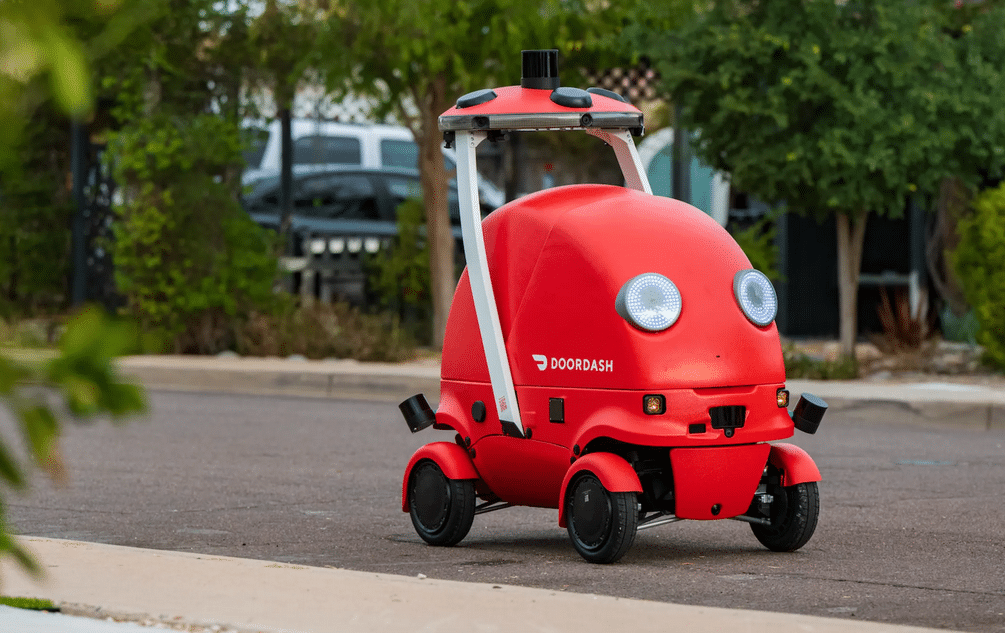
On March 6, 2026, DoorDash announced that the city of Fremont, California, kicked off its 4th Annual Restaurant Week with a fitting first delivery. DoorDash’s autonomous delivery robot, Dot, rolled up to Fremont Bank and handed Mayor Raj Salwan the inaugural order, setting the tone for a celebration that now includes a record 70 participating restaurants running through March 15.
The moment was more than a publicity stunt. Dot is manufactured right in Fremont at Sonic Manufacturing Technologies, and the city recently agreed to a formal partnership with DoorDash to bring the robot into the community through a measured rollout designed around public safety and community engagement. An encroachment permit governs the deployment, with speed limitations and a standardized incident response plan in place. The current permit runs through March 2027.
Dot is an all-electric, compact robot built to navigate city streets and deliver orders directly to the door. DoorDash sees it as the next step in building a more efficient and sustainable delivery ecosystem, one that layers autonomous robots on top of its existing network rather than replacing it.
For Fremont, the partnership is consistent with its identity as a hub for innovation. Supporting local restaurants during Restaurant Week while debuting homegrown robotics technology on city streets makes a clear statement about where the city is headed.
The event included remarks from DoorDash Labs Senior Director Harrison Shih, Mayor Salwan, and Fremont Bank President Don Marek. The week runs in partnership with DoorDash, Fremont Bank, Yelp, and the Fremont Chamber of Commerce.
“Fremont is a city that builds things: Advanced technology, world-class manufacturing, and now, the next generation of autonomous delivery with Dot,” said DoorDash Labs’ Harrison Shih. “And we believe in the power of automation to expand opportunity and connect the city. For Fremont restaurants, they will be able to reach more customers, more efficiently. For consumers, it means another convenient, sustainable way to support local favorites. For the city of Fremont, it means fewer short car trips and stronger local commerce. We’re proud to be building the future here and proud to celebrate the entrepreneurs who make this city thrive.”
“This partnership supports Fremont businesses end-to-end, from Sonic Manufacturing in Fremont where DoorDash’s delivery robot Dot was made, to our local restaurants that will benefit from this additional delivery method,” said Fremont Mayor Raj Salwan. “As the first to receive a delivery from Dot, I found this process smooth and efficient, and look forward to seeing Dot on our streets, safely delivering orders to Fremont residents soon.”
EVinfo.net’s Take: The Rise of Autonomous Vehicles and Robots Will Supercharge the EV Transition
The shift to electric vehicles is already underway, but a second wave is building behind it, and it may accelerate the transition faster than most people expect. Autonomous vehicles and robots are not just a separate technological story. They are deeply intertwined with electrification, and as they scale, they will pull EV adoption along with them in ways that go far beyond consumer car purchases.
Autonomy and Electrification Are Natural Partners
There is a reason nearly every major autonomous vehicle program in the world is built on an electric platform. Autonomous systems depend on precise, consistent power delivery and low-vibration mechanical environments. Electric drivetrains provide both. They are also far simpler to integrate with the software and sensor stacks that self-driving technology requires, with fewer moving parts, more predictable behavior, and the ability to regenerate energy during braking.
This means that as autonomous vehicle programs mature and deploy at scale, they will bring enormous electric fleets with them. Robotaxis, autonomous freight trucks, and last-mile delivery vehicles will not be running on gasoline. They will be electric by design, and the infrastructure built to support them will reinforce and expand the charging networks that consumer EV drivers also depend on.
Fleets Will Drive Volume, and Volume Drives Everything
Consumer EV adoption, while growing, is still constrained by factors like purchase price, charging convenience, and range anxiety. Autonomous commercial fleets do not face those same barriers in the same way. Fleet operators make decisions based on total cost of ownership, and electric autonomous vehicles win that calculation decisively. Lower fuel costs, fewer maintenance requirements, and the efficiency gains that come from software-optimized driving all point in the same direction.
When fleets commit to electric at scale, the entire supply chain responds. Battery production ramps up. Costs come down. Charging infrastructure gets built out in more locations because the economics finally justify the investment. Every consumer who has hesitated to buy an EV because of limited charging options in their area benefits from the infrastructure that autonomous fleet operators helped fund and justify.
This is how technology transitions actually happen. It is rarely the early adopter consumer alone who tips the market. It is the institutional and commercial demand that creates the conditions for mass adoption.
Delivery Robots Are Already Expanding the EV Footprint
It is easy to focus on autonomous cars when thinking about self-driving technology, but robots designed for last-mile delivery are already operating in cities and quietly expanding what counts as an electric vehicle. DoorDash’s Dot, recently deployed in Fremont, California, is one example. These compact, all-electric devices navigate sidewalks and city streets, reducing the need for short delivery trips that would otherwise be made by gas-powered vehicles.
As delivery robots proliferate, they represent a growing category of electric devices operating in urban environments, each one displacing fossil fuel consumption at the margins. Aggregated across thousands of deployments in dozens of cities, the impact becomes meaningful. They also normalize the presence of electric autonomous devices in public spaces, building familiarity and public comfort with a technology that will only become more prevalent.
Autonomous Freight Will Transform Long-Haul Electrification
One of the most challenging frontiers for EV adoption is long-haul trucking. The energy density requirements are enormous, charging times matter enormously for commercial operators, and the economics have to work across millions of miles. Autonomous freight companies are investing heavily in solving exactly these problems, because removing the driver changes the math on nearly everything.
An autonomous electric truck that can run longer routes with optimized charging stops, without the constraints of human rest requirements, becomes a genuinely competitive alternative to diesel in ways that a human-driven electric truck is not yet. As autonomous freight companies build out their charging corridors and depot infrastructure, they are laying the groundwork for an electric heavy-transport network that did not previously exist.
The Infrastructure Feedback Loop
Perhaps the most important dynamic is the feedback loop between autonomous deployment and charging infrastructure. Every autonomous fleet that commits to electric creates demand for charging in new locations. That demand justifies investment in infrastructure that previously could not be funded on consumer demand alone. More infrastructure makes electric vehicles more practical for more people. More consumer adoption drives further investment. The cycle accelerates.
This is already visible in cities where robotaxi programs have operated. Charging depots built for autonomous fleets become anchors for broader charging networks. The same pattern will play out with delivery robots, autonomous freight corridors, and eventually the full range of autonomous industrial equipment that is moving toward electrification.
A Globally Accelerating Story
This dynamic is not limited to North America. China, which leads the world in both EV adoption and autonomous vehicle development, is already seeing these forces compound. European freight corridors are being planned with autonomous electric trucks in mind. In markets where consumer EV adoption has moved more slowly, autonomous commercial fleets may end up leading the transition rather than following it.
The countries and cities that invest in the policy frameworks and infrastructure to support autonomous electric deployment will find themselves ahead not just on autonomy but on electrification broadly. The two transitions are inseparable, and the momentum from one feeds directly into the other.
The EV transition was always going to happen. Autonomous vehicles and robots are making it happen faster.

Electric Vehicle Marketing Consultant, Writer and Editor. Publisher EVinfo.net.
Services