Ford is Pushing Ahead With Its EVs, Reveals Secret EV Unit Amid Growing Chinese Competition
As much of the global auto industry pulls back from all-electric vehicles after incurring billions in losses, Ford Motor is continuing to invest in its next generation of EVs, which CEO Jim Farley has positioned as potentially transformative for the sector.
This push comes amid significant headwinds, including a broader slowdown in EV adoption, $19.5 billion in restructuring charges tied to Ford’s electric business, the rollback of U.S. consumer EV incentives, and the recent departure of a top EV executive.
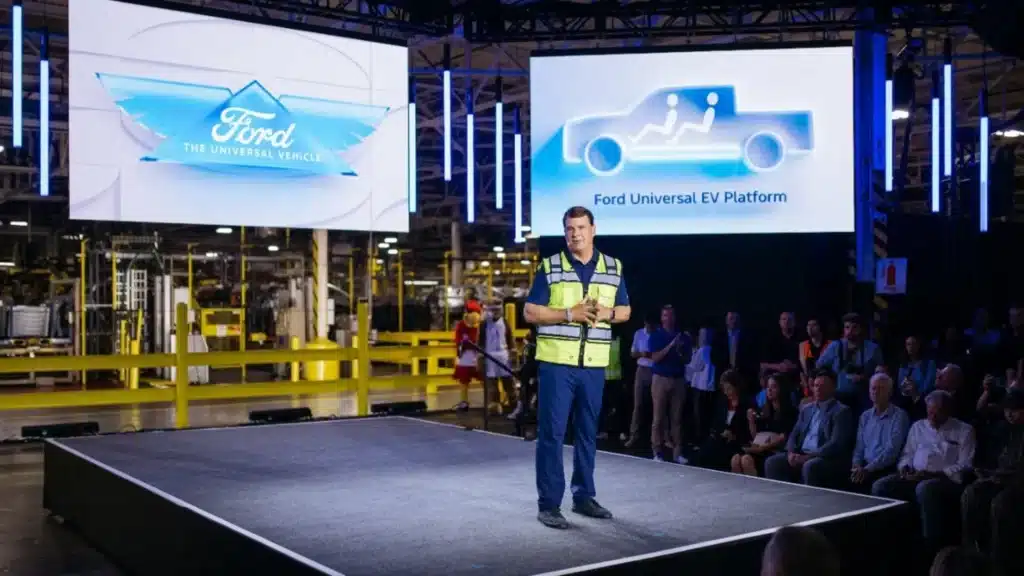
“Agility is key,” said Alan Clarke, Ford’s EV product leader, speaking at the company’s new Electric Vehicle Development Center in Long Beach, California. He emphasized the company’s ability to adapt to shifting market dynamics despite ongoing industry challenges.

Central to Ford’s strategy is its new Universal Electric Vehicle (UEV) platform, a clean-sheet architecture designed to deliver profitability and cost competitiveness against global leaders such as Chinese automakers. The platform is expected to play a critical role in moving Ford’s Model e division from sustained losses to breakeven by 2029, with future EVs targeted to become profitable within a year of launch.
The first vehicle based on the platform will be a midsize electric pickup, expected to start around $30,000 and launch in the U.S. next year, followed by a broader lineup built on the same architecture.
Clarke, an early member of Ford’s skunk works EV team, was recently promoted following the departure of Doug Field, the company’s former head of EV and advanced technology. Despite the leadership change, Ford executives maintain that the groundwork laid for the UEV program remains intact.
Competition from China remains a major factor shaping Ford’s strategy. Chinese automakers have rapidly expanded their global presence, increasing market share significantly over the past five years while accelerating development timelines. Some startups are now bringing vehicles to market in roughly 20 months, far faster than traditional automakers.
According to GlobalData, global market share for Chinese brands has jumped nearly 70% in five years. In 2020, China’s share was 14.1%, growing to 23.6% in 2025. EVinfo.net reported that for the first time, BYD surpassed Ford Motor Company in global vehicle sales, delivering 4.6 million units in 2025, roughly 200,000 more than Ford’s 4.4 million.
Ford believes it can compete but acknowledges structural differences, including government support and lower labor costs in China. As a result, the company is focusing on speed, cost reduction, and strategic partnerships with global automakers to remain competitive.
The UEV platform incorporates several cost-saving innovations, including smaller lithium iron phosphate battery packs produced in the U.S., a 48-volt electrical architecture, and streamlined manufacturing processes. Ford expects meaningful efficiency gains, including fewer parts, reduced assembly complexity, and faster production times.
Executives have described the UEV initiative as a “moonshot,” with Farley comparing its potential impact to the Model T in terms of reshaping how vehicles are designed and built. The company is also applying lessons from past EV programs that fell short of expectations, shifting focus toward smaller, more affordable vehicles rather than larger, more expensive models.
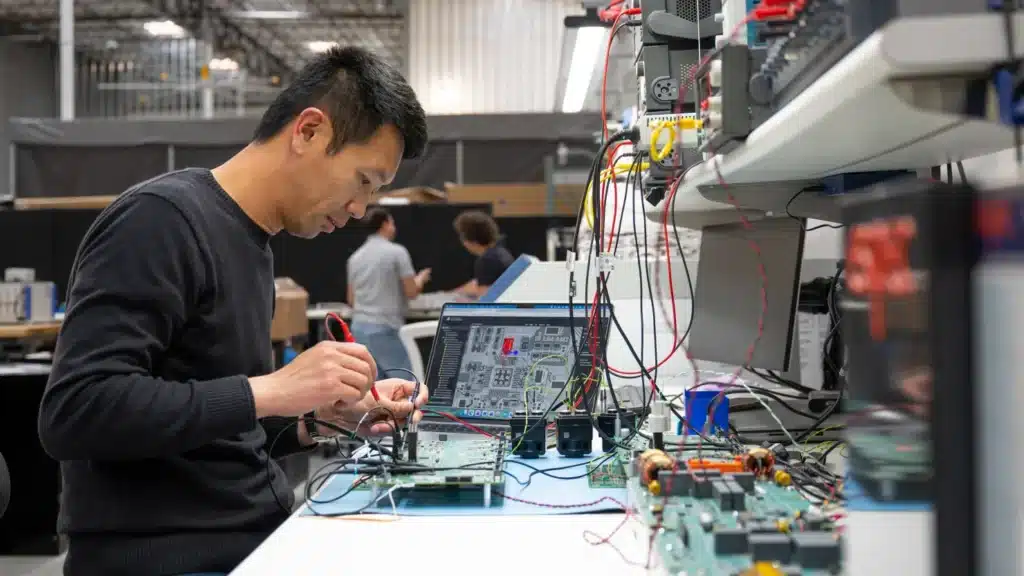
At the core of this effort is Ford’s skunk works team, formed around 2022 to operate with greater speed and flexibility outside traditional corporate constraints. The group is now supported by a new development hub in Long Beach, where hundreds of engineers and specialists from automotive, aerospace, and technology backgrounds are working on next-generation EVs.
The facility spans roughly 270,000 square feet, with additional testing infrastructure under development. While the initial pickup was designed earlier, the center is intended to support future vehicles and continued evolution of the UEV platform.
Ford leadership sees the initiative as extending beyond a single product line. The technologies, processes, and design philosophies developed through the skunk works program are expected to influence the company’s broader vehicle portfolio.
Despite ongoing uncertainty in the EV market, Ford is maintaining its long-term bet, aiming to accelerate development timelines and deliver more affordable electric vehicles that align with consumer expectations.
EVinfo.net’s Take: The Timing Could Hardly Be Worse for USA’s Cutbacks on EVs
Ford seems to be doing everything right this time, despite past mistakes. But the key will be surviving the federal government’s mistakes, as China keeps quickly growing its automotive industry globally.
At a moment when the global auto industry is entering its most consequential transition in a century, recent U.S. policy shifts, cutting the federal EV tax credit and loosening emissions standards, are undercutting domestic automakers just as competition intensifies. Ford lost $19.5 billion, mostly from federal government mistakes.
The timing could hardly be worse.
Nowhere is that pressure more evident than in the rise of BYD. In 2025, BYD delivered 4.6 million vehicles globally, surpassing Ford Motor Company, which sold roughly 4.4 million units. That milestone is more than symbolic. It signals a structural shift in the balance of power within the global auto market.
China’s automotive sector has spent years scaling aggressively, backed by coordinated industrial policy, supply chain control, and relentless speed in product development. The result is a wave of EVs that are not only cost-competitive, but increasingly technologically sophisticated. Chinese automakers are iterating faster, launching vehicles in nearly half the time of traditional OEMs, and expanding into global markets with growing confidence.
Against that backdrop, U.S. policy is moving in the opposite direction.
The federal EV tax credit has been one of the few tools helping bridge the affordability gap between internal combustion vehicles and EVs. Weakening it directly impacts consumer adoption at a time when scale is essential. At the same time, relaxing emissions standards reduces the urgency for automakers to transition, effectively slowing momentum when acceleration is needed most.
For companies like Ford, which are already navigating billions in EV-related losses while investing in next-generation platforms, policy stability is critical. Pulling back support mid-transition creates uncertainty not just for automakers, but for suppliers, infrastructure developers, and fleet operators building around an electrified future.
The competitive implications are significant. If U.S. automakers slow their EV programs while Chinese firms continue to expand, the gap will widen, not just in technology, but in manufacturing scale, cost structure, and global market share.
This is not just about EVs. It is about industrial competitiveness.
The auto industry remains a cornerstone of the U.S. economy, supporting millions of jobs and anchoring advanced manufacturing. Ceding leadership in the next generation of vehicles risks long-term erosion of that base.
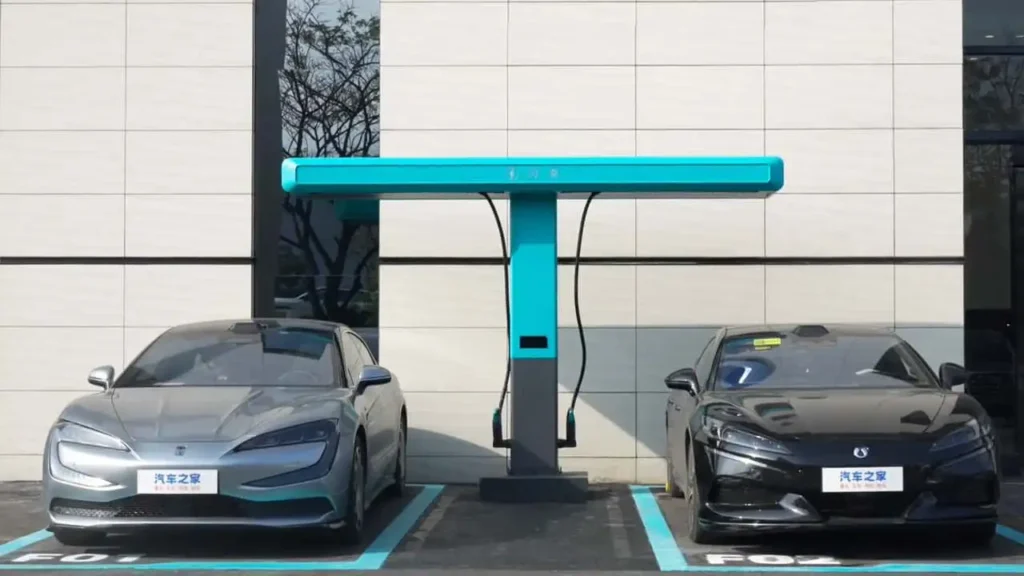
China isn’t ahead only on sales, but technology as well. BYD introduced its Flash charging technology to Europe recently, unveiling the Denza Z9GT as the first European-market vehicle capable of using the system.
Equipped with BYD’s latest lithium iron phosphate Blade battery, the Z9GT charges from 10% to 70% in five minutes and from 10% to 97% in nine minutes. In temperatures as low as -30 degrees Celsius, where most EVs slow dramatically, it charges from 20% to 97% in 12 minutes.
Speaking at the Beijing Auto Show, BYD executive vice president Stella Li emphasized that the company’s growth does not depend on entering the United States. Instead, BYD is focused on meeting rising demand in markets such as Brazil, the UK, and across Europe.
Reversing course, supporting EVs again in the USA will not be simple, but the direction is clear. Sustained incentives, consistent regulatory signals, and strategic investment are necessary to compete in a market that is no longer moving at a traditional pace. There’s a new buzzword: “China Speed.”
Without that alignment, the trajectory is equally clear: China’s auto industry will continue to rise, and the U.S. industry will keep experiencing a slow, but measurable, contraction in global relevance.

Electric Vehicle Marketing Consultant, Writer and Editor. Publisher EVinfo.net.
Services