Fast-growing Virtual Power Plants May Provide Part of the Vast Need for More Energy in U.S.
Virtual power plants (VPPs) are making nationwide headlines, due to the fact they could be an important part of the solutions to the dire need for more energy in the United States.
According to the U.S. Department of Energy, the nation will need approximately 200 gigawatts of additional peak power capacity in the coming years. To put that into perspective, a single gigawatt can power roughly 750,000 homes annually and is equivalent to about 1.3 million horsepower. Meeting this surge in demand through traditional power plants alone will be difficult, prompting utilities and energy providers to explore alternative solutions.
On May 30, 2026, NBC News reported that VPPs currently exist, or are in the works, in 35 states and Washington, D.C. The largest networks are in California and Texas.
America’s electric grid is facing an unprecedented challenge as the rapid expansion of artificial intelligence drives demand for new data centers across the country. Energy experts warn that existing power generation capacity will not be enough to support the projected growth.
“The grid hasn’t seen growth for decades, and people don’t realize that,” said Paul Dickson, president of Sunrun, the nation’s largest distributed energy company. “That’s getting turned on its head over the next 15 years. The grid is anticipating 40% growth, and so it’s a lot of strain on the same poles and wires.”
One of the most promising approaches is the use of Virtual Power Plants (VPPs). Unlike conventional power plants, VPPs are decentralized networks that connect and coordinate distributed energy resources such as residential solar systems, home battery storage, electric vehicle chargers, smart thermostats, and electric water heaters. Using cloud-based software, these devices can be managed collectively and operated as a single flexible power resource that helps stabilize the grid and reduce strain during periods of high demand.
The potential impact is significant. A report from the Rocky Mountain Institute estimates that VPPs could reduce U.S. peak electricity demand by as much as 60 gigawatts by 2030 while lowering annual power sector costs by approximately $17 billion.
While battery storage remains a foundational component of most virtual power plants, the range of participating technologies continues to expand. Utilities are increasingly integrating smart thermostats, electric water heaters, and electric vehicles alongside stationary batteries, creating larger and more responsive networks capable of supporting the grid as electricity demand accelerates.
Homeowners with solar, home batteries, and EVs are making and saving money by sending power back to the grid to be used in VPPs. NBC reported a Texas couple are paid a $240 yearly reward from their solar provider, Sunrun, on top of monthly credits, which so far have been up to $30 once all their power needs are met.
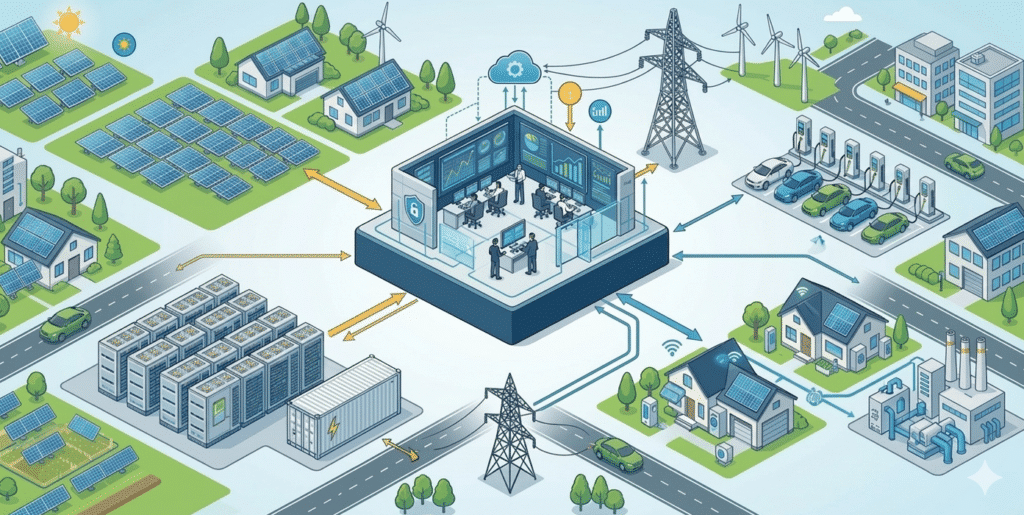
States, Utilities Took 106 Actions To Advance VPPs In 2025
In February, PV Magazine reported that Virtual Power Plants (VPPs) continued their rapid expansion across the United States in 2025, with states, regulators, and utilities taking 106 separate actions to support the growing technology, according to a new report from the Smart Electric Power Alliance (SEPA) and the NC Clean Energy Technology Center (NCCETC).
The report found that 35 states and the District of Columbia advanced policies, regulations, or utility programs focused on VPPs and distributed energy resource (DER) aggregation. As electricity demand rises due to AI data centers, electrification, and extreme weather events, utilities are increasingly looking to VPPs as a flexible and cost-effective way to strengthen grid reliability.
One of the biggest trends identified in the report was a shift toward more comprehensive DER aggregation strategies. Utilities are moving beyond standalone battery programs and developing portfolios of flexible energy resources managed through Distributed Energy Resource Management Systems (DERMS). New programs increasingly allow participation from technologies such as heat pumps, smart water heaters, bidirectional EV chargers, and managed EV charging systems.
Several states took notable steps during 2025. Colorado approved Xcel Energy’s Aggregator VPP program targeting 125 MW of enrollment, while Illinois passed legislation directing the development of new VPP programs. Maryland utilities filed proposals for broad VPP initiatives following the state’s DRIVE Act, and Virginia’s Dominion Energy proposed a DERMS platform capable of coordinating battery storage, managed charging, and demand-response resources.
The U.S. Department of Energy has established a goal of reaching between 80 and 160 gigawatts of VPP capacity by 2030. According to recent estimates from Ohm Analytics, VPP capacity reached nearly 40 GW by the end of 2025, representing annual growth of approximately 21%. If that pace continues, the country could approach 100 GW of VPP capacity by the end of the decade, making virtual power plants an increasingly important tool for meeting America’s growing electricity needs.
EVinfo.net’s Take: Enode Flex: The Flexibility Platform For Energy Retailers
Enode’s solutions allow consumers to take charge of their energy consumption, by automatically optimizing it based on price and renewable supply. Businesses, ranging from large electricity suppliers to climate tech startups, can innovate at a faster pace and offer new value propositions to their customers, using these solutions.
Enode has launched Enode Flex, a new platform designed to help energy retailers turn connected residential energy devices into a practical, grid-supporting resource. The platform builds on Enode’s existing Connect and Optimize products, which already manage more than 500,000 connected devices including EVs, home batteries, solar systems, and heat pumps.
The main goal of Flex is to help retailers create and operate residential Virtual Power Plants (VPPs). Instead of simply connecting devices, Flex aggregates thousands of distributed energy resources into a single flexible load that can be monitored, forecasted, and controlled in real time. Energy retailers can see available flexibility, model different dispatch scenarios, and send commands across their portfolio while respecting customer preferences and device constraints.
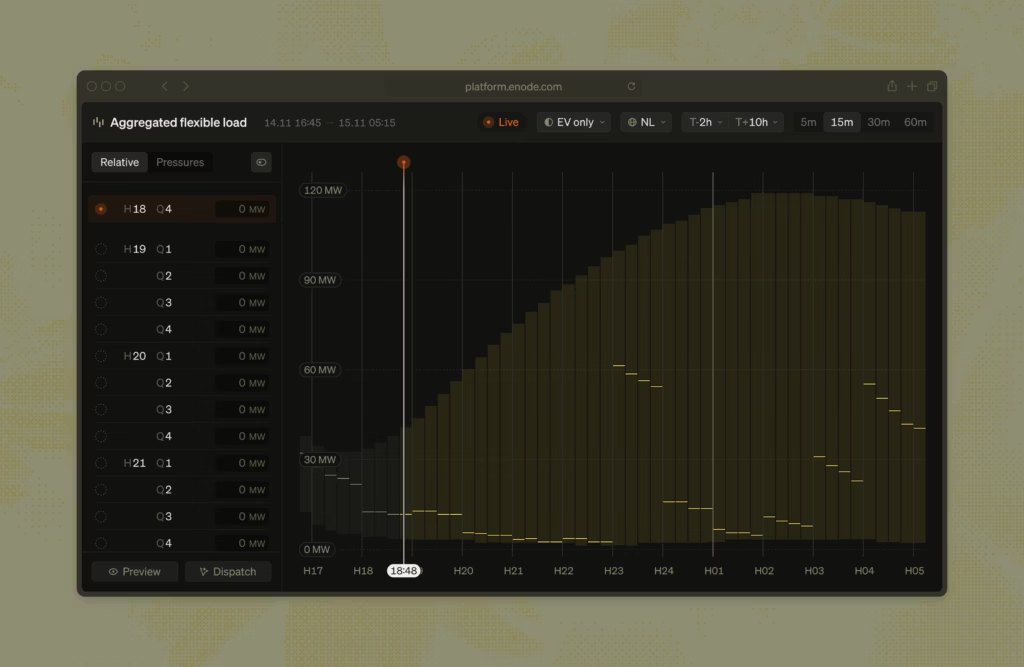
Key features include:
Real-time visibility into aggregated flexible load and available up/down flexibility.
Forecasting and load-shaping tools that allow retailers to simulate changes before dispatching them.
Integration with existing energy management systems, trading platforms, billing systems, CRM software, and customer applications.
API access and dashboard tools that support participation in energy markets and grid services.
According to Enode, Flex enables retailers to use connected devices for applications such as:
Day-ahead and intraday energy optimization
Reducing imbalance costs
Managing wholesale market volatility
Participating in ancillary service markets
Supporting grid reliability through demand flexibility programs
The company says Flex was developed with input from energy retailers and is intended to fit into existing utility and retail energy operations rather than requiring a separate platform. The launch reflects a broader industry trend toward using distributed energy resources, including EVs, batteries, and smart home technologies, as flexible grid assets capable of supporting growing electricity demand and renewable energy integration.
Understanding DERs, V2X and EV Charging Infrastructure (3 Part Series) – WEBINAR – Summer 2026
EV expert Omar Riahi recommends this webinar on the topic of DERs, V2X and EV Charging Infrastructure, for which he has taught in the past.
Dont’ miss Understanding DERs, V2X and EV Charging Infrastructure (3 Part Series) – WEBINAR – Summer 2026.
Series Description
Part 1 of 3 – June 18, 2026 (12pm – 2pm)
Part 2 of 3 – July 23, 2026 (12pm – 2pm)
Part 3 of 3 – August 20, 2026 (12pm – 2pm)
As an attendee you will be provided with a foundational understanding of distributed energy resources (DERs), vehicle-to-everything (V2X) technology, and electric vehicle (EV) charging infrastructure. Learn how these technologies contribute to energy efficiency, grid stability, and the transition to a sustainable energy future. This three part webinar series offers practical insights to help you confidently step towards the completion of your next EV charging project in the evolving energy landscape.
Instructor Bio:
Neill Sturgess, Director of Programs at EV Re-Fleet
Neill is a passionate learning and development professional with over 15 years of experience in the field. His focus is to make end-to-end authentic, relevant and engaging training experiences for all learners. He has designed, facilitated and implemented over 100 lessons for over 4000 learners throughout his career to date. Prior to starting as the Director of Programs at EV Re-Fleet, Neill led learning and development programs at several health tech startups, FreshBooks and at Apple.
Off Grid Solar Offers Tremendous Value
To participate in cost saving clean energy programs such as VPPs, home and business owners have many options. For example, in addition to installing solar on your home’s rooftop, there are other, more affordable options. Many people don’t realize a home battery can be used for emergency power and cost saving through peak shaving, even if you are postponing a solar installation, or are even never considering getting home solar.
An example is my own home. I’m postponing a full solar installation since the cost remains high. But I’m considering a home battery and off grid solar on a new shed in the backyard, allowing me an additional office space. My current home office is in the living room, not an ideal location.
If your’e looking for home or business solar, off grid solar, or other clean energy assistance, look no further than Voltarium.
Voltarium is emerging as a specialized player in the rapidly evolving electrification and energy transition landscape, positioning itself at the intersection of engineering, infrastructure, and EV deployment. While not a consumer-facing brand, the company focuses on supporting organizations with the design and implementation of advanced electrical systems, particularly as industries shift toward electrified transportation and energy solutions.
Book a meeting today with Pedro Chavez Jr, Chief Executive Officer & Founder. Chavez is highly knowledgable on off grid solar and many other clean energy topics.

Electric Vehicle Marketing Consultant, Writer and Editor. Publisher EVinfo.net.
Services