Lucid Air Sapphire EV Blasts Past Gas-Powered Competition to 200 Mph in Car & Driver’s Test Race
A common electric vehicle (EV) myth is that EVs are not fast or do not make good sportscars or supercars. A recent Car & Driver test race debunked that myth. EVinfo.net debunked it also, along with 10 other myths.
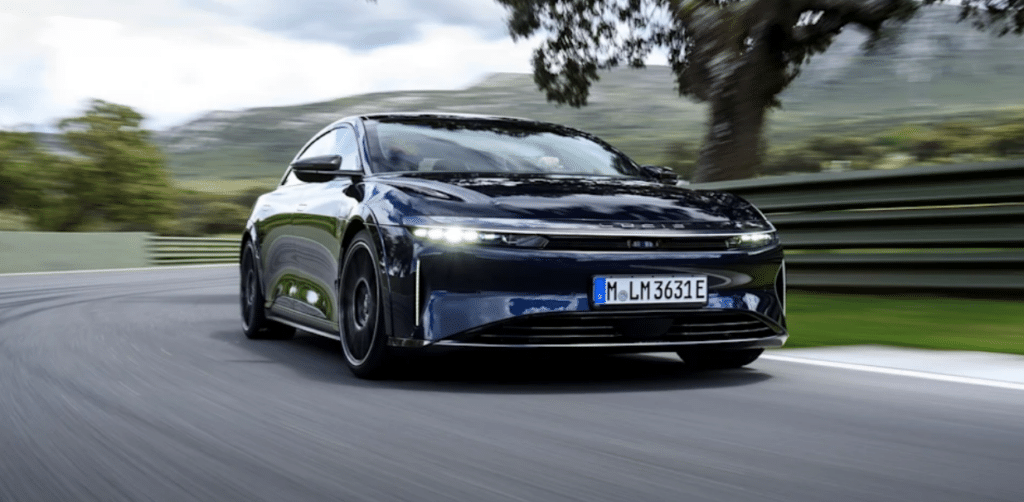
The Lucid Air Sapphire demonstrated just how brutally quick a high-performance electric vehicle can be, beating the Chevrolet Corvette ZR1X and McLaren 750S in Car and Driver’s latest 0-to-200-to-0 mph testing.
Car and Driver tested four vehicles capable of approaching 200 mph, including the 1,234-horsepower Lucid Air Sapphire, Chevrolet Corvette ZR1X, McLaren 750S and Porsche 911 Turbo S. The Porsche failed to complete the test after reaching a governed 199.3 mph despite a claimed 200-mph top speed.
The Lucid delivered the standout performance, completing the 0-to-200-to-0 run in just 25.7 seconds. That was 6.1 seconds quicker than the Corvette ZR1X and 12.0 seconds faster than the McLaren 750S.
Reaching 200 mph requires far more than strong acceleration. Aerodynamic drag becomes increasingly important at extreme speeds, with the power required to overcome drag at 200 mph roughly 2.4 times greater than at 150 mph and eight times greater than at 100 mph.
The Sapphire, which reaches a governed 208 mph, continued accelerating strongly beyond 150 mph. Its aerodynamic efficiency and enormous electric power allowed it to reach 200 mph more than seven seconds faster than the Corvette.
Braking from 200 mph also presents a major challenge because the brakes must dissipate 1.8 times more energy than when stopping from 150 mph. The Corvette and McLaren held an advantage under braking, while the heavier Lucid required nearly a quarter-mile to stop.
Despite that disadvantage, the Sapphire’s acceleration advantage was overwhelming. It completed the entire 0-to-200-to-0 run in less than a mile, establishing a new benchmark in Car and Driver’s test.
The result demonstrates the extraordinary performance potential of electric powertrains. The Lucid Air Sapphire is not simply competitive with some of the world’s fastest gasoline-powered sports cars. In this test, it left them well behind.
EVinfo.net’s Take: Why EVs Make Better Sports Cars and Race Cars
Electric vehicles are proving that high performance does not require a gasoline engine. EV powertrains deliver instant torque, allowing electric sports cars to accelerate with remarkable speed while providing precise power control through sophisticated software and multiple motors.
The absence of a traditional transmission and engine also gives EV designers greater freedom with weight distribution, packaging and aerodynamics. Regenerative braking adds another advantage, recovering energy while helping control the car on the track.
The rapid development of electric performance cars such as the Lucid Air Sapphire demonstrates what EV technology can deliver. Electric race cars are also proving themselves in competition, with Formula E continuing to grow as a global motorsport series and an important technology showcase.
Formula E demonstrates that electric racing can provide close competition, advanced technology and exciting performance without internal combustion engines. As battery technology, power electronics and charging systems continue improving, lessons learned on the racetrack can eventually benefit everyday EVs.
EVs are still developing as performance machines, but the combination of instant torque, sophisticated electronic control and rapidly advancing battery technology gives electric sports cars and race cars enormous potential.

Electric Vehicle Marketing Consultant, Writer and Editor. Publisher EVinfo.net.
Services