Governor Newsom Signs New Laws to Accelerate California’s EV Future
On September 20, 2026, California Gov. Gavin Newsom’s office announced the Governor signed a package of legislation aimed at speeding deployment of electric vehicle charging infrastructure, expanding charging access and providing consumers with additional information and incentives as the state continues its transition to zero-emission transportation.
The package includes SB 969 by Sen. Eloise Reyes, SB 1283 by Sen. Anna Caballero, AB 1820 by Assemblymember Pilar Schiavo, SB 1213 by Sen. Eloise Reyes, SB 1267 by Sen. Ben Allen and SB 615 by Sen. Ben Allen. Together, the measures address charging deployment, multifamily housing, zero-emission truck incentives, EV charging access in homeowner associations and battery information for consumers.
SB 969 updates the inspection process for certain public EV chargers that have been tested by manufacturers. The change is intended to allow qualifying chargers to begin operating sooner while maintaining safeguards related to the accuracy of electricity delivered to customers.
SB 1283 clarifies that streamlined permitting rules for EV charger installations also cover associated infrastructure work, including trenching, electrical upgrades, solar canopies and battery storage. The clarification is intended to reduce delays between charger approval and construction.
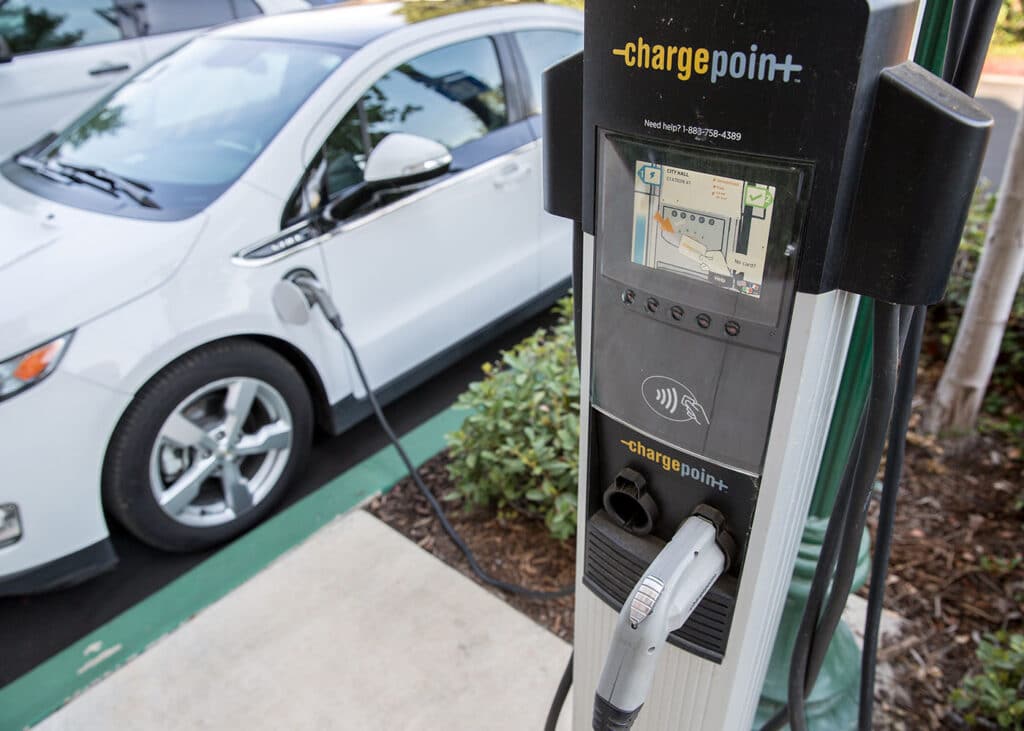
AB 1820 addresses charging at apartments and mixed-use developments by reducing permitting barriers and fees for charging projects. The measure is intended to improve access for renters and other Californians who may not have a private garage or driveway where they can install a charger.
The other three measures address additional consumer and fleet issues. SB 1213 improves transparency around state incentives for zero-emission trucks. SB 1267 addresses EV charging access for Californians living in homeowner associations, while SB 615 provides consumers with additional battery information when comparing electric vehicles.
The legislation also builds on California’s MyFirstEV program. Eligible first-time zero-emission vehicle buyers can receive an instant rebate of up to $3,500 toward a qualifying new vehicle or up to $1,750 toward a qualifying used vehicle. The program is backed by a $135.5 million state investment matched dollar-for-dollar by participating automakers, for a total of $271 million in point-of-sale savings.
MyFirstEV is part of a broader $600 million investment funded through Cap-and-Invest revenue and smog-abatement fees. The funding also supports Clean Cars 4 All, the Clean Truck and Bus Voucher Incentive Project and the Carl Moyer Program, which provide assistance for cleaner vehicles and equipment.
California has more than 216,445 public and shared EV charging plugs statewide, including more than 20,000 DC fast-charging ports. The California Energy Commission also allocated $98.5 million in light-duty zero-emission vehicle infrastructure funding for fiscal year 2025-26, with an emphasis on Level 1 and Level 2 charging at homes and multifamily residences.
The state has exceeded its original goal of 1.5 million zero-emission vehicle sales by 2025, with more than 2.7 million cumulative ZEV sales. During the second quarter of 2026, Californians purchased 86,857 new ZEVs, representing 19.1% of all new vehicle sales in the state.
The new laws focus on practical issues that can affect EV adoption, from the time required to bring chargers online to access at multifamily properties and homeowner associations. Along with consumer incentives and continued investment in charging infrastructure, the measures add to California’s existing efforts to expand zero-emission transportation.
Electric Vehicle Marketing Consultant, Writer and Editor. Publisher EVinfo.net.
Services