Shell to Shut Down Volta as It Shifts Toward Fast Charging at Branded Sites
Shell has announced plans to wind down operations of Volta Inc., the electric vehicle (EV) charging company it acquired in 2023, as part of a strategic pivot toward fast charging infrastructure at Shell-branded sites. The decision, revealed in August 2025, reflects Shell’s view that this model is more scalable and profitable than Volta’s retail-based charging network.
Volta’s network, which spanned 31 U.S. states and territories, offered public charging at high-traffic destinations such as shopping centers, grocery stores, and pharmacies. It also featured a development pipeline of more than 3,400 chargepoints and a unique media platform that displayed digital advertising on charging units. However, Shell confirmed it will end the Volta Media platform by October 31 and shut down associated charging stations by December 31, with potential transfers of infrastructure to other operators under consideration.
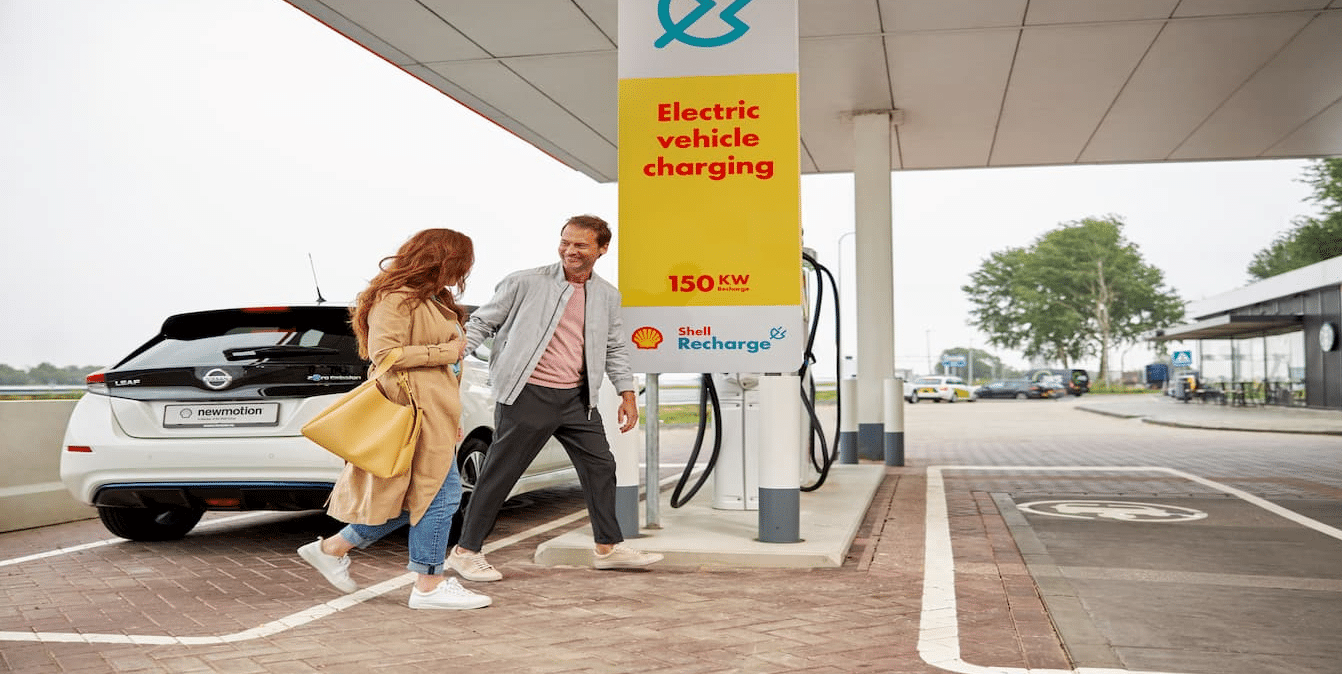
The company said it is focusing its U.S. EV business, one of Shell’s seven global priority markets, on DC fast charging at Shell-branded gas stations and standalone charging hubs in high-growth regions. Shell is working with retail and commercial partners to manage the transition and emphasized that its ambition to build a competitive U.S. e-mobility business “remains strong.”
Retail media, a key feature of Volta’s ad-supported model, will not be part of Shell’s new approach. Instead, the focus will be on building reliable charging infrastructure and expanding services where Shell sees a clear competitive advantage. The move aligns with Shell’s broader energy transition strategy, which centers on selective investment in low-carbon opportunities.
“As the EV charging industry evolves, we must respond with agility,” Shell said in a statement. “These changes are necessary to build a successful and scalable EV charging network that future generations can rely on.”
Shell currently serves about 8 million customers daily at roughly 12,000 U.S. gas stations, including nearly 200 company-operated convenience retail sites. Globally, its mobility sites welcome 32 million customers each day for fuels, EV charging, and convenience services.
Volta Charging: From Visionary Ad-Supported EV Network to Shell Shutdown
Founded with the idea that EV charging could be both accessible and free for drivers, Volta Charging carved out a unique niche in the electric mobility space. Its distinctive stations, often located at shopping centers, grocery stores, and other high-traffic destinations, featured large digital screens that displayed paid advertising, helping offset the cost of charging for users. This ad-supported model aimed to accelerate EV adoption by removing cost barriers and placing chargers where people already spent time.
In 2023, Volta was acquired by Shell for approximately $169 million. The acquisition was framed as a way to strengthen Shell’s U.S. EV charging footprint, diversify its offerings, and compete more aggressively in a growing market.
Which Oil Companies Offer EV Charging? A Look at the Energy Industry’s Electric Pivot
As electric vehicles gain mainstream traction, several of the world’s largest oil and gas companies are reimagining their role in transportation by moving into the EV charging space. This shift reflects both a recognition of changing consumer demand and a strategic effort to remain relevant in a decarbonizing economy.
BP has been one of the most aggressive movers in this space. Through its BP Pulse brand, formerly known as Chargemaster in the UK, the company is building a global network of ultra-fast DC charging sites and aims to have more than 100,000 EV charge points worldwide by 2030.
In the United States, BP has opened its first Gigahub in Houston with 24 high-speed chargers, as well as its first public charging hub at a TravelCenters of America location in Florida. More than 40 of these TA hubs are planned along major highways. BP is also expanding through partnerships, working with Simon Property Group to install more than 900 ultra-fast bays at retail destinations and with LAZ Parking to bring chargers to urban parking facilities. Its hardware strategy includes a $100 million order of Tesla ultra-fast chargers and an additional rollout with Tritium equipment.
In July 2025, BP Pulse opened its largest EV charging hub in the United States. Located just two miles from Los Angeles International Airport (LAX), the flagship LAX location features 48 ultrafast charging bays, equipped with a mix of 400kW and 150kW DC fast chargers.

Shell has also made significant investments, building out its Shell Recharge Solutions network and acquiring companies like Greenlots, Ubitricity, and Volta Charging. In Europe, Shell is targeting 50,000 on-street charging points via Ubitricity by 2025, while in the U.S. it is pivoting toward DC fast charging at its branded fuel stations and standalone hubs. While Shell is winding down Volta’s ad-supported retail network in favor of more scalable models, it continues to see the U.S. as one of its seven priority markets for EV growth.
TotalEnergies is another major player, aiming to deploy more than 150,000 EV charge points across Europe by 2025. Its charging footprint spans cities such as Greater Amsterdam, Antwerp, London, and Paris, as well as networks in China and Singapore. The company is also adding high-power chargers along highways, with a particular emphasis on its home market of France.
Other oil companies, including Eni, Repsol, PKN Orlen, and Petronas, have begun making moves into EV charging, albeit on a smaller scale. In contrast, ExxonMobil, Valero, and ConocoPhillips have shown little visible investment in EV infrastructure to date, focusing their strategies elsewhere.
The transformation of oil companies into EV charging providers is more than just a diversification play. By leveraging their vast real estate at fueling stations, customer service experience, and energy distribution capabilities, these companies are positioning themselves as key mobility service providers in the electric era. The stakes are high: as the automotive industry electrifies, the companies that can offer reliable, fast, and convenient charging stand to become as indispensable to EV drivers as gas stations once were to those driving combustion vehicles.
EVinfo.net’s Take: Why Oil Companies Should Invest in EV Charging
The global shift toward electric vehicles (EVs) is accelerating, and traditional oil companies face a choice: adapt or risk losing relevance. Investing in EV charging infrastructure is not just a business opportunity, it’s a strategic necessity for companies that have long dominated mobility energy.
First, EV adoption is growing rapidly. Consumers are embracing electric cars, trucks, and vans for both environmental reasons and lower operating costs. As more vehicles hit the road, demand for convenient, reliable charging will surge. Oil companies, with their extensive networks of gas stations and retail locations, are uniquely positioned to provide this infrastructure. By converting existing real estate into charging hubs, these companies can leverage assets they already own to serve the mobility needs of the future.
Second, EV charging represents a new revenue stream. While gasoline margins fluctuate with oil prices, charging fees and related services can provide steady income. Innovative models, including subscription plans, destination-based charging, and ad-supported stations, allow companies to diversify revenue and capture value from new consumer behaviors. BP’s BP Pulse network, Shell Recharge Solutions, and TotalEnergies’ growing European footprint are examples of how energy majors are already monetizing the EV transition.
Third, investing in EV infrastructure helps oil companies maintain customer loyalty. Drivers who switch to EVs will still need convenient locations for charging, convenience items, and services. Companies that anticipate this shift and provide reliable, fast, and accessible charging can retain their brand relevance and continue serving millions of customers daily.
Finally, EV charging aligns with broader energy transition goals. Stakeholders, regulators, and investors are increasingly prioritizing sustainability. By participating in the EV ecosystem, oil companies demonstrate responsiveness to climate concerns and position themselves as forward-thinking energy providers rather than fossil fuel incumbents. This can improve public perception, open doors to partnerships, and reduce regulatory pressures.
In short, investing in EV charging is both a defensive and offensive strategy for oil companies. It safeguards their role in mobility, creates new revenue opportunities, strengthens customer relationships, and signals commitment to a low-carbon future. Those that act quickly are likely to emerge as leaders in the energy landscape of the 21st century.
Global EV Sales Grew by 28%, to Over 9 Million in First Half of 2025
The world is quickly adopting EVs, and if oil companies that haven’t already invested in EV charging don’t move soon on it soon, massive profits could be lost.
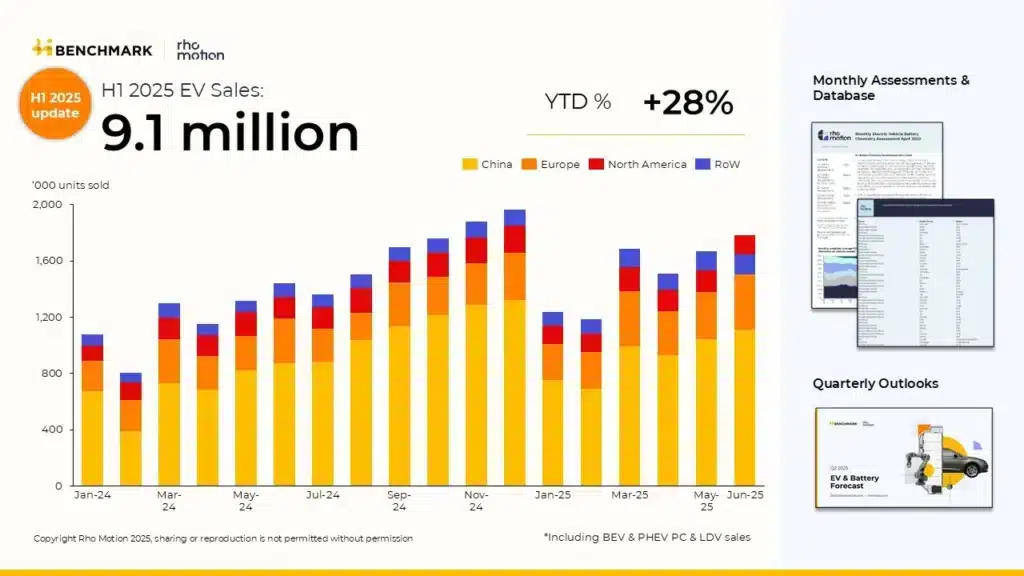
Rho Motion, a Benchmark Mineral Intelligence company specializing in electric vehicle (EV) supply chain research, has released new data revealing that global EV sales reached an impressive 9.1 million units in the first half of 2025. This marks a 28% increase compared to the same period in 2024, highlighting continued momentum in the transition to electric mobility.
June 2025 alone saw EV sales grow by 24% year-on-year and 7% month-on-month versus May 2025, underscoring sustained demand despite broader economic uncertainties.

Electric Vehicle Marketing Consultant, Writer and Editor. Publisher EVinfo.net.
Services