QuantumScape and Corning Partner on Solid-State EV Batteries
On September 30, 2025, QuantumScape and Corning Incorporated announced entering into an agreement to jointly develop ceramic separator manufacturing capabilities for QuantumScape’s solid-state EV batteries. The collaboration aims to achieve high-volume production for commercial applications, combining the strengths of both companies in materials science and manufacturing. Corning’s ceramics expertise is seen as essential to supporting the scaling of QS’s battery technology.
QuantumScape’s mission is to revolutionize energy storage with next-generation solid-state lithium-metal batteries, focusing on greater energy density, faster charging, and enhanced safety. Both companies emphasize their shared commitment to advancing battery technology.
Corning Inc. is a large materials science company with an estimated 57,500 employees and $13.1 billion in annual revenue in 2024. The company has over 80 manufacturing plants across 42 countries and is a leader in engineering and advanced manufacturing of glass, ceramics, and other materials.
“QS and Corning are driven by a shared spirit of innovation in science and technology,” said Ron Verkleeren, Senior Vice President, Corning Emerging Innovations Group. “We’re excited to collaborate with QS to help advance the future of battery technology.”
“Corning’s world-class capabilities in ceramics manufacturing makes it an ideal addition to the QS technology ecosystem,” said Dr. Siva Sivaram, CEO and President of QS. “Together with our ecosystem partners, we’re building the foundation for scalable production of our high-performance solid-state batteries and furthering our mission to revolutionize energy storage.”
QuantumScape’s Innovative Solid-State Battery Technology Enables Charging Speeds Under 15 Minutes
QuantumScape’s solid-state battery technology introduces two key innovations: an anodeless architecture and a proprietary solid ceramic separator. These innovations aim to overcome the limitations of conventional lithium-ion batteries by improving energy density, charging speed, battery life, and safety.
The anodeless design eliminates the need for graphite or silicon anodes, significantly increasing both volumetric and gravimetric energy densities. This results in batteries that can store more energy in a smaller and lighter space. Additionally, the technology enables charging speeds of under 15 minutes, thanks to the removal of the lithium diffusion bottleneck in the anode material. The solid ceramic separator, replacing the organic separator in traditional cells, enhances safety by being non-flammable and non-combustible. It also improves battery lifespan by preventing capacity loss at the anode interface.
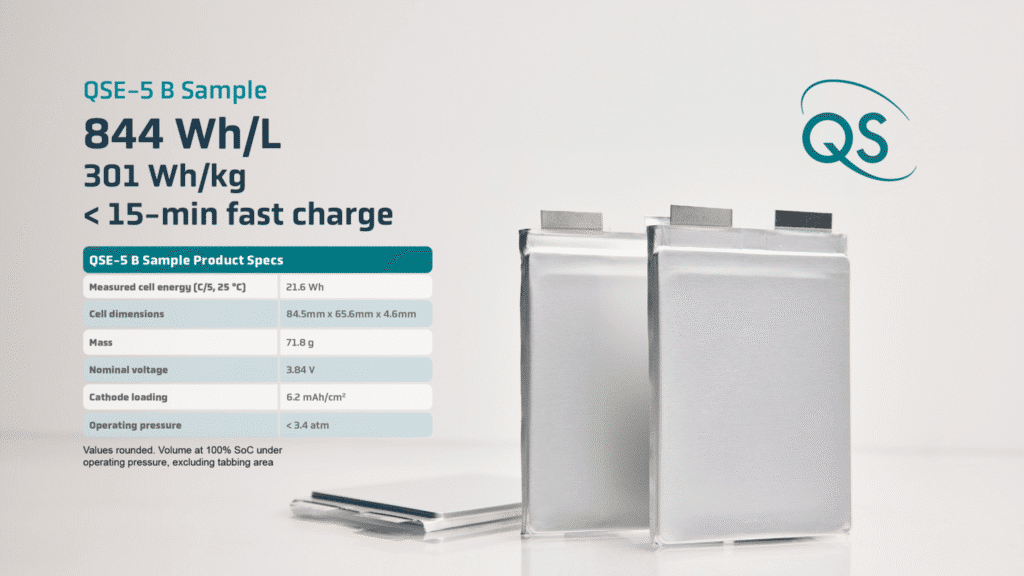
QuantumScape’s first planned commercial product, the QSE-5, is designed to provide an unmatched combination of energy density, fast charging, and safety for electric vehicles. The company’s technology is compatible with various cathode chemistries, such as Nickel Manganese Cobalt (NMC) and Lithium Iron Phosphate (LFP), offering flexibility for different energy storage applications and future advancements.
The solid-state battery features a lithium-metal anode, which forms during the first charge, and a proprietary ceramic separator that prevents dendrite formation while ensuring stability. These advancements offer several benefits over conventional lithium-ion batteries, including higher energy density, faster charging, longer lifespan, improved safety, and lower costs. The technology’s energy density could enable electric vehicles to achieve ranges of 400-500 miles, depending on vehicle design.
In terms of energy density, QuantumScape’s technology can achieve energy densities of 800–1,000 Wh/L, which translates to greater energy storage per volume or weight, reducing the size and weight of the battery pack. The higher specific energy (Wh/kg) further contributes to vehicle efficiency by reducing overall weight, which can improve performance. The combination of these innovations positions QuantumScape to deliver a next-generation battery solution for electric vehicles and other energy storage needs.
Solid-State EV Batteries Will Change the Game Forever
The electric vehicle (EV) revolution is well underway, but one breakthrough could transform it from an evolution into a revolution: solid-state batteries. Long hailed as the “holy grail” of energy storage, solid-state technology promises to overcome the very limitations that have kept many drivers hesitant about making the switch to electric.
Unlike today’s lithium-ion batteries, which use a liquid electrolyte, solid-state batteries rely on a solid electrolyte. This fundamental shift brings major advantages. Energy density is higher, meaning cars can travel much farther on a single charge. Charging times could shrink from hours to mere minutes, addressing one of the most common concerns about EV ownership.
The impact on cost and sustainability could be just as dramatic. As the technology matures, solid-state batteries are expected to become cheaper to produce, relying on less rare and volatile raw materials. Longer lifespans will further reduce replacement needs, lowering the total cost of ownership for consumers while easing supply chain pressures on the industry.
Automakers around the world are racing to commercialize solid-state batteries. Toyota has announced pilot production plans, while companies like QuantumScape, Samsung, and Solid Power are pushing prototypes closer to reality. Several automakers like Mercedes-Benz, BMW, and Toyota are actively testing prototypes and planning commercial deployments in the coming years, with mass production expected in the 2030s.
The road ahead may still take a few years, but once solid-state batteries hit the mass market, the shift to electric mobility will be even more unstoppable than it is right now.